

100% PASS RATE Fortinet Network Security Expert NSE5_FNC_AD_7.6 Certified Exam DUMP with 61 Questions
Updates For the Latest NSE5_FNC_AD_7.6 Free Exam Study Guide!
Fortinet NSE5_FNC_AD_7.6 Exam Syllabus Topics:
| Topic | Details |
|---|---|
| Topic 1 |
|
| Topic 2 |
|
| Topic 3 |
|
| Topic 4 |
|
NEW QUESTION # 35
While discovering network infrastructure devices, a switch appears in the inventory topology with a question mark (?) on the icon. What would cause this?
- A. The SNMP ObjectlD is not recognized by FortiNAC-F.
- B. The wrong SNMP community string was entered during discovery.
- C. A read-only SNMP community siring was used.
- D. SNMP is not enabled on the switch.
Answer: A
Explanation:
In FortiNAC-F, theInventory topologyuses specific icons to represent the status and model of discovered network infrastructure. When a switch or other network device is discovered via SNMP, FortiNAC-F retrieves itsSystem ObjectID (sysObjectID)to identify the specific make and model. This OID is then compared against the internal database of supported device mappings.
Aquestion mark (?)icon appearing on a discovered switch indicates that while the discovery process successfully communicated with the device (meaning SNMP credentials were correct), theSNMP ObjectID is not recognizedor mapped in the current version of FortiNAC-F. This essentially means the device is " unsupported " by the current software out-of-the-box. Because the OID is unknown, FortiNAC-F does not know which CLI or SNMP command set to use for critical functions like L2 polling (host visibility) or VLAN switching (enforcement). To resolve this, an administrator can manually " Set Device Mapping " to a similar existing model or a " Generic SNMP Device " if only basic L3 visibility is required.
" Discovered devices displaying a ' ? ' iconindicate the currently running version does not have a mapping for that device ' sSystem OID(device is not supported). Device mappings are used to manage the device by performing functions such as L2/L3 Polling, Reading, and Switching VLANs. " -Fortinet Technical Tip:
Options for devices unable to be modeled in Inventory.
NEW QUESTION # 36
A user was attempting to register their host through the registration captive portal. After successfully registering, the host remained in the registration VLAN. Which two conditions would cause this behavior? (Choose two.)
- A. There is no agent installed on the host.
- B. The port default VLAN is the same as the Registration VLAN.
- C. There is another unregistered host on the same port
- D. The wrong agent s installed.
Answer: B,C
Explanation:
The process of moving a host from a Registration VLAN to a Production VLAN (Access VLAN) is a fundamental part of the FortiNAC-F "VLAN steering" workflow. When a host successfully registers via the captive portal, FortiNAC-F evaluates its Network Access Policies to determine the correct VLAN. If the host remains stuck in the Registration VLAN despite a successful registration, it is typically due to port-level restrictions or the presence of other unregistered devices.
The two most common reasons for this behavior as per the documentation are:
The port default VLAN is the same as the Registration VLAN: If the "Default VLAN" field in the switch port's model configuration is set to the same ID as the Registration VLAN, the port will not change state because FortiNAC-F believes it is already in its "normal" or "forced" state.
There is another unregistered host on the same port: FortiNAC-F maintains the security posture of the physical port. If multiple hosts are connected to a single port (e.g., via a hub or unmanaged switch) and at least one host remains "Rogue" (unregistered), FortiNAC-F will generally keep the entire port in the isolation/registration VLAN to prevent the unregistered host from gaining unauthorized access to the production network.
Issues with agents (A, B) typically prevent a host from completing compliance or registration but do not usually result in a "stuck" status after registration has already been marked as successful in the system.
"If a port is identified as having Multiple Hosts, and those hosts require different levels of access, FortiNAC remains in the most restrictive state (Registration or Isolation) until all hosts on that port are authorized... Additionally, verify the Default VLAN setting for the port; if the Default VLAN and Registration VLAN match, the system will not trigger a VLAN change upon registration." - FortiNAC-F Administration Guide: Troubleshooting Host Management.
NEW QUESTION # 37
Refer to the exhibit.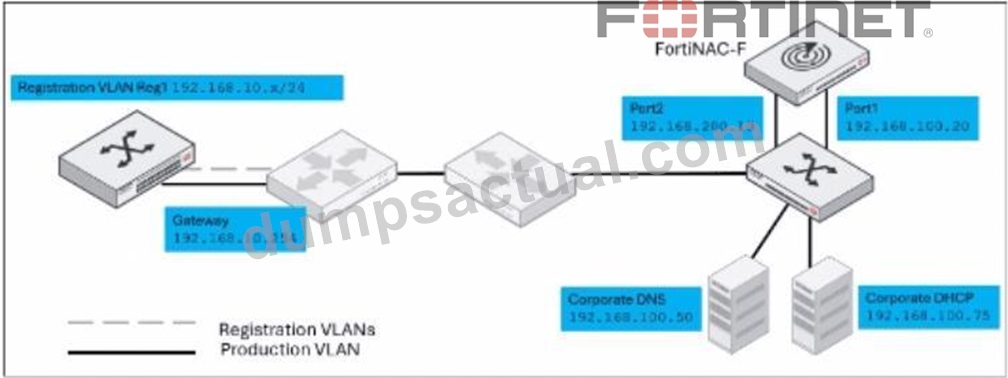
Given this topology, and a layer 3 registration network configuration, which IP address would be designated in the DHCP relay configuration for the registration network?
- A. 192.168.200.10
- B. 192.168.10.254
- C. 192.168.100.20
- D. 192.168.100 75
Answer: A
Explanation:
The correct answer is D . In a Layer 3 registration or isolation network design, DHCP requests from the isolated registration VLAN are not served locally on that VLAN by a normal production DHCP server.
Instead, the registration VLAN's DHCP relay must forward DHCP traffic to FortiNAC-F port2 , because port2 is the captive network service interface. The study guide states that in Layer 3 captive networks, DHCP traffic is relayed to port2 from the captive networks, and that the FortiNAC-F port2 interface provides DHCP, DNS, and captive portal services for hosts assigned to those captive networks.
In the exhibit, the registration VLAN is 192.168.10.x/24 , with gateway 192.168.10.254 . That gateway is where the DHCP relay would be configured, but it is not the relay destination. The relay destination must be the FortiNAC-F port2 address, shown as 192.168.200.10 . The corporate DHCP server 192.168.100.75 is for production network addressing, not registration isolation. The FortiNAC-F port1 address 192.168.100.20 is the administrative or production-facing interface, not the captive network service interface. Therefore, the DHCP relay should point to 192.168.200.10 .
NEW QUESTION # 38
An administrator wants each department to create and manage its own contractor accounts but not be able to manage contractor accounts for other departments. What must the administrator configure to limit the sponsor
' s capabilities?
- A. The contractor ' s template
- B. The user/host profile applied to the contractor
- C. The sponsor ' s administrative profile
- D. The portal settings on the kiosk portal page
Answer: C
Explanation:
The correct answer is D . FortiNAC-F limits what a sponsor can create and manage through the administrator profile assigned to that sponsor. The study guide explains that sponsors can be restricted to specific guest or contractor templates and that the Manage Guests settings in the admin profile define whether the sponsor can manage all accounts, no accounts, or only accounts they created. It also states that allowed templates are defined in the admin profile, meaning each department can be given access only to its own contractor template.
The contractor template defines account fields, role values, authentication method, account duration, and related account properties, but it does not by itself restrict what a sponsor can manage. Portal settings control how users interact with the captive portal or kiosk page, not sponsor administrative scope. A user/host profile is used for matching users or hosts in policy decisions; it does not delegate sponsor permissions. For departmental separation, the administrator must create sponsor-specific administrative profiles that allow only the appropriate templates and account-management scope.
NEW QUESTION # 39
An organization has FortiNAC-F deployed and is using Layer 3 isolation networks across multiple sites with firewalls. At a minimum, which three protocols must be allowed between the isolation networks and FortiNAC-F? (Choose three.)
- A. HTTP/HTTPS
- B. DHCP
- C. DNS
- D. NTP
- E. DDNS
Answer: A,B,C
Explanation:
The correct answers are C, D, and E . In a Layer 3 captive or isolation network design, FortiNAC-F port2 acts as the captive network service interface. The study guide states that Layer 3 captive networks require DHCP traffic to be relayed to port2 from the captive networks, and that the FortiNAC-F interface provides DHCP, DNS, and captive portal services to hosts assigned to any captive network.
That means the firewall path between the isolation VLANs and FortiNAC-F must allow DHCP , so isolated endpoints can receive an IP address from the FortiNAC-F captive network scope; DNS , so the isolated endpoint uses FortiNAC-F as its DNS server and gets redirected correctly; and HTTP/HTTPS , so the endpoint can load the FortiNAC-F captive portal page. The guide's browser-redirection flow confirms this sequence: the host is moved to the isolation VLAN, requests DHCP, receives FortiNAC-F as the DNS server, performs DNS lookup, and then Apache/Tomcat services present the portal content.
Option A , DDNS, is not required for captive portal operation. Option B , NTP, may be useful for endpoint time accuracy or certificate-related workflows, but it is not part of the minimum traffic required for FortiNAC- F isolation network operation.
NEW QUESTION # 40
An administrator is configuring FortiNAC-F to manage FortiGate VPN users. As part of this configuration, what is the purpose of the FortiGate firewall policy that applies to clients not yet authorized?
- A. To allow access to only the FortiGate VPN interface
- B. To allow access to only the production DNS server
- C. To allow access to only the production DNS server
- D. To allow access to only the FortiNAC-F VPN interface
Answer: D
Explanation:
The correct answer is C . The FortiNAC-F study guide explains that all VPN hosts are initially treated as unauthorized. For those unauthorized VPN hosts, the FortiGate firewall policy must allow traffic only to and from the FortiNAC-F VPN isolation interface and deny all other traffic. This forces the connecting VPN client into the FortiNAC-F validation process, including captive portal presentation and FortiNAC-F agent communication or download.
Options A and B are incorrect, and they appear duplicated in the question. The client is not supposed to be granted access only to the production DNS server while still unauthorized. FortiGate assigns DNS during VPN connection setup, with production DNS as primary and the FortiNAC-F VPN isolation interface as secondary, but the unauthorized firewall policy restricts useful access to FortiNAC-F so that validation can occur. Option D is wrong because the VPN client has already connected to the FortiGate VPN service; the authorization workflow requires access to the FortiNAC-F VPN isolation interface , not merely the FortiGate VPN interface.
NEW QUESTION # 41
Refer to the exhibit.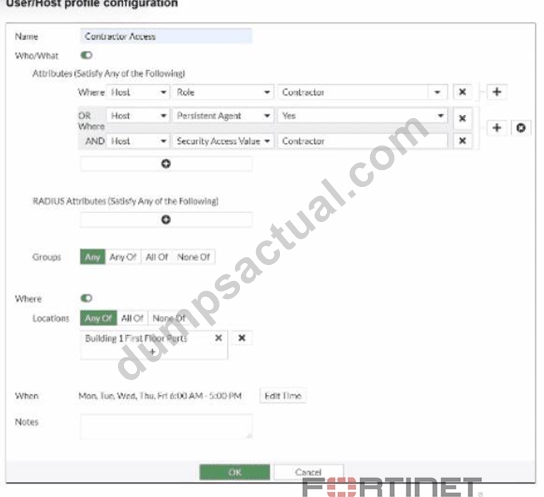
If a host is connected to a port in the Building 1 First Floor Ports group, what must also be true to match this user/host profile?
- A. The host must have a role value of contractor, an installed persistent agent or a security access value of contractor, and be connected between 6 AM and 5 PM.
- B. The host must have a role value of contractor or an installed persistent agent and a security access value of contractor, and be connected between 6 AM and 5 PM.
- C. The host must have a role value of contractor or an installed persistent agent, a security access value of contractor, and be connected between 9 AM and 5 PM.
- D. The host must have a role value of contractor or an installed persistent agent or a security access value of contractor, and be connected between 6 AM and 5 PM.
Answer: B
Explanation:
TheUser/Host Profilein FortiNAC-F is the fundamental logic engine used to categorize endpoints for policy assignment. As seen in the exhibit, the configuration uses a combination of Boolean logic operators (ORandAND) to define the " Who/What " attributes.
According to theFortiNAC-F Administrator Guide, attributes grouped together within the same bracket or connected by anORoperator require only one of those conditions to be met. In the exhibit, the first two attributes are " Host Role = Contractor " OR " Host Persistent Agent = Yes " . This forms a single logical block. This block is then joined to the third attribute ( " Host Security Access Value = Contractor " ) by anANDoperator. Consequently, a host must satisfyat least oneof the first two conditionsANDsatisfy the third condition to match the " Who/What " section.
Furthermore, the profile includesLocationandWhen(time) constraints. The exhibit shows the location is restricted to the " Building 1 First Floor Ports " group. The " When " schedule is explicitly set toMon-Fri 6:00 AM - 5:00 PM. For a profile to match,allenabled sections (Who/What, Locations, and When) must be satisfied simultaneously. Therefore, the host must meet the conditional contractor/agent criteria, possess the specific security access value, and connect during the defined 6 AM to 5 PM window.
" User/Host Profiles use a combination of attributes to identify a match. Attributes joined byORrequire any one to be true, while attributes joined byANDmust all be true. If aSchedule(When) is applied, the host must also connect within the specified timeframe for the profile to be considered a match. All criteria in the Who
/What, Where, and When sections are cumulative. " -FortiNAC-F Administration Guide: User/Host Profile Configuration.
NEW QUESTION # 42
When configuring isolation networks in the configuration wizard, why does a layer 3 network typo allow for mora than ono DHCP scope for each isolation network typo?
- A. There can be more than one isolation network of each type
- B. Any scopes beyond the first scope are used if the initial scope runs out of IP addresses.
- C. Configuring more than one DHCP scope allows for DHCP server redundancy
- D. The layer 3 network type allows for one scope for each possible host status.
Answer: A
Explanation:
In FortiNAC-F, theLayer 3 Network typeis specifically designed for deployments where the isolation networks-such as Registration, Remediation, and Dead End-are separated from the FortiNAC appliance ' s service interface (port2) by one or more routers. This architecture is common in large, distributed enterprise environments where endpoints in different physical locations or branches must be isolated into subnets that are local to their respective network equipment.
The reason the Configuration Wizard allows for more than one DHCP scope for a single isolation network type (state) is thatthere can be more than one isolation network of each typeacross the infrastructure. For instance, if an organization has three different sites, each site might require its own unique Layer 3 registration subnet to ensure efficient routing and to accommodate local IP address management. By allowing multiple scopes for the " Registration " state, FortiNAC can provide the appropriate IP address, gateway, and DNS settings to a rogue host regardless of which site ' s registration VLAN it is placed into.
When an endpoint is isolated, the network infrastructure (via DHCP Relay/IP Helper) directs the DHCP request to the FortiNAC service interface. FortiNAC then identifies which scope to use based on the incoming request ' s gateway information. This flexibility ensures that the system is not limited to a single flat subnet for each isolation state, supporting a scalable, multi-routed network topology.
" Multiple scopes are allowed for each isolation state (Registration, Remediation, Dead End, VPN, Authentication, Isolation, and Access Point Management). Within these scopes, multiple ranges in the lease pool are also permitted... This configWizard option is used when Isolation Networks are separated from the FortiNAC Appliance ' s port2 interface by a router. " -FortiNAC-F Configuration Wizard Reference Manual:
Layer 3 Network Section.
NEW QUESTION # 43
Refer to the exhibit.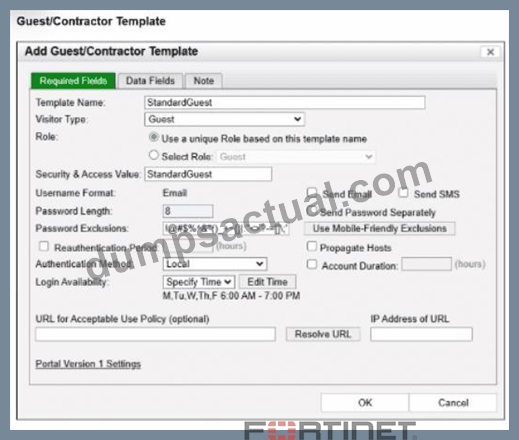
What will happen to the host of a guest user created from this template if the time of connection is 8:00 PM?
- A. The host will be marked as a rogue device.
- B. The host will be marked as non-authenticated.
- C. The host will be administratively disabled.
- D. The host will be marked as at-risk.
Answer: B
Explanation:
In FortiNAC-F, theGuest & Contractor Templateis a configuration object that defines the parameters for accounts created by sponsors or through self-registration. One of the critical security controls within this template is theLogin Availabilitysetting. This setting restricts the specific days and times during which a guest or contractor is permitted to authenticate and access the network.
As shown in the exhibit, the " StandardGuest " template hasLogin Availabilityset to " Specify Time " , with a schedule defined asMon-Fri, 6:00 AM to 7:00 PM. If a guest user attempts to connect or authenticate at8:00 PM, which is outside of the permitted window, FortiNAC-F ' s policy engine will automatically deny the authentication request. When an authentication attempt is denied due to schedule restrictions, the system does not move the host into the " Authenticated " or " Registered " state required for production access. Instead, the host ismarked as non-authenticatedin the adapter or host view.
This behavior ensures that even if a guest possesses valid credentials, their access is strictly bound by the organizational policy for visitor hours. The host will typically remain in its current isolation or registration VLAN, and the user will see a message on the captive portal indicating that their account is not currently authorized for login. It is important to distinguish this from " at-risk " (C), which relates to security scan failures, or " rogue " (B), which typically refers to unknown devices that have not yet been associated with a valid account or profiling rule.
" Login Availabilitydefines the timeframe during which the guest or contractor account is valid for network access. This schedule is enforced at the time of authentication. If a user attempts to log in outside of the designated window, the authentication is rejected by the system. Consequently, the host record will reflect anon-authenticatedstatus, and the device will remain restricted to the isolation or registration network until a valid login window is reached. " -FortiNAC-F Administration Guide: Guest and Contractor Templates Section.
NEW QUESTION # 44
An administrator has created several device profiling rules and evaluated all existing devices in the database.
Some of the devices appear in the profiled devices view because they matched a rule, but they remain unknown and the registration column in the profiled devices view shows " No " .
What is the most likely cause?
- A. The device profiling rule has registration set to manual.
- B. The devices have persistent agents installed, and the point of connection has PA optimization enabled.
- C. The confirm device profiling rule option is not enabled.
- D. The devices match more than one device profiling rule.
Answer: C
Explanation:
In FortiNAC-F,Device Profiling Rulesare used to automatically identify and categorize devices (such as IP cameras, printers, or IoT devices) based on fingerprints like DHCP fingerprints, OIDs, or MAC prefixes.
When a device matches a rule, it appears in theProfiled Devicesview.
However, matching a rule does not automatically register the device in the database unless the rule is configured to do so. If the devices appear in the view but remain " Unknown " and show " No " in the registration column, it indicates that the " Confirm " (or " Auto-register " ) action has not been triggered. In the Device Profiling Rule configuration, there is a setting called " Allow Auto-Approval " or " Confirm " . If this is not enabled, the system identifies the device but waits for an administrator to manually approve the match before changing the host status from " Unknown " to " Registered " .
This is a common " safety " configuration used during the initial deployment phase to ensure that the profiling rules are accurate before the system begins automatically granting network access based on those matches.
" If a device matches a rule but is not registered, check the rule configuration. TheConfirmoption (within the Method or Rule settings) determines if the system automatically registers the device upon a match.
IfConfirmis not enabled, the device will remain in the ' Profiled ' state with a registration status of ' No ' until an administrator manually promotes the device. " -FortiNAC-F Administration Guide: Device Profiling Rules.
NEW QUESTION # 45
While troubleshooting a network connectivity issue, an administrator determines that a device was being automatically provisioned to an incorrect VLAN. Where would the administrator look to identify when and why FortiNAC-F made the network access change?
- A. The Security Event view
- B. The Admin Auditing view
- C. The Reports view
- D. The Port Changes view
Answer: D
Explanation:
The correct answer is C . The Port Changes view is the correct troubleshooting location when FortiNAC-F changes endpoint network access, such as moving a switch port into a different VLAN. The study guide states that any time FortiNAC-F changes network access for an endpoint, the change is documented in Network > Port Changes . This view shows the date and time of the change, whether a CLI configuration was executed, the reason for the change, the role or access policy that caused it, the port that was changed, and the VLAN the port was changed to.
This directly matches the troubleshooting requirement in the question: the administrator needs to know when the VLAN change happened and why FortiNAC-F made that network access decision. Option A , Security Event view, is used for security-related events, not detailed port-level VLAN-change history. Option B , Reports view, is too broad and not the operational audit trail for a specific access change. Option D , Admin Auditing, tracks administrative actions, but an automatic policy-driven VLAN assignment is documented under Port Changes, not primarily as an admin audit event.
NEW QUESTION # 46
Which two actions must the administrator perform to allow FortiNAC-F to process incoming syslog messages from an unknown vendor? (Choose two.)
- A. The device sending the messages must be modeled in the Network Inventory view.
- B. The device must have an event parser created for it.
- C. The device must be added as a log receiver in FortiNAC-F.
- D. The device must be added as a server in the Host view.
Answer: A,B
Explanation:
The correct answers are A and B . For FortiNAC-F to process syslog messages from a vendor that is not already known, it needs a parser so it can understand the message structure. The study guide describes this under syslog integration: syslog files must be created, and FortiNAC-F parses CSV, CEF, or tag/value messages by using column mapping or tag-to-value mapping. That parser is what allows FortiNAC-F to extract the correct event information from the incoming message.
The sending device must also be modeled in the Inventory view, normally as a pingable device, and its Incoming Events setting must be set to Syslog with the appropriate parser selected. The guide is blunt on this point: FortiNAC-F does not process syslog or trap messages unless the source address belongs to a modeled device.
Option C is wrong because adding the device as a server in the Host view does not prepare FortiNAC-F to parse syslog input. Option D is also wrong because log receivers are for sending FortiNAC-F event or alarm information out to external systems such as FortiAnalyzer, SIEM, or a syslog server, not for receiving and parsing unknown-vendor syslog messages.
NEW QUESTION # 47
Where should you configure MAC notification traps on a supported switch?
- A. On all ports except uplink ports
- B. Only on ports defined as learned uplinks
- C. Only on ports that generate linkup and linkdown traps
- D. On all ports on the switch
Answer: A
Explanation:
In FortiNAC-F, MAC notification traps (also known as MAC Move or MAC Change traps) are essential for achieving real-time visibility of endpoint connections and disconnections. When a device connects to a switch port, the switch generates an SNMP trap that informs FortiNAC-F of the new MAC address on that specific interface. This allows FortiNAC-F to immediately initiate the profiling and policy evaluation process without waiting for the next scheduled L2 poll.
According to the FortiNAC-F Administration Guide and Switch Integration documentation, MAC notification traps should be configured on all ports except uplink ports. Uplink ports are the interfaces that connect one switch to another or to the core network. Because these ports see the MAC addresses of every device on the downstream switches, enabling MAC notification on uplinks would cause the switch to send a massive volume of redundant traps to FortiNAC-F every time any device anywhere in the downstream branch moves or reconnects. This can overwhelm the FortiNAC-F process queue and degrade system performance.
By only enabling these traps on "edge" or "access" ports-where individual endpoints like PCs, printers, and VoIP phones connect-FortiNAC-F receives precise data regarding exactly where a device is physically located. Uplinks should be identified in the FortiNAC-F inventory as "Uplink" or "Learned Uplink," which tells the system to ignore MAC data seen on those specific ports.
"To ensure accurate host tracking and optimal system performance, SNMP MAC notification traps must be enabled on all access (downlink) ports. Do not enable MAC notification traps on uplink ports, as this will result in excessive and unnecessary trap processing. Uplink ports should be excluded to prevent the system from attempting to map multiple downstream MAC addresses to a single infrastructure interface." - FortiNAC-F Administration Guide: SNMP Configuration for Network Devices.
NEW QUESTION # 48 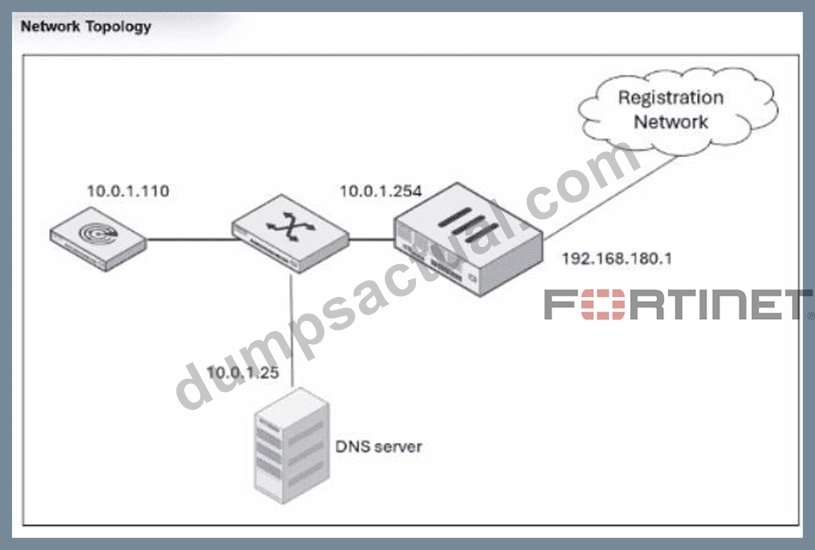
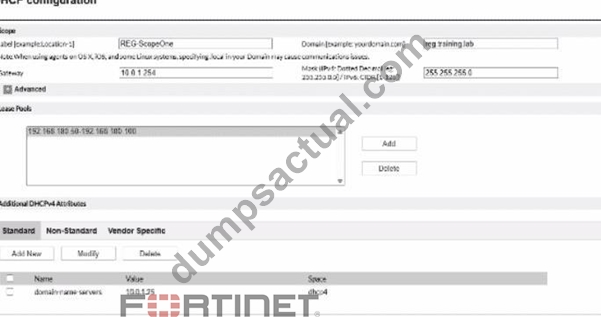
An administrator has configured the DHCP scope for a registration isolation network, but the isolation process isn ' t working.
What is the problem with the configuration?
- A. The label uses a system-reserved value.
- B. The lease pool does not contain a complete subnet.
- C. The gateway defined for the scope is incorrect.
- D. The domain name server designation is incorrect.
Answer: C
Explanation:
In a FortiNAC-F deployment, the configuration of theDHCP scopefor isolation networks (Registration, Remediation, etc.) must perfectly align with the underlying network infrastructure to ensure that isolated hosts can communicate with the FortiNAC appliance. In the provided exhibits, there is a clear discrepancy between theDHCP configurationand theNetwork Topology.
As shown in the " Network Topology " exhibit, theRegistration Networkresides on a router interface (or sub- interface) with the IP address192.168.180.1. This address represents the default gateway for any host placed into the Registration VLAN. However, the " DHCP configuration " exhibit shows the scope " REG-ScopeOne
" configured with aGateway of 10.0.1.254. This 10.0.1.254 address belongs to the management/service network (port2 of FortiNAC), not the registration subnet. If a host in the Registration VLAN receives this incorrect gateway via DHCP, it will attempt to send all off-link traffic to an unreachable IP, preventing it from loading theCaptive Portalor communicating with the FortiNAC server.
According to theFortiNAC-F Configuration Wizard Reference, when defining a Layer 3 network scope, the " Gateway " field must contain the IP address of the router interface that acts as the gateway for that specific isolation VLAN. The FortiNAC appliance itself usually sits on a different subnet, and traffic is directed to it via the router ' s DHCP Relay (IP Helper) and DNS redirection.
" When configuring scopes for a Layer 3 network, theGatewayvalue must be the IP address of the router interface for that subnet. This allows the host to reach its local gateway to route traffic. If the gateway is misconfigured, the host will be unable to reach the FortiNAC eth1/port2 interface for registration... Ensure the Gateway matches the network topology for the isolation VLAN. " -FortiNAC-F Configuration Wizard Reference Manual: DHCP Scopes.
NEW QUESTION # 49
Refer to the exhibit.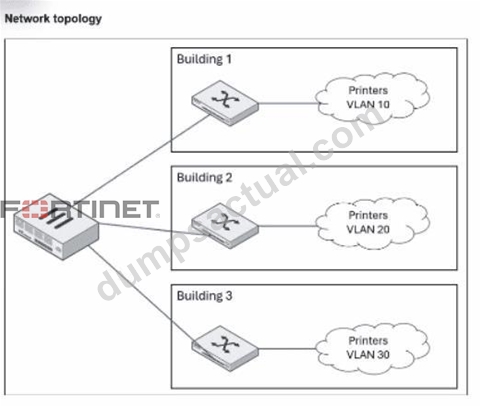
An administrator wants to use FortiNAC-F to automatically provision printers throughout their organization.
Each building uses its own local VLAN for printers.
Which FortiNAC-F feature would allow this to be accomplished with a single network access policy?
- A. Dynamic host groups
- B. Logical networks
- C. Device profiling rules
- D. Preferred VLAN designations
Answer: B
Explanation:
The FortiNAC-FLogical Networkfeature is specifically designed to provide an abstraction layer between high- level security policies and the underlying physical network infrastructure. In large-scale deployments where different physical locations (like Building 1, 2, and 3 in the exhibit) use different local VLAN IDs for the same type of device (e.g., VLAN 10, 20, and 30 for printers), managing separate policies for each building would create significant administrative overhead.
By using aLogical Network, an administrator can create a single entity-for example, a logical network named " Printers " -and use it as the " Access Value " in a singleNetwork Access Policy. The mapping of this logical label to a specific physical VLAN occurs at theModel Configurationlevel for each network device.
When a printer connects to a switch in Building 1, FortiNAC-F evaluates the policy, identifies that the printer should be in the " Printers " logical network, and checks the Model Configuration for that specific switch to see which VLAN ID is mapped to that label (VLAN 10). If the same printer moves to Building 3, the same single policy applies, but FortiNAC-F provisions it to VLAN 30 based on the local mapping for that building ' s switch.
This architectural approach ensures that policies remain consistent and easy to manage regardless of the complexity or variations in the local network topology.
" Logical Networks provide a way to define a network access requirement once and apply it across many different network devices that may use different VLAN IDs for that access... Each managed device can usedifferent VLAN IDs for the same Logical Network label. You can define the Logical Networks based on requirements and then associate the network to a VLAN ID when the managed device is configured in theModel Configuration. " -FortiNAC-F IoT Deployment Guide: Define the Logical Networks.
NEW QUESTION # 50
An administrator wants to build device profiling rules based on network traffic, but the network session view is not populated with any records.
Which two settings can be enabled to gather network session information? (Choose two.)
- A. Layer 3 polling on the infrastructure devices
- B. Network traffic polling on any modeled infrastructure device
- C. Firewall session polling on modeled FortiGate devices
- D. Netflow setting on the FortiNAC-F interfaces
Answer: C,D
Explanation:
In FortiNAC-F, the Network Sessions view provides a real-time and historical log of traffic flows, including source/destination IP addresses, ports, and protocols. This data is essential for building Device Profiling Rules that rely on "Traffic Patterns" or "Network Footprints" to identify devices (e.g., an IP camera communicating with its specific NVR). If the network session view is empty, the system is not receiving the necessary flow or session data from the network infrastructure.
According to the FortiNAC-F Administration Guide, there are two primary methods to populate this view:
NetFlow/sFlow/IPFIX (C): FortiNAC-F can act as a flow collector. By enabling NetFlow settings on the FortiNAC-F service interface (port2/eth1) and configuring your switches or routers to export flow data to the FortiNAC IP, the system can parse these packets and record sessions.
Firewall Session Polling (B): For environments with FortiGate firewalls, FortiNAC-F can proactively poll the FortiGate via the REST API to retrieve its current session table. This is particularly useful as it provides session visibility without requiring the overhead of configuring NetFlow on every access layer switch.
Settings like Layer 3 Polling (D) only provide ARP table mappings (IP to MAC correlation) and do not provide the detailed flow information required for the session view.
"The Network Sessions view displays information regarding active and inactive network traffic sessions... To populate this view, FortiNAC must receive data through one of the following methods: * NetFlow/sFlow Support: Configure network devices to send flow data to the FortiNAC service interface. * Firewall Session Polling: Enable session polling on modeled FortiGate devices to retrieve session information via API. These records are then used by the Device Profiler to match rules based on traffic patterns." - FortiNAC-F Administration Guide: Network Sessions and Flow Data Collection.
NEW QUESTION # 51
Refer to the exhibit.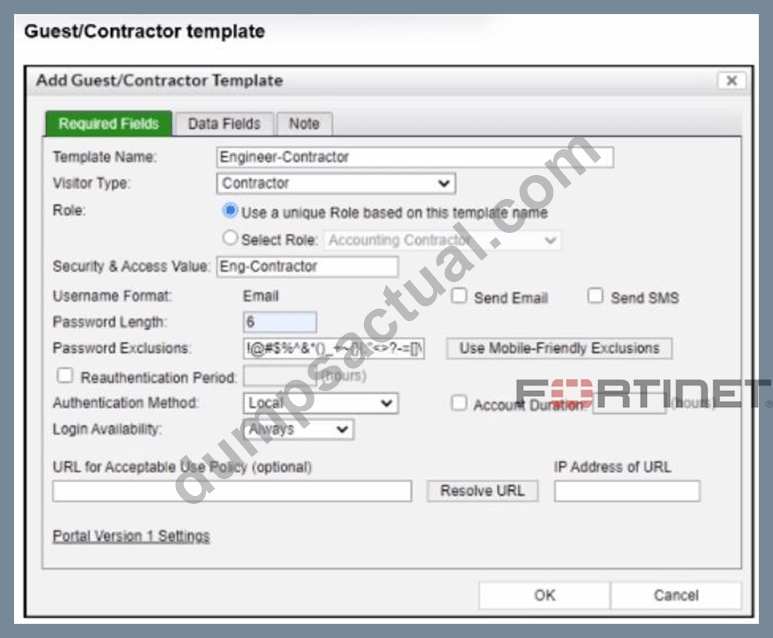
When a contractor account is created using this template, which value is set in the accounts Role field?
- A. Engineer-Contractor
- B. Accounting Contractor
- C. Eng-Contractor
- D. Contractor
Answer: A
Explanation:
The correct answer is A . In the exhibit, the Template Name is Engineer-Contractor , and the selected Role option is Use a unique Role based on this template name . That means FortiNAC-F uses the template name itself as the role value for any account created from this guest/contractor template. The study guide confirms this behavior: by default, the Role field is populated with the template name, although the administrator can alternatively select from an existing role list. It also states that the role value in the guest and contractor template populates the Role field of any account created from that template.
Option B , Eng-Contractor , is wrong because that value is entered in the Security and Access Value field, not the Role field. That value can still be used in user/host profiles or policies, but it does not populate the account Role field. Option C , Contractor , is only the Visitor Type , which controls the kind of guest
/contractor account and associated icon behavior. Option D , Accounting Contractor , is visible in the disabled Select Role dropdown, but that option is not selected because the template is configured to use a unique role based on the template name.
NEW QUESTION # 52
Refer to the output below.
Examine the communication between a primary FortiNAC-F (192.168.10.10) and a secondary FortlNAC-F (192.168.10.110) configured as a 1+1 HA pair. What is the current state of the FortiNAC-F HA pair?
- A. The database replication failed
- B. The secondary server is running and in control.
- C. The primary server is running and in control.
- D. Failover from the primary server to the secondary server is in progress.
Answer: C
Explanation:
The correct answer is D . The log output shows the local IP address as 192.168.10.10 , which the question identifies as the primary FortiNAC-F server. In the same output, FortiNAC-F reports inControl true and controlServer true , which means the local primary server is currently the control server. The line showing communication to 192.168.10.110 returns Running - Not In Control , confirming that the secondary server is alive but is not the active controlling node.
This matches FortiNAC-F 1+1 HA behavior. The study guide describes a 1+1 HA pair as an active-passive deployment where one FortiNAC-F device is designated primary and the other secondary. Database and configuration synchronization keep the devices aligned, but only one server is in control at a time. If the primary fails, the secondary assumes control automatically; otherwise, the primary remains the active control server.
Option A is wrong because the secondary explicitly reports Not In Control . Option B is wrong because the output does not show database replication failure. Option C is wrong because failover is not in progress; the output shows a stable state where the primary is in control and the secondary is running as the passive node.
NEW QUESTION # 53
An administrator wants FortiNAC-F to return a group of user-defined RADIUS attributes in RADIUS responses.
Which condition must be true to achieve this?
- A. Inbound RADIUS requests must contain the Calling-Station-ID attribute.
- B. The device models in the inventory view must be configured for proxy-based authentication.
- C. RADIUS accounting must be enabled on the FortiNAC-F RADIUS server configuration.
- D. The requesting device must support RFC 5176.
Answer: A
Explanation:
In FortiNAC-F, the RADIUS Attribute Groups feature allows administrators to return customized RADIUS attributes (such as specific VLAN IDs, filter IDs, or vendor-specific attributes) in an Access-Accept packet sent back to a network device. This is particularly useful for supporting "Generic RADIUS" devices that are not natively supported but can be managed using standard AVPairs.
According to the FortiNAC-F Generic RADIUS Wired Cookbook and the RADIUS Attribute Groups section of the Administration Guide, there is one critical prerequisite for this feature to function: the inbound RADIUS request must contain the Calling-Station-ID attribute. The Calling-Station-ID typically contains the MAC address of the connecting endpoint. Because FortiNAC-F is a host-centric system, it uses the MAC address as the unique identifier to look up the host record, evaluate the associated Network Access Policy, and determine which Logical Network (and thus which Attribute Group) should be applied. If the incoming request lacks this attribute, FortiNAC-F cannot reliably identify the host and, as a safety mechanism, will not include any user-defined RADIUS attributes in the response. This ensures that unauthorized or unidentifiable devices do not receive privileged access through misapplied attributes.
"Configure a set of attributes that must be included in the RADIUS Access-Accept packet returned by FortiNAC... Requirement: Inbound RADIUS request must contain Calling-Station-Id. Otherwise, FortiNAC will not include the RADIUS attributes. This attribute is used to identify the host and its current state within the FortiNAC database." - FortiNAC-F 7.6.0 Generic RADIUS Wired Cookbook: Configure RADIUS Attribute Groups.
NEW QUESTION # 54
In which three ways would deploying a FortiNAC-F Manager into a large environment consisting of several FortiNAC-F CAs simplify management? (Choose three.)
- A. Pooled licenses
- B. Global visibility
- C. Global version control
- D. Global infrastructure device inventory
- E. Global authentication security policies
Answer: A,B,C
Explanation:
The FortiNAC-F Manager (FortiNAC-M) is designed as a centralized management platform for large-scale distributed environments where multiple FortiNAC-F Control and Application (CA) appliances are deployed across different sites. According to the FortiNAC-F Manager Administration Guide, the deployment of a Manager simplifies administrative overhead in three specific ways:
First, it provides Global Version Control (B). The Manager serves as a central repository for firmware and software updates, allowing administrators to push specific versions to all managed CAs simultaneously, ensuring consistency across the entire fabric. Second, it enables Pooled Licenses (D). Instead of purchasing and managing individual licenses for every CA, licenses are centralized on the Manager. The Manager then distributes these licenses to the CAs as needed based on their host counts. This "floating" license model optimizes cost and prevents individual sites from running out of capacity while others have excess. Third, it offers Global Visibility (E). The Manager aggregates host and device data from every managed CA into a single console. This "single pane of glass" allows an administrator to search for a specific MAC address or user across the entire global organization without logging into individual servers.
While the Manager can assist with configuration templates, authentication security policies (C) and infrastructure modeling (A) are still predominantly managed at the local CA level to ensure site-specific logic and performance.
"The FortiNAC Manager provides a central management console for multiple FortiNAC-F servers (CAs). Key benefits include: * License Management: Licenses are pooled on the Manager and allocated to managed CAs as needed. * Software Management: Firmware updates can be centrally managed and pushed to all CAs from the Manager. * Centralized Monitoring: Provides a global view of all hosts, adapters, and events across the entire managed environment." - FortiNAC-F Manager Administration Guide: Overview and Benefits.
NEW QUESTION # 55
When creating a device profiling rule, what are two advantages of registering the device in the host view? (Choose two.)
- A. The devices will have connection logs.
- B. The devices can be associated with a user.
- C. The devices can be managed as a generic SNMP device.
- D. The devices can be polled for connection status.
Answer: A,B
Explanation:
In FortiNAC-F, the Device Profiler is a rule-based engine that evaluates unknown "rogue" devices and classifies them based on fingerprints and behavior. When a profiling rule matches a device, the administrator can configure the rule to automatically register that device. The registration process can place the device record in two primary locations: the Topology View (as a device) or the Host View (as a registered host).
According to the FortiNAC-F Administration Guide, registering a device in the Host View provides significant advantages for identity management and historical tracking. First, the devices can be associated with a user (C). In the FortiNAC database architecture, the Host View is the primary repository for endpoint identity; placing a profiled device here allows the system to link that hardware (MAC address) to a specific user account, whether that user is an employee, guest, or a system-level "owner". This association is essential for Role-Based Access Control (RBAC) and for tracking accountability across the network fabric.
Second, devices registered in the Host View will have connection logs (B). FortiNAC-F maintains a detailed operational history for all host records, including every instance of the device connecting to or disconnecting from a port, its IP address assignments, and the specific policies applied during each session. These logs are invaluable for troubleshooting connectivity issues and for security forensic audits, as they provide a clear timeline of the device's lifecycle on the network. In contrast, devices managed only in the Topology View are typically treated as infrastructure components where the focus is on device availability rather than individual session history.
"Devices that are registered and associated with a user are placed in the Host View and removed from the Profiled Devices window... Placing a device in the Host View allows for the tracking of connection history and the association of the device with a specific identity or user record within the FortiNAC database." - FortiNAC-F Administration Guide: Device Profiler How it Works.
NEW QUESTION # 56
Refer to the exhibits.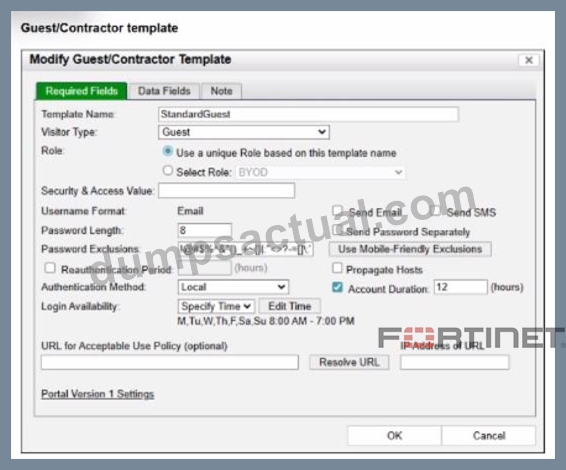
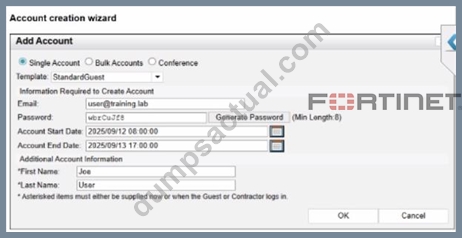
Based on the given configurations and settings, on which date and time would a guest account created at 8:00 AM on 2025/09/12 expire?
- A. 2025/09/12 at 17:00:00
- B. 2025/09/12 at 8:00 PM
- C. 2025/09/13 at 17:00:00
- D. 2025/09/12 at 7:00 PM
Answer: C
Explanation:
Questio ns no: 22
Verified Answe r: D
Comprehensive and Detailed 250 to 300 words each Explanation with Exact Matched Extract from FortiNAC-F Administrator library and documentation for current versions (including F 7.2, 7.4, and 7.6) documents:
In FortiNAC-F, the expiration of a guest or contractor account is determined by the configuration settings within the Account Creation Wizard and the associated Guest/Contractor Template. While a template can define a default "Account Duration" (as seen in the 12-hour setting in the second exhibit), the Account Creation Wizard allows an administrator to manually specify or override the start and end parameters for a specific user session.
According to the FortiNAC-F Administration Guide regarding guest management, the Account End Date field in the creation wizard is the definitive timestamp for when the account object will be disabled or deleted from the system. In the provided exhibit (Account Creation Wizard), the administrator has explicitly set the Account Start Date to 2025/09/12 08:00:00 and the Account End Date to 2025/09/13 17:00:00.
Even though the template indicates an "Account Duration" of 12 hours, this value typically serves as a pre-populated default. When a manual date and time are entered into the wizard, those specific values take precedence for that individual account. The account will remain active and valid until 5:00 PM (17:00:00) on the following day, 2025/09/13. It is also important to note the "Login Availability" from the template (8:00 AM - 7:00 PM); while the account exists until the 13th at 17:00:00, the user would only be able to authenticate during the active hours defined by the login schedule on both days.
"When creating an account, the administrator can select a template to provide default settings. However, specific values such as the Account End Date can be modified within the Account Creation Wizard. The date and time specified in the 'Account End Date' field determines the absolute expiration of the account. Once this time is reached, the account is moved to an expired state and the user's network access is revoked." - FortiNAC-F Administration Guide: Guest and Contractor Account Management.
NEW QUESTION # 57
......
Best NSE5_FNC_AD_7.6 Exam Preparation Material with New Dumps Questions https://www.dumpsactual.com/NSE5_FNC_AD_7.6-actualtests-dumps.html
Fast Exam Updates NSE5_FNC_AD_7.6 dumps with PDF Test Engine Practice https://drive.google.com/open?id=1IX0gwtMbBRSJHkdu7tqLZhvbwnefU_bC
