

100% Reliable Microsoft ISO-IEC-27001-Lead-Auditor-CN Exam Dumps Test Pdf Exam Material
Based on Official Syllabus Topics of Actual PECB ISO-IEC-27001-Lead-Auditor-CN Exam
NEW QUESTION # 48
在第三方認證審核期間,受審核方會提供您問題清單。下列哪四項構成 ISO/IEC 27001:2022 管理系統背景下的「外部」問題?
- A. 訓練支出削減導致員工能力水準低下
- B. 由於政府制裁而無法購買原料
- C. 由於員工假期減少,士氣低落
- D. 為因應高通膨而提高利率
- E. 與過時的生產設備有關的生產率下降
- F. 因政府政策改變而導致補助金減少
- G. 因管理不善導致缺勤增加
- H. 人口老化導致勞動成本上升
Answer: B,D,F,H
Explanation:
According to ISO/IEC 27001:2022, which specifies the requirements for establishing, implementing, maintaining and continually improving an information security management system (ISMS), clause 4.1 requires an organization to determine external and internal issues that are relevant to its purpose and that affect its ability to achieve the intended outcomes of its ISMS2. External issues are those that originate from outside the organization, such as legal, regulatory, cultural, social, political, economic, natural and competitive factors2. Internal issues are those that originate from within the organization, such as governance, structure, roles and responsibilities, policies, objectives, culture, capabilities, resources and information systems2. Therefore, based on this definition, four examples of external issues in the context of a management system to ISO/IEC 27001:2022 are a rise in interest rates in response to high inflation (which affects the economic environment of the organization), a reduction in grants as a result of a change in government policy (which affects the political and legal environment of the organization), higher labour costs as a result of an aging population (which affects the social and demographic environment of the organization), and inability to source raw materials due to government sanctions (which affects the trade and supply environment of the organization)2. The other options are examples of internal issues, as they originate from within the organization or its activities. For example, poor levels of staff competence as a result of cuts in training expenditure (which affects the capabilities and resources of the organization), increased absenteeism as a result of poor management (which affects the culture and performance of the organization), poor morale as a result of staff holidays being reduced (which affects the motivation and satisfaction of the organization's personnel), and a fall in productivity linked to outdated production equipment (which affects the efficiency and quality of the organization's processes)2. References: ISO/IEC 27001:2022 - Information technology - Security techniques - Information security management systems - Requirements
NEW QUESTION # 49
您是一位經驗豐富的審核團隊領導,指導審核員進行培訓。接受培訓的審核員的任務是審查適用性聲明 (SoA) 中列出的並在現場實施的技術控制措施。
從以下內容中選擇您希望接受培訓的審核員審查的四項控制措施。
- A. 資訊資產清單的發展與維護
- B. 遠距工作安排
- C. 現場閉路電視和門禁系統的運行
- D. 組織對設備維護的安排
- E. 保密與保密協議
- F. 組織的業務連續性安排
- G. 進出裝載區的通道
- H. 組織如何評估其技術漏洞的暴露程度
- I. 如何實施針對惡意軟體的防護
- J. 機構對資訊刪除的安排
- K. 資訊安全意識、教育與培訓
- L. 在組織內部以及向其他組織傳輸訊息的規則
- M. 如何管理對原始程式碼和開發工具的訪問
- N. 供應商協定中如何解決資訊安全問題
- O. 電源線和資料線如何進入建築物
- P. 對人員進行驗證檢查
Answer: C,H,I,M
Explanation:
According to ISO/IEC 27001:2022, which specifies the requirements for establishing, implementing, maintaining and continually improving an information security management system (ISMS), an organization should select and implement appropriate controls to achieve its information security objectives1. The controls should be derived from the results of risk assessment and risk treatment, and should be consistent with the Statement of Applicability (SoA), which is a document that identifies the controls that are applicable and necessary for the ISMS1. The controls can be selected from various sources, such as ISO/IEC 27002:2013, which provides a code of practice for information security controls2. Therefore, if an auditor in training has been tasked with reviewing the technological controls listed in the SoA and implemented at the site of an organization that stores data on behalf of external clients, four controls that would be expected to review are:
* How protection against malware is implemented: This is a technological control that aims to prevent, detect and remove malicious software (such as viruses, worms, ransomware, etc.) that could compromise the confidentiality, integrity or availability of information or information systems2. This control is related to control A.12.2.1 of ISO/IEC 27002:20132.
* How the organisation evaluates its exposure to technical vulnerabilities: This is a technological control that aims to identify and assess the potential weaknesses or flaws in information systems or networks that could be exploited by malicious actors or cause accidental failures2. This control is related to control A.12.6.1 of ISO/IEC 27002:20132.
* How access to source code and development tools are managed: This is a technological control that aims to protect the intellectual property rights and integrity of software applications or systems that are developed or maintained by the organization or its external providers2. This control is related to control A:14.2.5 of ISO/IEC 27002:20132.
* The operation of the site CCTV and door control systems: This is a technological control that aims to monitor and restrict physical access to the premises or facilities where information or information systems are stored or processed2. This control is related to control A.11.1.4 of ISO/IEC 27002:20132.
The other options are not examples of technological controls, but rather organizational, legal or procedural controls that may also be relevant for an ISMS audit, but are not within the scope of the auditor in training's task. For example, the development and maintenance of an information asset inventory (related to control A.
8.1.1), rules for transferring information within the organization and to other organizations (related to control A.13.2.1), confidentiality and nondisclosure agreements (related to control A.13.2.4), verification checks on personnel (related to control A.7.1.2), remote working arrangements (related to control A.6.2.1), information security within supplier agreements (related to control A.15.1.1), business continuity arrangements (related to control A.17), information deletion (related to control A.8.3), information security awareness, education and training (related to control A.7.2), equipment maintenance (related to control A.11.2), and how power and data cables enter the building (related to control A.11) are not technological controls, but rather organizational, legal or procedural controls that may also be relevant for an ISMS audit, but are not within the scope of the auditor in training's task. References: ISO/IEC 27001:2022 - Information technology - Security techniques - Information security management systems - Requirements, ISO/IEC 27002:2013 - Information technology - Security techniques - Code of practice for information security controls
NEW QUESTION # 50
場景 6:Cyber ACrypt 是一家網路安全公司,透過提供反惡意軟體和設備安全、資產生命週期管理和設備加密來提供端點保護。為了根據 ISO/IEC 27001 驗證其 ISMS 並證明其對網路安全卓越的承諾,該公司經歷了由指定審計團隊負責人 John 領導的細緻的審計過程。
在接受審計任務後,John 立即組織了一次會議,概述了審計計劃和團隊角色。他們審查了 Cyber ACrypt 的文檔信息,包括資訊安全政策和操作程序,確保每一份文件都符合標準並具有標準化的格式,包括作者標識、生產日期、版本號和批准日期。這次徹底的檢查旨在確定持續改進和遵守 ISMS 要求。該文件對於審計團隊和 Cyber ACrypt 了解初步審計結果和需要關注的領域至關重要。
審計組也決定對主要相關方進行訪談。這項決定的目的是收集可靠的審計證據來驗證管理系統是否符合 ISO/IEC 27001 的要求。與 Cyber ACrypt 各個層級的相關方進行接觸為審計團隊提供了寶貴的觀點以及對 ISMS 的實施和有效性的理解。
第一階段審計報告揭露了值得關注的關鍵領域。適用性聲明 (SoA) 和 ISMS 政策在多個方面存在缺陷,包括風險評估不足、存取控制不充分以及缺乏定期政策審查。這促使 Cyber ACrypt 立即採取行動來解決這些缺陷。他們對戰略文件的快速回應和修改體現出了對實現合規的堅定承諾。
為了彌補審計團隊的網路安全知識差距而引入的技術專長在識別風險評估方法中的缺陷和審查網路架構方面發揮了關鍵作用。這包括評估防火牆、入侵偵測和預防系統以及其他網路安全措施,以及評估 Cyber ACrypt 如何偵測、回應和恢復外部和內部威脅。在約翰的監督下,技術專家將審計結果傳達給了 Cyber ACrypt 的代表。然而,審計小組發現,由於收取了被審計單位的諮詢費,該專家的客觀性可能受到影響。考慮到技術專家在審核過程中的行為,審核組長決定與認證機構討論這個問題。
根據上述情景,回答以下問題:
哪些用於評估文件資訊的標準尚未經過審計團隊的驗證? (參考場景6)
- A. 記錄資訊的內容
- B. 管理文件資訊的程序
- C. 記錄資訊的格式
Answer: B
Explanation:
Comprehensive and Detailed In-Depth
C . Correct Answer:
Scenario 6 states that the audit team reviewed the content and format of the documents but does not mention an evaluation of the document management procedure.
ISO/IEC 27001 requires that procedures for managing documented information be reviewed.
A . Incorrect:
The content of documents was reviewed for compliance with ISO/IEC 27001 clauses.
B . Incorrect:
The audit team confirmed that all documents were in a standardized format.
Relevant Standard Reference:
ISO/IEC 27001:2022 Clause 7.5 (Documented Information Requirements)
NEW QUESTION # 51
情境 6
Sinvestment是一家提供多種保險方案的保險公司,包括房屋保險、商業保險和人壽保險。該公司最初成立於北加州,現已將業務拓展至歐洲和非洲等其他地區。除了業務成長之外,Sinvestment還致力於遵守其所在行業的相關法律法規,並防止任何資訊安全事件的發生。他們已實施基於ISO標準的資訊安全管理系統(ISMS)。
/IEC 27001,並已申請認證。
認證機構指派了一支審核團隊進行審核。審核團隊與Sinvestment簽署保密協議後,便開始了審核工作。第一階段審核的所有活動均在現場進行,但應Sinvestment的要求,對已存檔資訊的審查工作將以遠端方式進行。
審計團隊首先進行了第一階段審計,審查了所需文件,包括資訊安全管理系統(ISMS)範圍聲明、資訊安全策略和內部審計報告。已記錄資訊的評估主要基於其內容和管理流程。
此外,審計人員還發現,與資訊安全培訓和意識提升專案相關的文件不完整,缺乏關鍵細節。當被問及此事時,Sinvestment 的高階管理人員表示,該公司已為所有員工提供了資訊安全培訓課程。
第二階段審計在第一階段審計三週後進行。審計小組發現,行銷部(未包含在審計範圍內)沒有控制員工存取權限的程序。
由於控制員工存取權限是 ISO/IEC 27001 的要求之一,並且已納入公司的資訊安全政策,因此該問題被納入了審計報告。
問題
根據情境 6,在評估已記錄的資訊時,審計師在第一階段審計中應該採取什麼行動?
- A. 忽略格式問題,只需驗證所需資訊是否存在,因為標準並未要求格式。
- B. 確保有管理已記錄資訊的程序
- C. 驗證所記錄的資訊是否符合適當的格式,並與本公司的文件流程保持一致。
Answer: C
Explanation:
The auditor should validate that documented information conforms to both content and format requirements defined by the organization's documentation procedure, making option A the correct answer. ISO/IEC 27001 clause 7.5 requires documented information to be controlled, which includes requirements for format, identification, version control, and approval, as defined by the organization.
During stage 1 audits, auditors assess whether the organization has appropriate procedures in place and whether documented information is created and managed in accordance with those procedures. This includes verifying that documents follow established templates, naming conventions, approval mechanisms, and version control practices.
Option B is incorrect because while ISO/IEC 27001 does not prescribe a specific format, it requires conformity to the organization's own documented information controls. Ignoring format would ignore part of the control requirement. Option C is partially correct in general, but insufficient in this context because the scenario explicitly states that the evaluation was based on content and procedure. The auditor must verify conformance, not just existence.
Therefore, validating alignment with documentation procedures, including format, is the correct auditor action.
NEW QUESTION # 52
您的組織目前正在尋求 ISO/IEC27001:2022 認證。您剛剛獲得內部 ISMS 審核員資格,ICT 經理希望利用您新獲得的知識來協助他設計資訊安全事件管理流程。
他確定了計劃流程中的以下階段,並要求您確認它們應按哪個順序出現。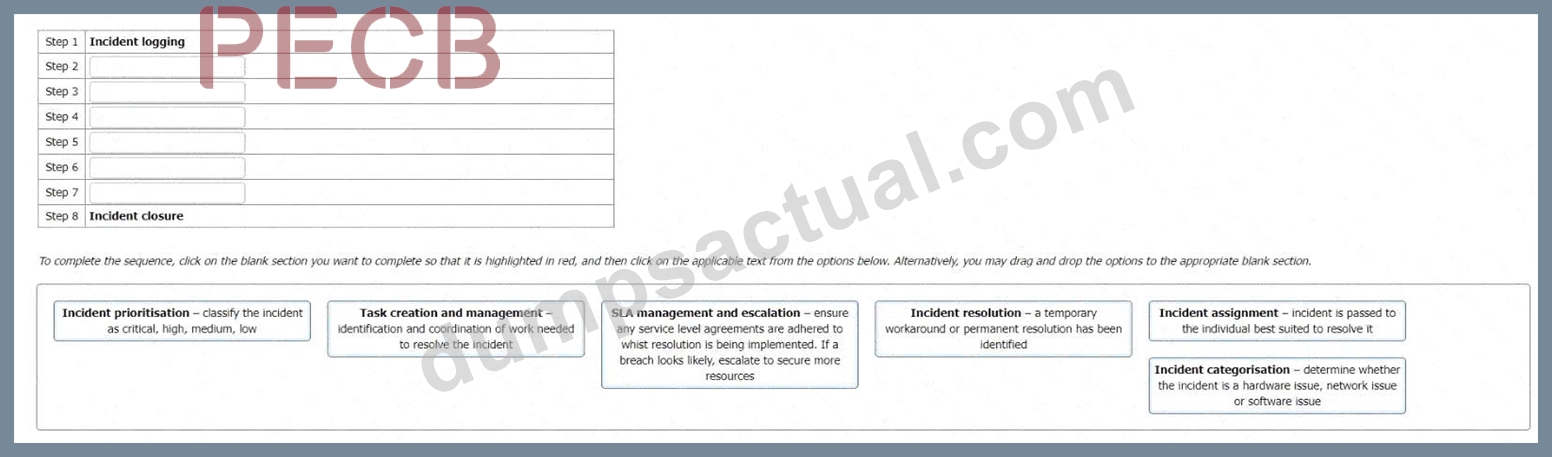
Answer:
Explanation: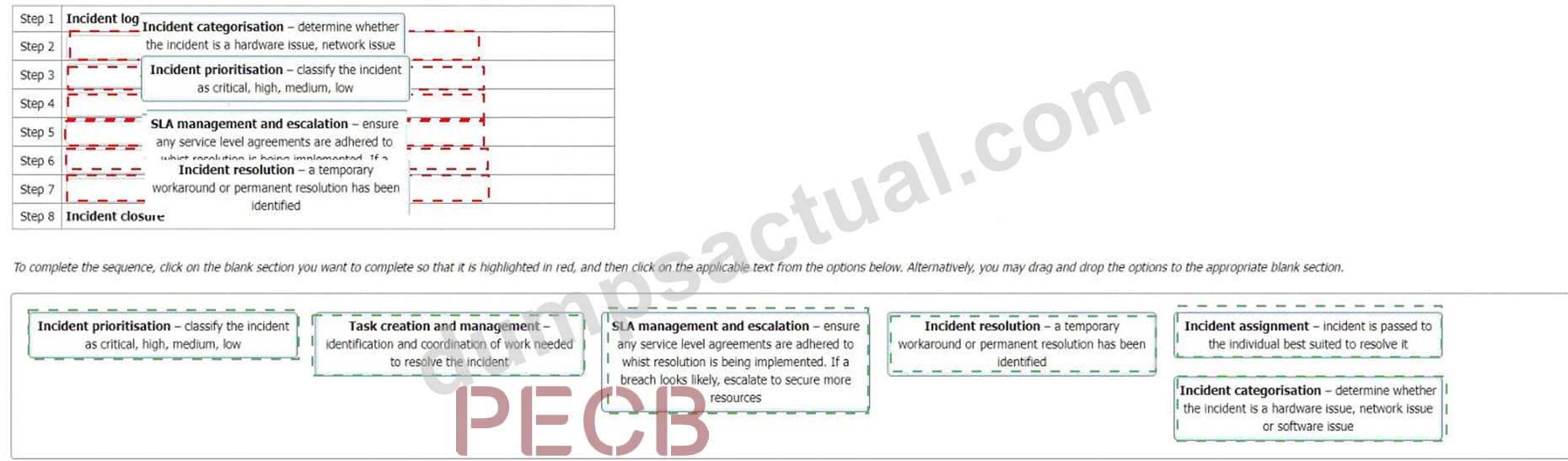
Explanation:
Step 1 = Incident logging Step 2 = Incident categorisation Step 3 = Incident prioritisation Step 4 = Incident assignment Step 5 = Task creation and management Step 6 = SLA management and escalation Step 7 = Incident resolution Step 8 = Incident closure The order of the stages in the information security incident management process should follow a logical sequence that ensures a quick, effective, and orderly response to the incidents, events, and weaknesses. The order should also be consistent with the best practices and guidance provided by ISO/IEC 27001:2022 and ISO
/IEC 27035:2022. Therefore, the following order is suggested:
* Step 1 = Incident logging: This step involves recording the details of the potential incident, event, or weakness, such as the date, time, source, description, impact, and reporter. This step is important to provide a traceable record of the incident and to facilitate the subsequent analysis and response. This step is related to control A.16.1.1 of ISO/IEC 27001:2022, which requires the organization to establish responsibilities and procedures for the management of information security incidents, events, and weaknesses. This step is also related to clause 6.2 of ISO/IEC 27035:2022, which provides guidance on how to log the incidents, events, and weaknesses.
* Step 2 = Incident categorisation: This step involves determining the type and nature of the incident, event, or weakness, such as whether it is a hardware issue, network issue, or software issue. This step is important to classify the incident and to assign it to the appropriate resolver or team. This step is related to control A.16.1.2 of ISO/IEC 27001:2022, which requires the organization to report information security events and weaknesses as quickly as possible through appropriate management channels. This step is also related to clause 6.3 of ISO/IEC 27035:2022, which provides guidance on how to categorize the incidents, events, and weaknesses.
* Step 3 = Incident prioritisation: This step involves assessing the severity and urgency of the incident, event, or weakness, and classifying it as critical, high, medium, or low. This step is important to prioritize the incident and to allocate the necessary resources and time for the response. This step is related to control A.16.1.3 of ISO/IEC 27001:2022, which requires the organization to assess and prioritize information security events and weaknesses in accordance with the defined criteria. This step is also related to clause 6.4 of ISO/IEC 27035:2022, which provides guidance on how to prioritize the incidents, events, and weaknesses.
* Step 4 = Incident assignment: This step involves passing the incident, event, or weakness to the individual or team who is best suited to resolve it, based on their skills, knowledge, and availability.
This step is important to ensure that the incident is handled by the right person or team and to avoid delays or confusion. This step is related to control A.16.1.4 of ISO/IEC 27001:2022, which requires the organization to respond to information security events and weaknesses in a timely manner, according to the agreed procedures. This step is also related to clause 6.5 of ISO/IEC 27035:2022, which provides guidance on how to assign the incidents, events, and weaknesses.
* Step 5 = Task creation and management: This step involves identifying and coordinating the work needed to resolve the incident, event, or weakness, such as performing root cause analysis, testing solutions, implementing changes, and documenting actions. This step is important to ensure that the incident is resolved effectively and efficiently, and that the actions are tracked and controlled. This step is related to control A.16.1.5 of ISO/IEC 27001:2022, which requires the organization to apply lessons learned from information security events and weaknesses to take corrective and preventive actions. This step is also related to clause 6.6 of ISO/IEC 27035:2022, which provides guidance on how to create and manage the tasks for the incidents, events, and weaknesses.
* Step 6 = SLA management and escalation: This step involves ensuring that any service level agreements (SLAs) are adhered to while the resolution is being implemented, and that the incident is escalated to a higher level of authority or support if a breach looks likely or occurs. This step is important to ensure that the incident is resolved within the agreed time frame and quality, and that any deviations or issues are communicated and addressed. This step is related to control A.16.1.6 of ISO
/IEC 27001:2022, which requires the organization to communicate information security events and weaknesses to the relevant internal and external parties, as appropriate. This step is also related to clause 6.7 of ISO/IEC 27035:2022, which provides guidance on how to manage the SLAs and escalations for the incidents, events, and weaknesses.
* Step 7 = Incident resolution: This step involves applying a temporary workaround or a permanent solution to resolve the incident, event, or weakness, and restoring the normal operation of the information and information processing facilities. This step is important to ensure that the incident is resolved completely and satisfactorily, and that the information security is restored to the desired level.
This step is related to control A.16.1.7 of ISO/IEC 27001:2022, which requires the organization to identify the cause of information security events and weaknesses, and to take actions to prevent their recurrence or occurrence. This step is also related to clause 6.8 of ISO/IEC 27035:2022, which provides guidance on how to resolve the incidents, events, and weaknesses.
* Step 8 = Incident closure: This step involves closing the incident, event, or weakness, after verifying that it has been resolved satisfactorily, and that all the actions have been completed and documented.
This step is important to ensure that the incident is formally closed and that no further actions are required. This step is related to control A.16.1.8 of ISO/IEC 27001:2022, which requires the organization to collect evidence and document the information security events and weaknesses, and the actions taken. This step is also related to clause 6.9 of ISO/IEC 27035:2022, which provides guidance on how to close the incidents, events, and weaknesses.
References:
ISO/IEC 27001:2022, Information technology - Security techniques - Information security management systems - Requirements1 PECB Candidate Handbook ISO/IEC 27001 Lead Auditor2 ISO 27001:2022 Lead Auditor - PECB3 ISO 27001:2022 certified ISMS lead auditor - Jisc4 ISO/IEC 27001:2022 Lead Auditor Transition Training Course5 ISO 27001 - Information Security Lead Auditor Course - PwC Training Academy6 ISO/IEC 27035:2022, Information technology - Security techniques - Information security incident management
NEW QUESTION # 53
問題:
在涉及多個審計團隊的聯合審計中,每次審計通常會指定多少個審計團隊負責人?
- A. 聯合審計中沒有指定的審計團隊負責人。
- B. 每個審計團隊都指定自己的審計團隊負責人。
- C. 每次審計只有一個審計團隊負責人,無論涉及多少個審計團隊。
Answer: C
Explanation:
Comprehensive and Detailed In-Depth Explanation:
* A. Correct Answer:
* Joint audits involve multiple teams but require only one designated audit team leader to ensure:
* Consistent audit methodology
* Coordination among teams
* Unified reporting structure
* B. Incorrect:
* While each team may have a coordinator, there is only one main leader responsible for the audit.
* C. Incorrect:
* ISO 19011 mandates the presence of a designated audit team leader in all audits.
Relevant Standard Reference:
* ISO 19011:2018 Clause 5.5.5 (Assigning Responsibility to the Audit Team Leader)
NEW QUESTION # 54
您是 ISMS 審核小組組長,由您的認證機構指派對客戶進行後續審核。您正在為此審核準備審核計畫。
下列哪兩項敘述是正確的?
- A. 應先驗證改進機會,然後再修正,最後採取糾正措施
- B. 應先驗證糾正措施,然後是糾正措施,最後是改進機會
- C. 驗證應專注於所採取的任何操作是否完成
- D. 應先檢視糾正措施,然後是糾正,最後是改進機會
- E. 驗證應重點關注所採取的任何行動是否有效
- F. 驗證應重點關注所採取的任何行動是否有效
Answer: C,E
Explanation:
According to ISO 27001:2022 clause 9.1.2, the organisation shall conduct internal audits at planned intervals to provide information on whether the information security management system conforms to the organisation' s own requirements, the requirements of ISO 27001:2022, and is effectively implemented and maintained12 According to ISO 27001:2022 clause 10.1, the organisation shall react to the nonconformities and take action, as applicable, to control and correct them and deal with the consequences. The organisation shall also evaluate the need for action to eliminate the causes of nonconformities, in order to prevent recurrence or occurrence.
The organisation shall implement any action needed, review the effectiveness of any corrective action taken, and make changes to the information security management system, if necessary12 A follow-up audit is a type of internal audit that is conducted after a previous audit to verify whether the nonconformities and corrective actions have been addressed and resolved, and whether the information security management system has been improved12 Therefore, the following statements are true for preparing a follow-up audit plan:
* Verification should focus on whether any action undertaken is complete. This means that the auditor should check whether the organisation has implemented all the planned actions to correct and prevent the nonconformities, and whether the actions have been documented and communicated as required12
* Verification should focus on whether any action undertaken has been undertaken effectively. This means that the auditor should check whether the organisation has achieved the intended results and objectives of the actions, and whether the actions have eliminated or reduced the nonconformities and their causes and consequences12 The following statements are false for preparing a follow-up audit plan:
* Verification should focus on whether any action undertaken has been undertaken efficiently. This is false because efficiency is not a criterion for verifying the actions taken to address the nonconformities and corrective actions. Efficiency refers to the optimal use of resources to achieve the desired outcomes, but it is not a requirement of ISO 27001:2022. The auditor should focus on the effectiveness and completeness of the actions, not on the efficiency12
* Corrections should be verified first, followed by corrective actions and finally opportunities for improvement. This is false because there is no prescribed order for verifying the corrections, corrective actions, and opportunities for improvement. The auditor should verify all the actions taken by the organisation, regardless of their sequence or priority. The auditor may choose to verify the actions based on their relevance, significance, or impact, but this is not a mandatory requirement12
* Opportunities for improvement should be verified first, followed by corrections and finally corrective actions. This is false because there is no prescribed order for verifying the opportunities for improvement, corrections, and corrective actions. The auditor should verify all the actions taken by the organisation, regardless of their sequence or priority. The auditor may choose to verify the actions based on their relevance, significance, or impact, but this is not a mandatory requirement12
* Corrective actions should be reviewed first, followed by corrections and finally opportunities for improvement. This is false because there is no prescribed order for reviewing the corrective actions, corrections, and opportunities for improvement. The auditor should review all the actions taken by the organisation, regardless of their sequence or priority. The auditor may choose to review the actions based on their relevance, significance, or impact, but this is not a mandatory requirement12 References:
1: ISO/IEC 27001:2022 Lead Auditor (Information Security Management Systems) Course by CQI and IRCA Certified Training 1 2: ISO/IEC 27001 Lead Auditor Training Course by PECB 2
NEW QUESTION # 55
您是經驗豐富的審核團隊領導,指導審核員進行培訓。
您的團隊目前正在對代表外部客戶儲存資料的組織進行第三方監督審核。接受培訓的審核員的任務是審查適用性聲明 (SoA) 中列出的並在現場實施的組織控制措施。
從以下內容中選擇您希望接受培訓的審核員審查的四項控制措施。
- A. 資訊資產清單的開發與維護
- B. 現場閉路電視和門禁系統的運行
- C. 組織的業務連續性安排
- D. 進出裝載區的通道
- E. 保密與保密協議
- F. 供應商協定中如何解決資訊安全問題
- G. 在組織內部以及向其他組織傳輸訊息的規則
- H. 電源線和資料線如何進入建築物
Answer: A,E,F,G
Explanation:
According to the PECB Candidate Handbook for ISO/IEC 27001 Lead Auditor, the auditor in training should review the organisational controls that are related to the information security policy, the roles and responsibilities, the information classification, the information exchange, the supplier relationships, and the information asset management1. These controls are aligned with the ISO/IEC 27001 requirements for clauses
5, 7, 8.2, 8.3, and 8.42. The other controls (A, D, G, and H) are more relevant to the physical and environmental security, the communications security, or the business continuity management, which are not part of the organisational controls3. References: 1: PECB Candidate Handbook for ISO/IEC 27001 Lead Auditor, page 42, section 5.2.32: ISO/IEC 27001:2022, clauses 5, 7, 8.2, 8.3, and 8.43: ISO/IEC 27001:2022, clauses 8.1, 8.5, and 8.6.
NEW QUESTION # 56
您詢問 IT 經理,為什麼組織仍在使用行動應用程序,而個人資料加密和假名化測試卻失敗了。此外,服務經理是否有權批准測試。
IT經理解釋說,根據軟體安全管理程序,測試結果應由他批准。加密和假名功能失敗的原因是這些功能嚴重降低了系統和服務效能。需要額外 150% 的資源來滿足這一點。服務經理同意存取控制足夠好並且可以接受。這就是服務經理簽署批准書的原因。
您對醫務人員的手機進行採樣,發現安裝了 ABC 的醫療保健移動應用程序,版本 1.01。你發現1.01版本沒有測試記錄。
IT經理解釋說,由於勒索軟體攻擊頻繁,外包行動應用開發公司對受測軟體進行了免費小幅更新,並對更新後的軟體進行了緊急發布,並口頭保證不會對安全造成任何影響。
以他20年的資訊安全經驗來看,沒有必要重新測試。
您正在準備審核結果 請選擇兩個正確的選項。
- A. 存在不合格項 (NC)。組織不控制計劃的變更並審查非預期變更的後果。 (與第8.1條相關)
- B. 存在不合格項 (NC)。 IT 經理不遵守軟體安全管理程序。 (與第 8.1 條相關,控制措施 A.8.30)
- C. 還有改進的機會 (OI)。該組織根據其提供的免費服務的範圍選擇外部服務提供者。 (與第 8.1 條相關,控制措施 A.5.21)
- D. 不存在不合格項 (NC)。 IT 經理展現了良好的領導能力。 (與條款相關
5.1,控制5.4) - E. 還有改進的機會 (OI)。 IT 經理應根據適當的測試做出是否繼續提供服務的決定。 (與第 8.1 條相關,控制措施 A.8.30)
- F. 不存在不合格項 (NC)。 IT 經理證明他完全有能力。 (與第7.2條相關)
Answer: A,B
Explanation:
According to ISO 27001:2022 Annex A Control 8.30, the organisation shall ensure that externally provided processes, products or services that are relevant to the information security management system are controlled. This includes developing and entering into licensing agreements that cover code ownership and intellectual property rights, and implementing appropriate contractual requirements related to secure design and coding in accordance with Annex A 8.25 and 8.2912 In this case, the organisation and the developer have performed security tests that failed, which indicates that the secure design and coding requirements of Annex A 8.29 were not met. The IT Manager explains that the encryption and pseudonymization functions failed because they slowed down the system and service performance, and that an extra 150% of resources are needed to cover this. However, this does not justify the acceptance of the test results by the Service Manager, who is not authorised to approve the test according to the software security management procedure. The Service Manager should have consulted with the IT Manager, who is the owner of the process, and followed the procedure for handling nonconformities and corrective actions. The Service Manager's decision to continue the service based on access control alone exposes the organisation to the risk of compromising the confidentiality, integrity, and availability of personal data processed by the mobile app. Therefore, there is a nonconformity (NC) with clause 8.1, control A.8.30.
According to ISO 27001:2022 Clause 8.1, the organisation shall plan, implement and control the processes needed to meet information security requirements, and to implement the actions determined in Clause
6.1. The organisation shall also control planned changes and review the consequences of unintended changes, taking action to mitigate any adverse effects, as necessary12 In this case, the organisation has not controlled the planned change of the mobile app from version 1.0 to version 1.01, which was a minor update provided by the outsourced developer in response to frequent ransomware attacks. The IT Manager explains that the developer performed an emergency release of the updated software, and gave a verbal guarantee that there will be no impact on any security functions.
However, this is not sufficient to ensure that the change is properly assessed, tested, documented, and approved before deployment. The IT Manager should have followed the change management process and procedure, and verified that the updated software meets the security requirements and does not introduce any new vulnerabilities or risks. The IT Manager's reliance on his 20 years of information security experience and the developer's verbal guarantee is not a valid basis for skipping the re-testing of the software. Therefore, there is a nonconformity (NC) with clause 8.1.
References:
1: ISO/IEC 27001:2022 Lead Auditor (Information Security Management Systems) Course by CQI and IRCA Certified Training 1 2: ISO/IEC 27001 Lead Auditor Training Course by PECB 2
NEW QUESTION # 57
場景 6:Cyber ACrypt 是一家網路安全公司,提供終端保護服務,包括反惡意軟體和設備安全、資產生命週期管理以及設備加密。為了驗證其資訊安全管理系統 (ISMS) 是否符合 ISO/IEC 27001 標準,並展現其對卓越網路安全的承諾,該公司接受了由指定的審計團隊負責人 John 領導的嚴謹審計流程。
在接受審計委託後,約翰立即組織了一次會議,概述了審計計劃和團隊角色。這一階段對於使團隊與審計的目標和範圍保持一致至關重要。然而,向 Cyber ACrypt 的員工進行的初步介紹顯示,他們對審計的範圍和目標理解存在重大差距,表明公司內部可能存在準備方面的挑戰。隨著第一階段審計的開始,團隊為現場活動做好了準備。他們審查了Cyber ACrypt的文檔信息,包括資訊安全策略和操作規程,確保每份文件都符合標準格式,並包含作者標識、生成日期、版本號和批准日期。此外,審計團隊也確保每份文件都包含標準相應條款要求的資訊。此階段發現,無需對描述任務執行的文件進行詳細審計,從而簡化了流程,使團隊能夠將精力集中在關鍵領域。在現場活動階段,團隊評估了Cyber ACrypt策略的管理責任。這項徹底的審查旨在確保持續改進並遵守資訊安全管理系統(ISMS)的要求。隨後,在第一階段審計輸出階段的文件中,審計團隊詳細記錄了他們的發現,重點強調了他們關於第一階段目標完成情況的結論。這份文件對於審計團隊和Cyber ACrypt理解初步審計結果和需要關注的領域至關重要。
審核組也決定對主要利害關係人進行訪談。此舉旨在收集可靠的審核證據,以驗證管理系統是否符合ISO標準。
/IEC 27001 要求。與 Cyber ACrypt 各層級的相關方進行溝通,為審計團隊提供了寶貴的視角,並加深了他們對資訊安全管理系統 (ISMS) 的實施和有效性的理解。
第一階段審計報告揭露了幾個關鍵問題。適用性聲明 (SoA) 和資訊安全管理系統 (ISMS) 政策在多個方面存在缺陷,包括風險評估不足、存取控制不完善以及缺乏定期政策審查。這促使 Cyber ACrypt 立即採取行動解決這些缺陷。他們迅速回應並對戰略文件進行了修改,體現了其致力於實現合規的堅定決心。
為彌補審計團隊網路安全知識缺口而引入的技術專家在識別風險評估方法中的缺陷和審查網路架構方面發揮了關鍵作用。這包括評估防火牆、入侵偵測和防禦系統以及其他網路安全措施,並評估 Cyber ACrypt 如何偵測、回應和從外部和內部威脅中復原。在 John 的指導下,技術專家將審計結果傳達給了 Cyber ACrypt 的代表。然而,審計團隊注意到,由於該專家收取了受審計方的諮詢費,其客觀性可能受到了影響。考慮到該技術專家在審計過程中的行為,審計團隊負責人決定與認證機構討論此事。
根據以上情景,回答以下問題:
問題:
根據情境 6,審計團隊負責人對技術專家的行為所做的決定是否可以接受?
- A. 不,審計團隊負責人應該直接向上級管理階層報告這個問題。
- B. 是的,如果審核員對技術專家的客觀性存有疑慮,他必須與認證機構討論他的疑慮。
- C. 不,質疑專家的客觀性並非審核組長與認證機構討論此事的合理理由。
Answer: B
Explanation:
Comprehensive and Detailed In-Depth Explanation:
* C. Correct Answer:
* ISO 17021-1:2015 Clause 5.2.4 requires auditors to report impartiality concerns.
* The technical expert received consultancy fees from Cyber ACrypt, creating a conflict of interest.
* The certification body must be informed to ensure audit integrity.
* A. Incorrect:
* Reporting to top management does not resolve certification body independence concerns.
* B. Incorrect:
* Impartiality is a critical concern in ISO/IEC 27001 certification.
Relevant Standard Reference:
* ISO/IEC 17021-1:2015 Clause 5.2.4 (Ensuring Impartiality in Audits)
NEW QUESTION # 58
為什麼在初次接觸時要考慮重要性?
- A. 定義審計團隊角色
- B. 確定審核時長
- C. 設定稽核目標
Answer: C
Explanation:
Comprehensive and Detailed In-Depth
C . Correct Answer:
Materiality helps auditors identify significant areas for audit focus and is used to set audit objectives appropriately.
Materiality determines which processes, risks, or controls are critical for achieving effective ISMS implementation.
A . Incorrect:
Materiality affects audit scope but does not directly determine duration.
B . Incorrect:
Team roles are assigned based on expertise, not materiality considerations.
Relevant Standard Reference:
ISO 19011:2018 Clause 6.2.3 (Determining Feasibility of Audit)
NEW QUESTION # 59
您是經驗豐富的審核團隊領導,指導審核員進行培訓。
您的團隊目前正在對代表外部客戶儲存資料的組織進行第三方監督審核。接受培訓的審核員的任務是審查適用性聲明 (SoA) 中列出的並在現場實施的技術控制措施。
從以下內容中選擇您希望接受培訓的審核員審查的四項控制措施。
- A. 保密與保密協議
- B. 組織的業務連續性安排
- C. 組織如何評估其技術漏洞的暴露程度
- D. 如何實施針對惡意軟體的防護
- E. 機構對資訊刪除的安排
- F. 資訊安全意識、教育與培訓
- G. 如何管理對原始程式碼和開發工具的訪問
- H. 電源線和資料線如何進入建築物
Answer: C,D,E,G
Explanation:
The four controls from the list that the auditor in training should review are:
*B. How access to source code and development tools are managed: This control requires the organisation to restrict and monitor the access to the source code and development tools that are used to create, modify, or maintain the software applications and systems that process or store the data of external clients. This is important for ensuring the integrity, confidentiality, and availability of the software and the data, as well as for preventing unauthorized changes, errors, or malicious code injection.
*D. How protection against malware is implemented: This control requires the organisation to implement appropriate measures to detect, prevent, and remove malware from the IT systems and devices that process or store the data of external clients. This includes using antivirus software, firewalls, email filtering, web filtering, and other tools to protect against viruses, worms, ransomware, spyware, and other malicious software. This is essential for safeguarding the data and the systems from corruption, theft, or damage caused by malware.
*E. How the organisation evaluates its exposure to technical vulnerabilities: This control requires the organisation to identify and assess the technical vulnerabilities that may affect the IT systems and devices that process or store the data of external clients. This includes using vulnerability scanning tools, penetration testing tools, threat intelligence sources, and other methods to discover and evaluate the weaknesses and gaps in the security of the systems and the devices. This is necessary for prioritizing and implementing the appropriate corrective actions and controls to mitigate the risks posed by the vulnerabilities.
*G. The organisation's arrangements for information deletion: This control requires the organisation to establish and implement policies and procedures for deleting the data of external clients from the IT systems and devices when it is no longer needed or required. This includes defining the criteria and methods for data deletion, such as secure erasure, encryption, or physical destruction. This is important for complying with the contractual obligations and the legal and regulatory requirements regarding the retention and disposal of the data, as well as for protecting the confidentiality and integrity of the data.
References: = ISO/IEC 27001:2022, Annex A, clauses A.8.9, A.8.10, A.8.11, and A.8.28; Understanding ISO
27001:2022: People, process, and technology, pages 6-7; What are the 11 new security controls in ISO 27001:
2022? - Advisera.
NEW QUESTION # 60
在第二階段審核的開幕會議上,客戶組織的總經理邀請審核團隊觀看 45 分鐘的新公司影片。審核組長應做出下列哪兩項回應?
- A. 建議可以在茶歇期間觀看該視頻
- B. 通知總經理審計團隊同意他的請求
- C. 說明審核組長將在開幕會議後留下來代表團隊觀看視頻
- D. 建議總經理審計團隊必須遵守計畫的時間表
- E. 說明審核小組將在稍後對觀看做出決定
- F. 邀請總經理當晚到審計師下榻的飯店參觀。
Answer: A,D
Explanation:
According to ISO 19011:2018, which provides guidelines for auditing management systems, an opening meeting is a formal communication between the audit team and the auditee at the start of an audit1. The purpose of the opening meeting is to confirm the audit objectives, scope and criteria, introduce the audit team and their roles, confirm the audit plan and logistics, explain the audit methods and procedures, and establish the communication channels1. Therefore, if the Managing Director of the client organization invites the audit team to view a new company video lasting 45 minutes during the opening meeting of a Stage 2 audit, the audit team leader should respond in a way that does not compromise the effectiveness and efficiency of the audit or create any misunderstanding or conflict with the auditee. Two possible ways to respond are to advise the Managing Director that the audit team has to keep to the planned schedule, as there may be limited time and resources available for the audit; or to suggest that the video could be viewed during a refreshment break, if it is relevant and useful for the audit and does not interfere with other audit activities1. The other options are not appropriate responses for the audit team leader to make in this situation. For example, stating that the audit team leader will stay behind after the opening meeting to view the video on behalf of the team may imply that the video is not important or relevant for the rest of the audit team; inviting the Managing Director to the auditors' hotel for a viewing that evening may create an impression of bias or favouritism; stating that the audit team will make a decision on the viewing at a later time may be vague or indecisive; and advising the Managing Director that the audit team agrees to his request may result in wasting valuable audit time or losing focus on the audit objectives1. Reference: ISO 19011:2018 - Guidelines for auditing management systems
NEW QUESTION # 61
下列哪三個短語是與審計相關的目標?
- A. 確定改進機會
- B. 國際標準
- C. 按時完成審核
- D. 監理要求
- E. 管理策略
- F. 確認管理系統的範圍
Answer: A,D,F
Explanation:
According to ISO 19011:2018, which provides guidelines for auditing management systems, the audit objectives are defined by the audit client and may include determining the extent of conformity or nonconformity of the audited management system against the audit criteria, evaluating the ability of the audited management system to ensure that the organization meets applicable statutory, regulatory and contractual requirements, identifying potential improvement opportunities for the audited management system, and facilitating continual improvement of the audited management system1. Therefore, these three phrases are examples of objectives in relation to an audit. The other options are not objectives, but rather elements or factors that may influence or affect an audit. For example, an international standard is a source of audit criteria, a management policy is a part of the audited management system, and completing an audit on time is a requirement for an effective audit. References: ISO 19011:2018 - Guidelines for auditing management systems
NEW QUESTION # 62
下列哪一個選項是利害關係人的定義?
當第三方認為自身受到某項決定或活動的影響時,可以向該組織提出申訴。
- A. 能夠控制、受控或自認受某項決策或活動控制的個人或組織
- B. 指能夠介入管理決策或認為自身受到管理決策介入的團體或組織。
- C. 能夠影響、受影響或認為自身受某項決定或活動影響的個人或組織
Answer: B
Explanation:
This is the definition of an interested party according to ISO 27001:2013, clause 3.16. An interested party is essentially a stakeholder, i.e., a person or organization that can influence or be influenced by the information security management system (ISMS) or its activities. Interested parties can have different needs and expectations regarding the ISMS, and these should be identified and addressed by the organization.
References:
* ISO/IEC 27001:2013, Information technology - Security techniques - Information security management systems - Requirements, clause 3.16
* PECB Candidate Handbook ISO 27001 Lead Auditor, page 10
* Identifying interested parties and their expectations for an ISO 27001 ISMS
* Examples of ISO 27001 interested parties
NEW QUESTION # 63
......
Free ISO-IEC-27001-Lead-Auditor-CN Dumps are Available for Instant Access: https://www.dumpsactual.com/ISO-IEC-27001-Lead-Auditor-CN-actualtests-dumps.html
View All ISO-IEC-27001-Lead-Auditor-CN Actual Exam Questions Answers and Explanations for Free: https://drive.google.com/open?id=1K7ujbOxkRVB4EnLfelVSRFrrC7gsf4xg
