

2025 Realistic FCSS_EFW_AD-7.4 Dumps Exam Tips Test Pdf Exam Material
Powerful FCSS_EFW_AD-7.4 PDF Dumps for FCSS_EFW_AD-7.4 Questions
NEW QUESTION # 14
Refer to the exhibit, which shows the packet capture output of a three-way handshake between FortiGate and FortiManager Cloud.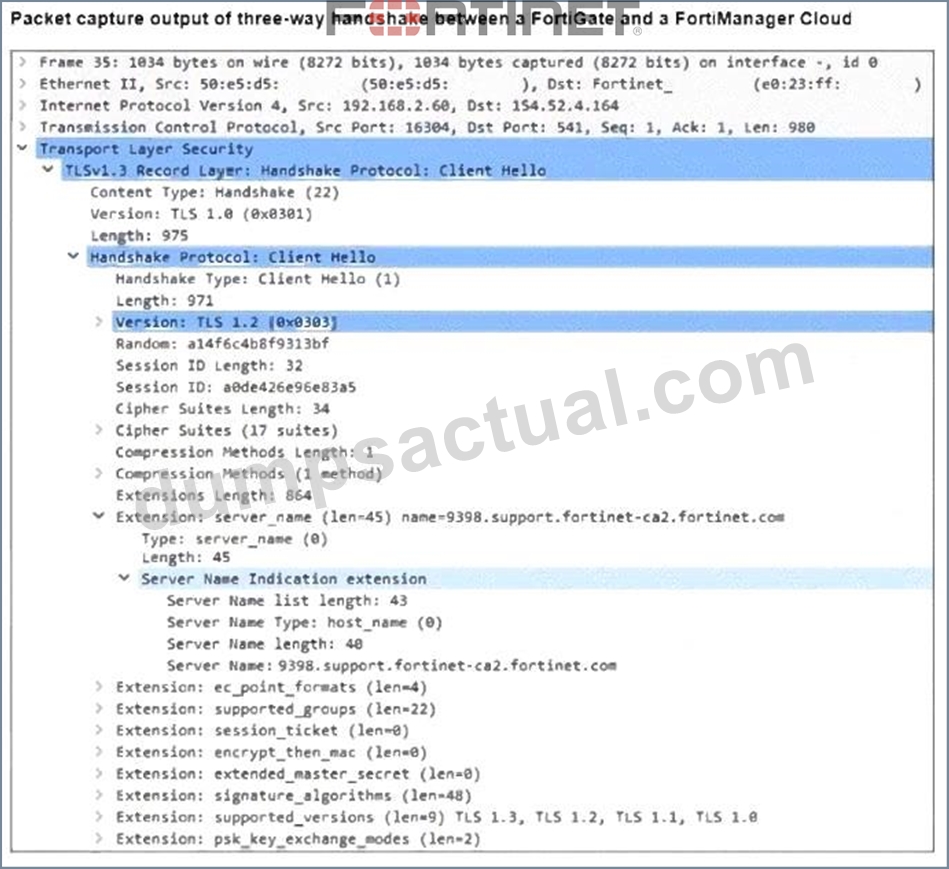
What two conclusions can you draw from the exhibit? (Choose two.)
- A. The wildcard for the domain *.fortinet-ca2.support.fortinet.com must be supported by FortiManager Cloud.
- B. If the TLS handshake contains 17 cipher suites it means the TLS version must be 1.0 on this three-way handshake.
- C. FortiGate is connecting to the same IP server and will receive an independent certificate for its connection between FortiGate and FortiManager Cloud.
- D. FortiGate will receive a certificate that supports multiple domains because FortiManager operates in a cloud computing environment.
Answer: A
Explanation:
The packet capture output displays aTLS Client Hellomessage from FortiGate to FortiManager Cloud. This message containsServer Name Indication (SNI), which is used to indicate the domain name that FortiGate is trying to connect to.
FortiGate will receive a certificate that supports multiple domains because FortiManager operates in a cloud computing environment.
# FortiManager Cloud hostsmultiple customersand domains under ashared infrastructure.
# The TLS handshake includesSNI (Server Name Indication), which allows FortiManager Cloud toserve multiple certificatesbased on the requested domain.
# This means FortiGate will likely receive amulti-domain or wildcard certificatethat can be used for multiple customers under FortiManager Cloud.
The wildcard for the domain .fortinet-ca2.support.fortinet.com must be supported by FortiManager Cloud.
# The SNI extension contains the domain9398.support.fortinet-ca2.fortinet.com.
# FortiManager Cloud must supportwildcard certificatessuch as *.fortinet-ca2.support.fortinet.com to securely manage multiple subdomains and customers.
# This ensures that FortiGate can validate the server certificate without any TLS errors.
NEW QUESTION # 15
Why does the ISDB block layers 3 and 4 of the OSI model when applying content filtering? (Choose two.)
- A. The ISDB blocks the IP addresses and ports of an application predefined by FortiGuard.
- B. FortiGate has a predefined list of all IPs and ports for specific applications downloaded from FortiGuard.
- C. The ISDB works in proxy mode, allowing the analysis of packets in layers 3 and 4 of the OSI model.
- D. The ISDB limits access by URL and domain.
Answer: A,B
Explanation:
TheInternet Service Database (ISDB)in FortiGate is used to enforce content filtering atLayer 3 (Network Layer) and Layer 4 (Transport Layer)of the OSI model by identifying applications based on their predefined IP addresses and ports.
FortiGate has a predefined list of all IPs and ports for specific applications downloaded from FortiGuard:
# FortiGate retrieves and updates apredefined listof IPs and ports for different internet services from FortiGuard.
# This allows FortiGate to block specific services atLayer 3 and Layer 4without requiring deep packet inspection.
The ISDB blocks the IP addresses and ports of an application predefined by FortiGuard:
# ISDB works by matching traffic to knownIP addresses and portsof categorized services.
# When an application or service is blocked, FortiGate prevents communication bydenying traffic based on its destination IP and port number.
NEW QUESTION # 16
A company's users on an IPsec VPN between FortiGate A and B have experienced intermittent issues since implementing VXLAN. The administrator suspects that packets exceeding the 1500-byte default MTU are causing the problems.
In which situation would adjusting the interface's maximum MTU value help resolve issues caused by protocols that add extra headers to IP packets?
- A. Adjust the MTU on interfaces only if FortiGate has the FortiGuard enterprise bundle, which allows MTU modification.
- B. Adjust the MTU on interfaces in controlled environments where all devices along the path allow MTU interface changes.
- C. Adjust the MTU on interfaces in all FortiGate devices that support the latest family of Fortinet SPUs:
NP7, CP9 and SP5. - D. Adjust the MTU on interfaces only in wired connections like PPPoE, optic fiber, and ethernet cable.
Answer: B
Explanation:
When usingIPsec VPNsandVXLAN, additional headers are added to packets, which can exceed thedefault
1500-byte MTU. This can lead tofragmentation issues, dropped packets, or degraded performance.
To resolve this, theMTU (Maximum Transmission Unit)should be adjustedonly if all devices in the network path support it. Otherwise, some devices may still drop or fragment packets, leading to continued issues.
Why adjusting MTU helps:
#VXLAN adds a 50-byte overheadto packets.
#IPsec adds additional encapsulation(ESP, GRE, etc.), increasing the packet size.
# If packets exceed the MTU, they may befragmented or dropped, causing intermittent connectivity issues.
# Lowering the MTU on interfaces ensurespackets stay within the supported size limitacross all network devices.
NEW QUESTION # 17
Which two statements about application layer test commands are true? (Choose two.)
- A. They are used to filter real-time debugs.
- B. Some of them can be used to restart an application.
- C. Some of them display statistics and configuration information about a feature or process.
- D. They display real-time application debugs.
Answer: B,C
NEW QUESTION # 18
Refer to the exhibit, which shows a partial enterprise network.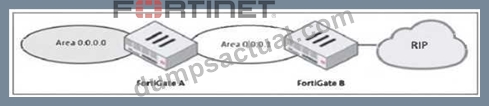
An administrator would like the area 0.0.0.0 to detect the external network.
What must the administrator configure?
- A. Configure a distribute-route-map-in on FortiGate B.
- B. Set the area 0.0.0.l type to stub on FortiGate A and B.
- C. Enable RIP redistribution on FortiGate B.
- D. Configure a virtual link between FortiGate A and B.
Answer: C
Explanation:
The diagram shows a multi-area OSPF network where:
FortiGate A is in OSPF Area 0 (Backbone area).
FortiGate B is in OSPF Area 0.0.0.1 and is connected to an RIP network.
To ensure that OSPF Area 0 (0.0.0.0) learns routes from the external RIP network, FortiGate B must redistribute RIP routes into OSPF.
Steps to achieve this:
1. Enable route redistribution on FortiGate B to inject RIP-learned routes into OSPF.
2. This allows OSPF Area 0.0.0.1 to forward RIP routes to OSPF Area 0 (0.0.0.0), making the external network visible.
NEW QUESTION # 19
What does the command set forward-domain <domain_ID> in a transparent VDOM interface do?
- A. It configures the interface to prioritize traffic based on the domain ID, enhancing quality of service for specified VLANs.
- B. It restricts the interface to managing traffic only from the specified VLAN, effectively segregating network traffic.
- C. It isolates traffic within a specific VLAN by assigning a broadcast domain to an interface based on the VLAN ID.
- D. It assigns a unique domain ID to the interface, allowing it to operate across multiple VLANs within the same VDOM.
Answer: C
Explanation:
In atransparent mode Virtual Domain (VDOM)configuration, FortiGate operates as aLayer 2 bridgerather than performing Layer 3 routing. Theset forward-domain <domain_ID>command is used to control how traffic is forwarded between interfaces within the sametransparent VDOM.
Aforward-domainacts as abroadcast domain, meaning only interfaces with thesame forward-domain ID can exchange traffic. This setting is commonly used toseparate different VLANs or network segments within the transparent VDOM while still allowing FortiGate to apply security policies.
NEW QUESTION # 20
An administrator has decreased all the TCP session timers to optimize the FortiGate memory usage.
However, after the changes, one network application started to have problems.
During the troubleshooting, the administrator noticed that the FortiGate deletes the sessions after the clients send the SYN packets, and before the arrival of the SYN/ACKs.
When the SYN/ACK packets arrive to the FortiGate, the unit has already deleted the respective sessions.
Which TCP session timer must be increased to fix this problem?
- A. TCP time wait.
- B. TCP session time to live.
- C. TCP half close.
- D. TCP half open.
Answer: D
NEW QUESTION # 21
Which of the following steps are executed to get antivirus and IPS updates using the pull method?
(Choose three.)
- A. FortiGate gets a list of server IP addresses that can be contacted.
- B. FortiGate starts sending rating queries to one of the servers in the list.
- C. FortiGate periodically queries for pending updates.
- D. FortiGate contacts DNS to resolve update.fortiguard.net.
- E. FortiGate registers its public IP address in FortiGuard.
Answer: A,C,D
NEW QUESTION # 22
Refer to exhibit, which contains the output of a BGP debug command.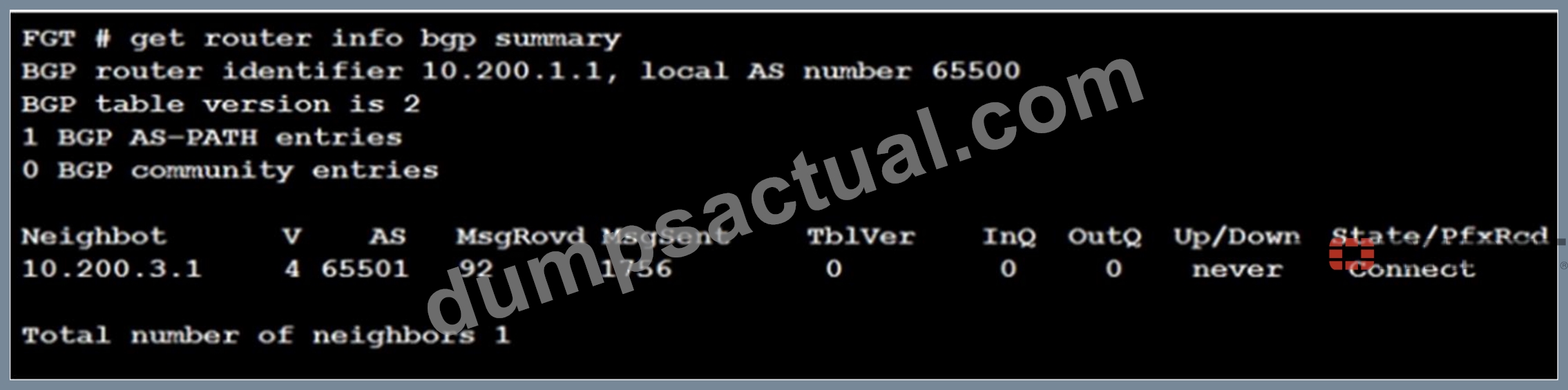
Which statement explains why the state of the 10.200.3.1 peer is Connect?
- A. The TCP session to 10.200.3.1 has not completed the three-way handshake.
- B. The local router is receiving the BGP keepalives from the peer, but it has not received a BGP prefix yet.
- C. The local router is receiving BGP keepalives from the remote peer, but the local peer has not received the OpenConfirm yet.
- D. The local router has received the BGP prefixes from the remote peer.
Answer: A
NEW QUESTION # 23
An administrator must automate a weekly backup of all the FortiGate devices in an enterprise network.
Which two steps must the administrator follow to implement this? (Choose two.)
- A. Create a script to be run in the device database.
- B. Integrate all the FortiGate devices in a Security Fabric environment.
- C. Create an automation stitch.
- D. Create metadata variables for all the FortiGate devices.
Answer: B,C
NEW QUESTION # 24
In which two states is a given session categorized as ephemeral? (Choose two.)
- A. A UDP session with only one packet received.
- B. A UDP session with packets sent and received.
- C. A TCP session waiting for FIN ACK.
- D. A TCP session waiting to complete the three-way handshake.
Answer: A,D
NEW QUESTION # 25
A FortiGate is rebooting unexpectedly without any apparent reason.
What troubleshooting tools could an administrator use to get more information about the problem?
(Choose two.)
- A. Firewall monitor.
- B. Crashlogs.
- C. Policy monitor.
- D. Logs.
Answer: B,D
NEW QUESTION # 26
Which two conditions must be met for a statistic route to be active in the routing table? (Choose two.)
- A. The link health monitor (if configured) is up.
- B. The outgoing interface is up.
- C. There is no other route, to the same destination, with a higher distance.
- D. The next-hop IP address is up.
Answer: A,B
NEW QUESTION # 27
View the exhibit, which contains the output of a debug command, then answer the question below.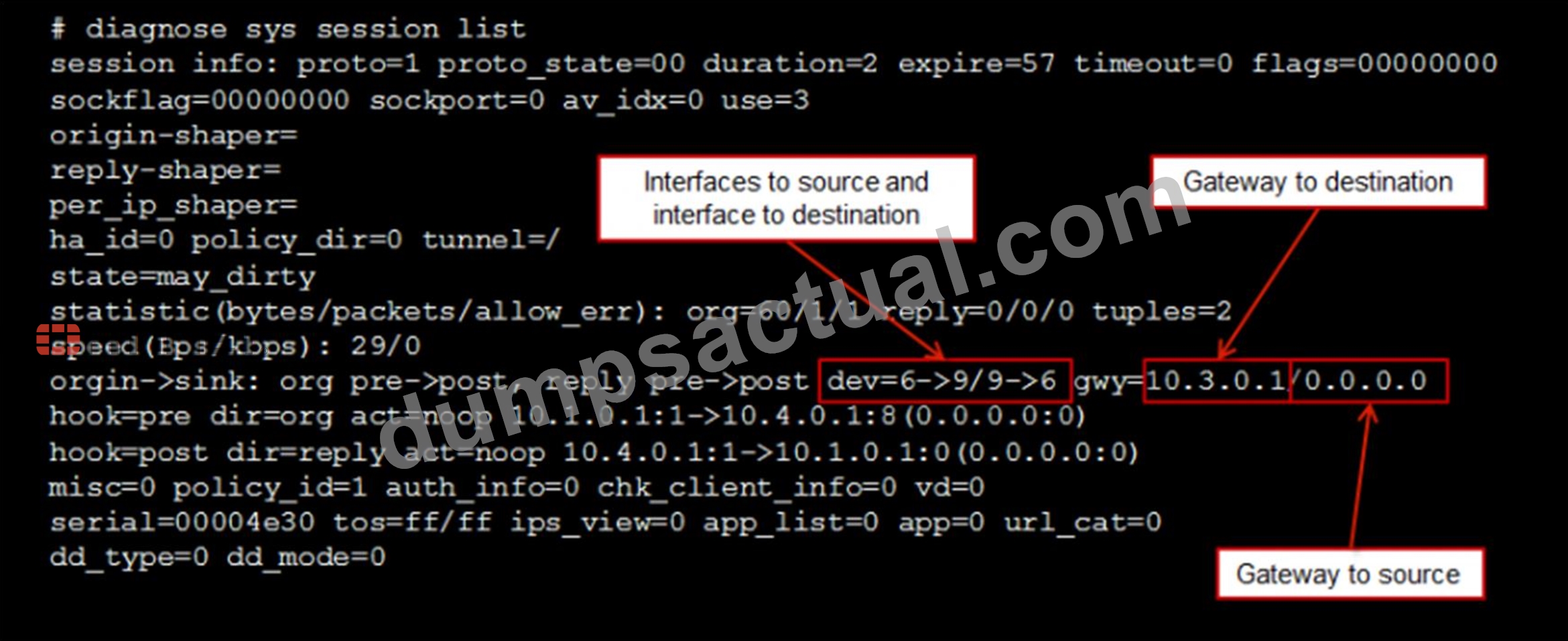
Why is the gateway to source for this session 0.0.0.0?
- A. The the source of the traffic is directly connected to the FortiGate.
- B. The traffic for this session is ICMP.
- C. The FortiGate is not doing NAT over this traffic.
- D. FortiGate has only seen the first packet sent by the originator.
Answer: D
NEW QUESTION # 28
Refer to the exhibit, which shows a hub and spokes deployment.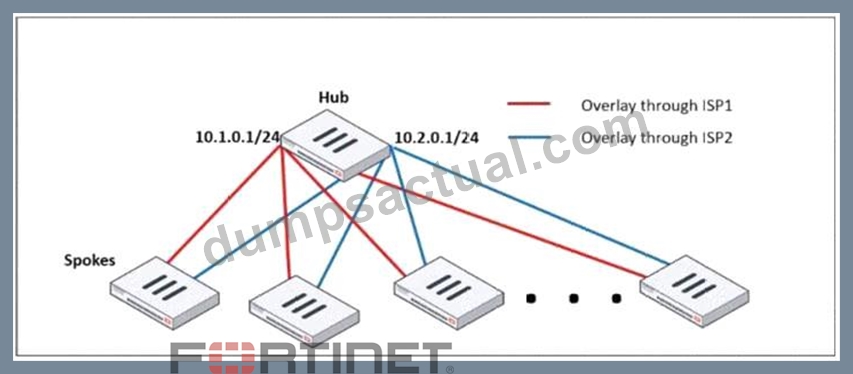
An administrator is deploying several spokes, including the BGP configuration for the spokes to connect to the hub.
Which two commands allow the administrator to minimize the configuration? (Choose two.)
- A. neighbor-range
- B. ibgp-enforce-multihop
- C. route-reflector-client
- D. neighbor-group
Answer: A,D
Explanation:
neighbor-group:
# This command is used to group multipleBGP neighborswith the same configuration, reducing redundant configuration.
# Instead of defining individual BGP settings for each spoke, the administrator can create aneighbor-group and apply the same policies, reducing manual work.
neighbor-range:
# This command allows the configuration ofa range of neighbor IPs dynamically, reducing the need to manually define each spoke neighbor.
# It automatically addsBGP neighborsthat match a given prefix, simplifying deployment.
NEW QUESTION # 29
Two independent FortiGate HA clusters are connected to the same broadcast domain. The administrator has reported that both clusters are using the same HA virtual MAC address. This creates a duplicated MAC address problem in the network.
What HA setting must be changed in one of the HA clusters to fix the problem?
- A. Session pickup.
- B. Group ID.
- C. Gratuitous ARPs.
- D. Group name.
Answer: B
NEW QUESTION # 30
Refer to the exhibit, which contains a partial VPN configuration.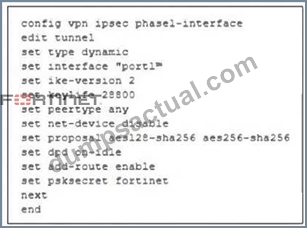
What can you conclude from this VPN IPsec phase 1 configuration?
- A. Peer IDs are unencrypted and exposed, creating a security risk.
- B. A separate interface is created for each dial-up tunnel, which can be slower and more resource intensive, especially in large networks.
- C. This configuration is the best for networks with regular traffic intervals, providing a balance between connectivity assurance and resource utilization.
- D. FortiGate will not add a route to its routing or forwarding information base when the dynamic tunnel is negotiated.
Answer: C
Explanation:
This IPsec Phase 1 configuration defines a dynamic VPN tunnel that can accept connections from multiple peers. The settings chosen here suggest a configuration optimized for networks with intermittent traffic patterns while ensuring resources are used efficiently.
Key configurations and their impact:
set type dynamic - This allows multiple peers to establish connections dynamically without needing predefined IP addresses.
set ike-version 2 - Uses IKEv2, which is more efficient and supports features like EAP authentication and reduced rekeying overhead.
set dpd on-idle - Dead Peer Detection (DPD) is triggered only when the tunnel is idle, reducing unnecessary keep-alive packets and improving resource utilization. set add-route enable FortiGate automatically adds the route to the routing table when the tunnel is established, ensuring connectivity when needed. set proposal aes128-sha256 aes256-sha256 Uses strong encryption and hashing algorithms, ensuring a secure connection.
set keylife 28800 Sets a longer key lifetime (8 hours), reducing the frequency of rekeying, which is beneficial for stable connections.
Because DPD is set to on-idle, the tunnel will not constantly send keep-alive messages but will still ensure connectivity when traffic is detected. This makes the configuration ideal for networks with regular but non-continuous traffic, balancing security and resource efficiency.
NEW QUESTION # 31
What is the diagnose test application ipsmenitor 5 command used for?
- A. To disable the IPS engine
- B. To enable IPS bypass mode
- C. To restart all IPS engines and monitors
- D. To provide information regarding IPS sessions
Answer: B
NEW QUESTION # 32
Refer to the exhibit, which shows an ADVPN network.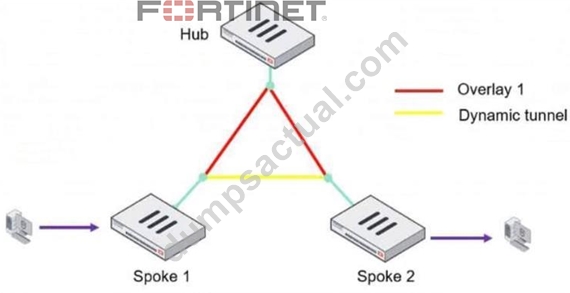
The client behind Spoke-1 generates traffic to the device located behind Spoke-2. What is the first message that the hub sends to Spoke-1 to bring up the dynamic tunnel?
- A. Shortcut offer
- B. Shortcut query
- C. Shortcut reply
- D. Shortcut forward
Answer: A
Explanation:
In an ADVPN (Auto-Discovery VPN) network, a dynamic VPN tunnel is established on-demand between spokes to optimize traffic flow and reduce latency.
Process:
1. Traffic Initiation:
A client behind Spoke-1 sends traffic to a device behind Spoke-2.
The traffic initially flows through the hub, following the pre-established overlay tunnel.
2. Hub Detection:
The hub detects that Spoke-1 is communicating with Spoke-2 and determines that a direct shortcut tunnel between the spokes can optimize the connection.
3. Shortcut Offer:
The hub sends a "Shortcut Offer" message to Spoke-1, informing it that a direct dynamic tunnel to Spoke-2 is possible.
4. Tunnel Establishment:
Spoke-1 and Spoke-2 then negotiate and establish a direct IPsec tunnel for communication.
NEW QUESTION # 33
Refer to the exhibit, which shows a partial routing table.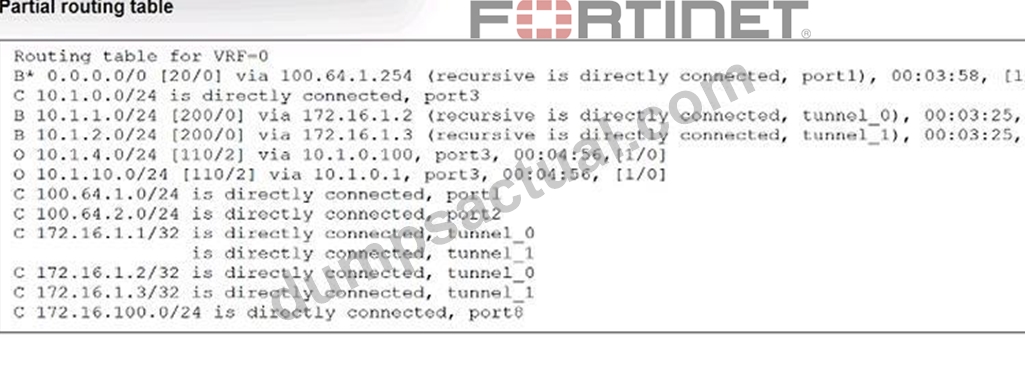
What two conclusions can you draw from the FortiGate output shown in the exhibit? (Choose two.)
- A. FortiGate is not using the destination subnets of the quick mode selectors to populate the routing table.
- B. add-route is enabled in the tunnel IPSec phase 1 configuration.
- C. FortiGate creates separate virtual interfaces for each VPN client.
- D. net-device is disabled in the tunnel IPSec phase 1 configuration.
Answer: A,D
NEW QUESTION # 34
An administrator has been assigned the task of creating a set of firewall policies which must be evaluated before any custom policies defined within the policy packages of managed FortiGate devices, across all 25 ADOMSs in FortiManager.
How should the administrator accomplish this task?
- A. Create a footer policy in the Global ADOM containing the firewall policies that must be evaluated first, and then assign this footer policy to all other ADOMs.
- B. Create a header policy in the Global ADOM containing the firewall policies that must be evaluated first, and then assign this header policy to all other ADOMs.
- C. Use a CLI script from the root ADOM on FortiManager to push these new policies to all FortiGate devices, through the FGFM tunnel.
- D. Move the FortiGate devices into a single globally scoped ADOM, and merge policy packages, inserting the new firewall policies at the top.
Answer: B
NEW QUESTION # 35
During the maintenance window, an administrator must sniff all the traffic going through a specific firewall policy, which is handled by NP6 interfaces. The output of the sniffer trace provides just a few packets.
Why is the output of sniffer trace limited?
- A. The traffic corresponding to the firewall policy is encrypted.
- B. auto-asic-off load is set to enable in the firewall policy,
- C. The option npudbg is not added in the diagnose sniff packet command.
- D. inspection-mode is set to proxy in the firewall policy.
Answer: B
NEW QUESTION # 36
Refer to the exhibit, which shows the ADVPN network topology and partial BGP configuration.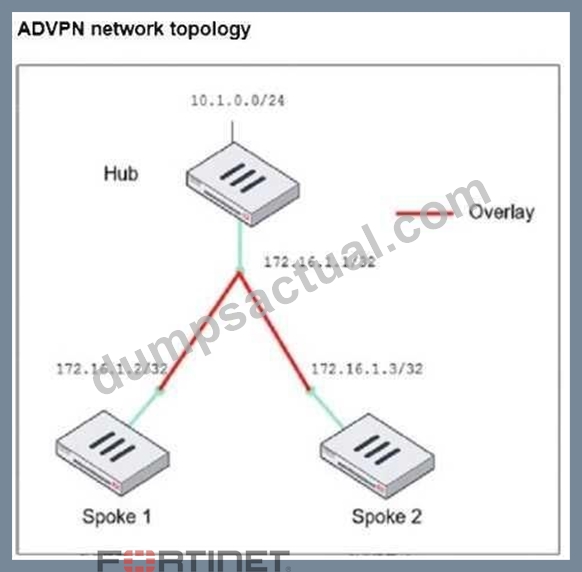

Which two parameters must an administrator configure in the config neighbor range for spokes shown in the exhibit? (Choose two.)
- A. set prefix 172.16.1.0 255.255.255.0
- B. set max-neighbor-num 2
- C. set route-reflector-client enable
- D. set neighbor-group advpn
Answer: A,D
Explanation:
In the given ADVPN (Auto-Discovery VPN) topology, BGP is being used to dynamically establish routes between spokes. The neighbor-range configuration is crucial for simplifying BGP peer setup by automatically assigning neighbors based on their IP range.
set neighbor-group advpn
The neighbor-group parameter is used to apply pre-defined settings (such as AS number) to dynamically discovered BGP neighbors.
The advpn neighbor-group is already defined in the configuration, and assigning it to the neighbor- range ensures consistent BGP settings for all spoke neighbors.
set prefix 172.16.1.0 255.255.255.0
This command allows dynamic BGP peer discovery by defining a range of potential neighbor IPs (172.16.1.1 - 172.16.1.255).
Since each spoke has a unique /32 IP within this subnet, this ensures that any spoke within the
172.16.1.0/24 range can automatically establish a BGP session with the hub.
NEW QUESTION # 37
......
Guaranteed Accomplishment with Newest Oct-2025 FREE: https://www.dumpsactual.com/FCSS_EFW_AD-7.4-actualtests-dumps.html
Authentic FCSS_EFW_AD-7.4 Dumps - Free PDF Questions to Pass: https://drive.google.com/open?id=1nGdYBhcG3eYboytua08ckJCR-ayG2oZ7
