

[Apr-2026] Pass BCS TM3 Tests Engine pdf - All Free Dumps
ISTQB Certified Tester Advanced Level - Test Management v3.0 Practice Tests 2026 | Pass TM3 with confidence!
NEW QUESTION # 27
Assume that you have calculated the following costs of quality:
Average cost of detection: €350
Average cost of internal failure: €250
Average cost of external failure: €4,500
The average costs of detection and internal failure are calculated using the number of defects found prior to release, while the average cost of external failure is calculated using the number of defects found after release.
What is the saving in cost of quality for each defect found in testing?
- A. €3,900
- B. €4,600
- C. €4,400
- D. €5,100
Answer: A
Explanation:
Comprehensive and Detailed Explanation From Exact Extract of ISTQB Certified Tester Advanced Level - Test Manager v3.0 syllabus:
The syllabus explains thecost of quality (CoQ)perspective for testing and distinguishes betweenpre-release costs(e.g., detection/appraisal andinternal failurecosts) andpost-release costs(external failurecosts). When a defect is foundduring testing, you incur detection and internal failure costs; if it escapes to production, you incur the (typically much higher) external failure cost. Thesaving per defect found in testingis calculated as:
External failure # (Detection + Internal failure)=€4,500 # (€350 + €250) = €4,500 # €600 = €3,900.
This aligns with the syllabus guidance to quantify testing's economic value by comparing avoided external failure costs with the costs of detecting and fixing defects before release (CoQ view).
NEW QUESTION # 28
Which of the following factors influences the risk impact?
- A. Maturity of the development organisation
- B. Complexity of technology being used
- C. Geographically distributed teams
- D. Frequency of use of the affected feature
Answer: D
Explanation:
Comprehensive and Detailed Explanation From Exact Extract of ISTQB Certified Tester Advanced Level - Test Manager v3.0 syllabus:
In the syllabus,risk impactconcerns thepotential damage or lossif a failure occurs (business, user, financial, legal, or reputational).Frequency of use of the affected featureincreases theexposureand thus theimpactwhen defects occur, making optionBcorrect. By contrast,complexity of technology,organizational maturity, anddistributed teamsprimarily influencelikelihood(the chance of defects entering/escaping), not the impact dimension (CTAL-TM v3.0 Syllabus, Risk-Based Testing section explaining factors oflikelihood vs.
impactand examples of each).
NEW QUESTION # 29
You are a test manager developing a master test plan. As part of the master test plan, you are defining exit criteria for the various test levels.
Which of the following exit criteria would be most appropriate and SMART for component testing, and which one would be most appropriate and SMART for system testing?
i. 95% of the tests prepared are executed successfully
ii. All test cases have been run
iii. 80% decision coverage for all tests run
iv. At least 30 defects have been found
v. At least two weeks of test execution
vi. No more open defects
- A. ii for component testing, iv for system testing
- B. iii for component testing, v for system testing
- C. v for component testing, vi for system testing
- D. iii for component testing, i for system testing
Answer: D
Explanation:
Comprehensive and Detailed Explanation From Exact Extract of ISTQB Certified Tester Advanced Level - Test Manager v3.0 syllabus:
The syllabus emphasizesSMART exit criteriatailored to the test level:
Forcomponent testing, structural coverage metrics (e.g.,decision coverage) are appropriate and measurable at code level, makingiii (80% decision coverage)suitable and SMART.
References: ISTQB CTAL-TM v3.0 Syllabus-Chapter 3 (Test Planning: defining level-appropriate and measurable entry/exit criteria; use of structural coverage for lower levels and outcome/behavior criteria for higher levels).
NEW QUESTION # 30
Which of the following is not true regarding applying a model-based approach, e.g., TMMi, for improvements at project level?
- A. The assessment should include test management processes such as test planning and test monitoring and control
- B. Practices at organisational level should be tailored appropriate to the project's context
- C. The assessment should include areas such as test policy and test organisation
- D. The assessment should include test engineering processes such as test design, test implementation and test execution
Answer: C
Explanation:
Comprehensive and Detailed Explanation From Exact Extract of ISTQB Certified Tester Advanced Level - Test Manager v3.0 syllabus:
The syllabus distinguishesorganizational-levelprocess areas (e.g.,test policy, test organization) fromproject- levelprocess areas (e.g.,test planning, monitoring/control; test design, implementation, execution) when applyingmodel-based improvementssuch as TMMi at different scopes.
Atproject level, assessments focus onproject processes and practices;test policyandtest organizationareorganizationalconcerns, not a correct inclusion for a project-level assessment.
Therefore,C is not truefor a project-level model-based improvement focus.A and Bare correct inclusions at project scope, andDis consistent with the syllabus guidance totailor organizational practices to the project context.
(References: CTAL-TM v3.0 Syllabus - Chapter 2 "Test Management in the Organization" - improvement approaches and scopes; descriptions contrasting organizational vs. project-level process areas and the use of model-based frameworks such as TMMi.)
NEW QUESTION # 31
During a test process improvement initiative, defect information is gathered to perform defect cluster analysis.
Which aspect is most likely being targeted for improvement?
- A. To reduce the total number of defects.
- B. To improve the defect removal efficiency.
- C. To minimise the costs associated with defects.
- D. To better understand risk and focus testing, as part of risk-based testing.
Answer: D
Explanation:
Comprehensive and Detailed Explanation From Exact Extract of ISTQB Certified Tester Advanced Level - Test Manager v3.0 syllabus:
Defect clustering (e.g., Pareto-style concentration of defects in certain components) is used to informrisk- based testingso that testing can beprioritized and focused on the riskiest areasof the product. In the CTAL-TM v3 syllabus, the test manager uses defect data and trends toprioritize test effort, allocate test depth/techniques where risk is higher, and provide traceable justification in planning and control (Chapter 4: Risk-Based Testing and effort allocation; Chapter 3: Test Planning - using historical/defect data to shape the approach and focus).
NEW QUESTION # 32
Your company is considering purchasing a test tool suite from a respectable vendor. Your manager has searched the internet for comparable products, but none of them meet his specific requirements. A tool demonstration has been arranged for next week and your team has been invited to attend. The tool suite consists of a test management tool, test execution tool, and a requirements management tool. There is a possibility of adding a performance testing tool at a later stage.
You have decided to attend the demo but raise some issues beforehand regarding expectations.
Which two issues from the options provided below should at least be raised?
- A. What are the problems we are trying to address?
- B. Do we have a set of tool requirements to validate the tool against?
- C. Which project will be selected to perform the tool pilot?
- D. Is customized training available?
- E. How will the implementation be organised?
Answer: A,B
Explanation:
Comprehensive and Detailed Explanation From Exact Extract of ISTQB Certified Tester Advanced Level - Test Manager v3.0 syllabus:
The syllabus reminds test managers thattool introduction must be problem-drivenandrequirements-based.
Before (or alongside) demos, teams should clarify:
Athebusiness/testing problemsand improvement goals the tool is meant to address (e.g., traceability, automation scale, reporting).
Baclear set of tool requirements/selection criteriato objectivelyassess the toolduring a demo or evaluation.
These two are theminimum critical questionsto ground any evaluation. WhileC,D, andEare important for later stages (rollout planning, piloting, and training), ISTQB stresses thatsuccessful adoption starts with defined needs and evaluation criteria, ensuring the demo and subsequent selection are aligned to real objectives.
Relevant syllabus areas:Test Tool and Automation-Tool selection and introduction(identify problems
/opportunities, define requirements and success criteria, evaluate, then plan pilot/rollout/training).
NEW QUESTION # 33
Ability to act with confidence is an important skill for a person to perform successfully in a project or team.
To which area of competence does "ability to act with confidence" belong?
- A. Social competence
- B. Methodological competence
- C. Professional competence
- D. Personal competence
Answer: D
Explanation:
Comprehensive and Detailed Explanation From Exact Extract of ISTQB Certified Tester Advanced Level - Test Manager v3.0 syllabus:
InPeople Skills - Team Composition, the syllabus distinguishes four competence areas.Personal competencecovers attributes such asself-confidence,resilience, self-management, and ownership-traits related to how an individual conducts themselves. "Ability to act with confidence" is therefore categorized underpersonal competence, not methodological (techniques), professional (domain/technical knowledge), or social (interaction with others).
(ISTQB CTAL-TM v3.0 - Chapter "People Skills - Team Composition": competence categories and examples; self-confidence falls underpersonal competence.)
NEW QUESTION # 34
You are the only tester in an Agile team. The test policy states that only defects that need to be solved outside the team are documented. You are receiving complaints from developers from other teams that they do not receive sufficient defect information to be able to efficiently and effectively solve the defects. You have used the ISO 29119 standard to identify which attributes could be added to the current defect report template.
Which two of the following options would be best to add to the current defect report template to solve the current issue?
- A. The name of the tester that found the defect
- B. Configuration in which the defect was found
- C. How to reproduce the defect
- D. Severity of the defect
- E. Test level where the defect was found
Answer: B,C
Explanation:
Comprehensive and Detailed Explanation From Exact Extract of ISTQB Certified Tester Advanced Level - Test Manager v3.0 syllabus:
In theTesting Process(defect management and reporting), the syllabus emphasizes that defect reports must containsufficient information to allow effective reproduction and diagnosisand that they should includeenvironment/configuration detailsrelevant to reproducing the failure and isolating the underlying defect. Concretely, the syllabus highlights information such assteps to reproduce,observed and expected results, andtest environment/configurationas essential elements to enable teams (especially external teams) to analyze and fix defects efficiently. Therefore, addingHow to reproduce the defect (B)and theConfiguration in which the defect was found (E)most directly addresses the complaint of insufficient information for external developers.
(ISTQB CTAL-TM v3.0 - Chapter "Testing Process": defect reporting content and quality; importance of reproducibility and environment details in defect reports.)
NEW QUESTION # 35
You are currently leading an independent test team. Based on the information given in the scenario, identify how the team could be improved most effectively.
- A. By providing a workshop on test design techniques
- B. By providing specific training on the systems being tested
- C. By providing training in the payroll domain
- D. By providing training on reviewing requirements
Answer: C
Explanation:
Comprehensive and Detailed Explanation From Exact Extract of ISTQB Certified Tester Advanced Level - Test Manager v3.0 syllabus:
According to theISTQB Certified Tester Advanced Level - Test Manager v3.0 Syllabus (Chapter 7: People Skills - Team Composition), team performance can be significantly improved by ensuring that testers possess an appropriate mix ofdomain knowledge,technical skills, andinterpersonal skills.
"An effective test team requires a balance between technical knowledge, testing skills, and knowledge of the business domain." (ISTQB CTAL-TM v3.0 Syllabus, Chapter 7 - People Skills, Section: Test Team Dynamics and Skill Development) When a team lacks understanding of thebusiness domain, such as payroll in this scenario, they may:
Struggle to interpret requirements or identify key risk areas.
Miss critical business logic defects.
Design test cases that fail to cover realistic user workflows.
Therefore, the most effective improvement would betraining in the payroll domain- strengthening theirdomain expertiseto enhance test design quality, communication with stakeholders, and defect detection effectiveness.
Why the Other Options Are Incorrect:
B). Workshop on test design techniques- Enhances technical testing skill but does not address lack of domain understanding.
C). Specific training on the systems being tested- Improves system familiarity but still lacks insight into business rules and domain-driven testing.
D). Training on reviewing requirements- Improves requirement analysis, but without domain knowledge, reviewers cannot effectively validate correctness or completeness.
References (from ISTQB Certified Tester Advanced Level - Test Manager v3.0 Syllabus):
Chapter 7:People Skills - Team Composition
Section:Test Team Dynamics and Skill Development
States thatdomain knowledge trainingis critical for tester effectiveness.
Emphasizes the need for balance amongtechnical, testing, and business knowledge.
NEW QUESTION # 36
Which of the following activities in the test process is considered to deliver a document which can be used as a major input for test process improvement?
- A. Test Completion
- B. Test Planning
- C. Test Execution
- D. Test Monitoring
Answer: A
Explanation:
Comprehensive and Detailed Explanation From Exact Extract of ISTQB Certified Tester Advanced Level - Test Manager v3.0 syllabus:
In the ISTQB CTAL-TM v3.0 syllabus (Chapter:Testing Process, section onTest Completion), the Test Completion activity includes producing thetest summary report, capturinglessons learned, and finalizing
/archiving testware. Thetest summary report and lessons learned are specifically identified as key inputs to test process improvement, enabling organizations to refine their approach, improve efficiency, and address gaps revealed during the test effort. This makesTest Completionthe activity that delivers the document(s) most directly used for ongoingtest process improvement.
(Reference: CTAL-TM v3.0 Syllabus - Chapter "Testing Process", subsection "Test Completion":
responsibilities include creating the test summary report, collecting lessons learned, and providing input to process improvement.)
NEW QUESTION # 37
You are a tester working in an Agile team for the tax office. Developers on the team have been trained and are experienced in component testing, including various types of code coverage and reviews. The test policy has a clear statement that shift-left is a main focus in trying to achieve software quality. The team is currently developing a new version of the critical income tax application.
Which test activities would you propose to mitigate the risks for the most critical features in the new version of the income tax application?
- A. Introduce formal test design techniques, e.g., decision tables and equivalence partitioning, during system testing
- B. Introduce IEC 61508 as a standard to follow, prescribing the test techniques and required level of coverage
- C. Define strict entry and exit criteria between the various test levels
- D. Introduce code reviews and statement coverage criteria
Answer: A
Explanation:
Comprehensive and Detailed Explanation From Exact Extract of ISTQB Certified Tester Advanced Level - Test Manager v3.0 syllabus:
The syllabus emphasizes applyingappropriate test design techniquesbased onriskandtest level. In an Agile, shift-left context where developers already performcomponent testingwithcoverage and reviews, the incremental risk mitigation forcritical business featuresatsystem levelcomes from applyingsystem-appropriate formal test design techniques(e.g.,equivalence partitioning, boundary value analysis, decision tables) to ensure thorough functional coverage of critical logic and business rules.
Option A (strict entry/exit criteria) is a control mechanism but does not directly enhance thoroughness for critical features.
Option B (IEC 61508) is asafetystandard not appropriate for a tax application and would be disproportionate.
Reference: ISTQB CTAL-TM v3.0 Syllabus, Chapter 3 (Test Planning, Monitoring, and Control) on selectingtest design techniquesby level and risk; Chapter 4 (Risk-Based Testing) on focusingadditional test design rigoronhigh-riskfeatures; Agile testing alignment in the syllabus sections that highlightshift-leftand tailoring practices per level.
NEW QUESTION # 38
Study the following characteristics:
Avoid re-inventing the wheel
Pool on experiences from earlier projects
They prompt thought in areas that are sometimes forgotten
Often used when compliance to specific standards is relevant
To which risk identification technique do these characteristics relate?
- A. Retrospectives
- B. Brainstorming
- C. Checklists
- D. Risk Workshops
Answer: C
Explanation:
Comprehensive and Detailed Explanation From Exact Extract of ISTQB Certified Tester Advanced Level - Test Manager v3.0 syllabus:
In the CTAL-TM v3.0 syllabus (Chapter on Risk-Based Testing), checklists are described as a reusable aid for identifying risks based on prior knowledge and experience. They help ensure important areas are not overlooked and are frequently used in contexts where compliance with standards is required. These characteristics match the question's bullets exactly (re-use/experience, prompting memory of commonly missed areas, and standards alignment).
Reference: ISTQB CTAL-TM v3.0 Syllabus, Chapter 4 (Risk-Based Testing) - section describingrisk identification techniquesincludingchecklists(purpose, reuse of prior experience, prompting thorough coverage, applicability for standards/compliance).
NEW QUESTION # 39
You have recently been employed as a test manager for a software company producing Human Resource (HR) systems... You have been asked to write a test strategy for the project and have chosen to implement a flexible and change-relatedreactive test strategy.
Which of the following would be an essential part of your test approach?
- A. Using defect-based attacks and exploratory testing
- B. Performing a detailed product risk analysis
- C. Using decision table testing, equivalence partitioning and boundary value analysis
- D. Implementing ISO/IEC 29119 as a testing framework
Answer: A
Explanation:
Comprehensive and Detailed Explanation From Exact Extract of ISTQB Certified Tester Advanced Level - Test Manager v3.0 syllabus:
In areactive(change-driven) test strategy-appropriate when requirements are evolving and flexibility is essential-the syllabus highlightsexploratory testinganddefect/experience-based techniques (defect-based attacks)as key elements because they adapt rapidly to change and emerging information.
A(product risk analysis) is central torisk-based/analyticalstrategies.
B(standard-compliant framework) aligns withstandard/process-compliantstrategies.
References: ISTQB CTAL-TM v3.0 Syllabus-Chapter 4 (Approaches for test prioritization and effort allocation: strategy/approach types including reactive strategies; emphasis on exploratory and defect-based approaches under change-driven contexts).
NEW QUESTION # 40
Test control uses the information from test monitoring to provide guidance and take corrective action when required.
Which of the following is not a possible test control action?
- A. Adjusting the test schedule
- B. Checking the fulfilment of the exit criteria
- C. Adding new resources
- D. Re-prioritisation of test cases
Answer: B
Explanation:
Comprehensive and Detailed Explanation From Exact Extract of ISTQB Certified Tester Advanced Level - Test Manager v3.0 syllabus:
The syllabus distinguishestest monitoring(collecting/assessing status information, e.g., progress vs plan, exit criteria status) fromtest control(takingcorrective actionsbased on monitoring).Control actionsincludere- prioritising tests,adjusting schedules, andadding resourcesto address variances and risks.Checking the fulfilment of exit criteriaismonitoringactivity (status assessment), not a control action.
(Reference: CTAL-TM v3.0 -Test Planning, Monitoring, and Control: differences between monitoring (status, metrics, exit criteria checks) and control (reprioritisation, rescheduling, resource adjustments, scope changes).)
NEW QUESTION # 41
To which category of cost of quality does "fixing a defect found during testing" belong?
- A. External failure costs
- B. Internal failure costs
- C. Defect prevention costs
- D. Appraisal costs
Answer: B
Explanation:
Comprehensive and Detailed Explanation From Exact Extract of ISTQB Certified Tester Advanced Level - Test Manager v3.0 syllabus:
The syllabus differentiatescost of qualityinto:
Prevention(to avoid defects),
Appraisal(to evaluate products, e.g., reviews, testing),
Internal failure(defectsfound before release, including the cost to fix during testing), and External failure(defects foundafter release)."Fixing a defect found during testing" is aninternal failure cost, because the failure is detected and corrected prior to delivery (CTAL-TM v3.0, Organizational Test Management - economics of testing and cost of quality categories).
NEW QUESTION # 42
The diagram below shows an incomplete defect management process, where three states (states X, Y and Z) have yet to be named appropriately.
Which of the following labels would correctly complete the process?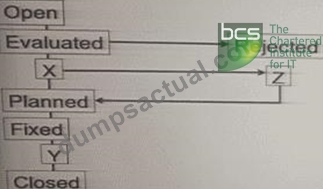
- A. X: Accepted, Y: Tested, Z: Deferred.
- B. X: Approved, Y: Reviewed, Z: Deferred.
- C. X: In Progress, Y: Verified, Z: Terminated.
- D. X: Accepted, Y: Reviewed, Z: Duplicate.
Answer: A
Explanation:
According to theISTQB Certified Tester Advanced Level - Test Manager v3.0 syllabus (Chapter 2: Test Management in the Organization), thedefect management processdefines how defects are handled from discovery to closure, ensuring traceability and communication between testing and development.
"The defect management process defines the states a defect may have during its lifetime, including identification, evaluation, correction, re-testing (confirmation testing), and closure." (ISTQB CTAL-TM v3.0 Syllabus, Chapter 2 - Defect Management Process) In the standard ISTQB defect workflow:
Afterevaluation, a defect can either be:
Rejected(e.g., not a defect, duplicate, or out of scope), or
Accepted(X) - meaning it is confirmed as a valid defect and will be corrected.
Once accepted, the defect isplannedfor correction andfixedby development.
After being fixed, it must betested (Y)- also referred to asconfirmation testingorretesting.
Some evaluated defects may bedeferred (Z)- postponed for future releases.
Thus, the correct states are:
X = Accepted(defect confirmed as valid and correction planned)
Y = Tested(confirmation testing after the fix)
Z = Deferred(postponed correction)
This sequence aligns directly with the ISTQB-defineddefect management lifecycle, which includes transitions betweenopen,evaluated,accepted (planned/fixed/tested), andclosed, as well as possiblerejectedordeferredbranches.
References (from ISTQB Certified Tester Advanced Level - Test Manager v3.0 Syllabus):
Chapter 2: Test Management in the Organization
Section:Defect Management Process
Describes thedefect states, includingopen, evaluated, accepted, planned, fixed, tested (retested), closed, and alternate states such asrejectedordeferred.
NEW QUESTION # 43
Management is sceptical regarding the budget request (€25,000) for the next testing project. You are asked for a cost-benefit calculation. Based on historical data from several projects, you have come up with the following numbers:
Average prevention cost per defect: €200
Average cost of detection per defect: €400
Average cost of internal failure: €150
Average cost of external failure: €2,500
Expected number of defects to be found in this project during testing: 50 What is the result for the expected cost-benefit calculation for the upcoming project?
- A. €87,500
- B. €92,500
- C. €62,500
- D. €72,500
Answer: A
Explanation:
Comprehensive and Detailed Explanation From Exact Extract of ISTQB Certified Tester Advanced Level - Test Manager v3.0 syllabus:
Per the syllabus, when building abusiness caseusing thecost of qualitymodel, compare theavoided external failure costswith thesum of relevant pre-release costs(prevention, detection/appraisal, and internal failure). For
50 expected defects found in testing:
Avoided external failure cost= 50 × €2,500 =€125,000
Pre-release costsper defect = €200 (prevention) + €400 (detection) + €150 (internal failure) =€750 Total pre-release costs= 50 × €750 =€37,500 Net benefit (cost-benefit)= €125,000 # €37,500 =€87,500 This computation follows the syllabus' guidance to quantify bothcosts(prevention, detection, internal failure) andbenefits(external failures avoided) to demonstrate the economic value of testing.
NEW QUESTION # 44
Assume you are a test manager of a project that develops software in the medical domain. You are responsible for analysing the organisational test strategy and the project context to choose the appropriate test approach.
You consider the following factors:
Detailed requirements of high quality are available
Parts of the software to be developed are expected to be safety critical Internal audits and an external audit by a government agency are expected to take place, as such traceability and evidence are important elements for the test approach A release date has been defined, and a marketing campaign has already been scheduled The project works according to the sequential V-model lifecycle The independent test team has a lot of domain knowledge but has also been trained and has experience in using test design techniques Which of the following test approaches would be most appropriate for this project?
- A. Risk-based testing to identify the most critical features and use a methodical approach to testing, e.g., more formal test design techniques to drive testing and ensure traceability
- B. Define acceptance criteria for each of the requirements and implement definition-of-done criteria to drive testing
- C. Experience-based testing, e.g., exploratory testing, to make maximum use of the domain knowledge of the testers
- D. Use Acceptance Test-Driven Development (ATDD) as a way to implement shift-left, and use test automation in addition to enhance product quality
Answer: A
Explanation:
Comprehensive and Detailed Explanation From Exact Extract of ISTQB Certified Tester Advanced Level - Test Manager v3.0 syllabus:
In regulated, safety-critical domains with audits and strong traceability requirements, the syllabus emphasizes defining amethodical, documented test approachwithin test planning, includingselection of formal test design techniquesandrisk-based testingto focus effort on the most critical features. These elements are explicitly tied toV-modelcontexts, where traceability from requirements through test conditions and cases is expected, and evidence is essential for internal and external audits (CTAL-TM v3.0 Syllabus - Chapter 3, Test Planning; and Chapter 4, Risk-Based Testing and effort allocation).
Option B aligns with these needs: applyingrisk-based testingto prioritize safety-critical functions and usingformal techniquesto producetraceable, auditabletest assets.
Options A and D are practices typically associated with agile/ATDD and "definition of done," which do not best fit asequential V-modelcontext. Option C (experience-based) may complement but isinsufficientas the primary approach wheretraceability and auditabilityare key.
(References: CTAL-TM v3.0 Syllabus - Chapter 3 "Test Planning, Monitoring, and Control" - defining the test approach and selecting test design techniques; Chapter 4 "Risk-Based Testing and Other Approaches for Test Prioritization and Effort Allocation" - prioritizing safety-critical areas; material on traceability/audit expectations in regulated contexts.)
NEW QUESTION # 45
Following up on the situation, the team lacks drive and is performing tasks too slowly. You have been asked to recruit an extra person into the team. Which of the following team roles would be most appropriate to enhance the team?
- A. A test process improvement consultant
- B. A person with the ability to complete tasks
- C. A person who brings new ideas to the team
- D. A person with in-depth technical skills
Answer: B
Explanation:
Comprehensive and Detailed Explanation From Exact Extract of ISTQB Certified Tester Advanced Level - Test Manager v3.0 syllabus:
According to theISTQB Certified Tester Advanced Level - Test Manager v3.0 Syllabus (Chapter 7: People Skills - Team Composition), theBelbin team role modelis referenced to describe how a balanced team benefits from diverse behavioral roles.
"A team should consist of people who complement each other's strengths and weaknesses. When the team lacks drive or the ability to meet deadlines, a role such as the Implementer or Completer-Finisher may be needed to ensure that work is completed efficiently and on time." (ISTQB CTAL-TM v3.0 Syllabus, Chapter 7 - People Skills, Section: Building and Leading Test Teams) When a test teamlacks driveand isslow in completing tasks, this indicates the absence oftask-oriented rolesthat emphasize execution and delivery. The Belbin roles that suit this gap include:
Implementer (Practical Organizer)- disciplined, reliable, and efficient in turning ideas into actions.
Completer-Finisher (Detail-Oriented Finisher)- conscientious and ensures that work is completed to the required standard.
Recruiting a person with astrong ability to complete tasksbest addresses this deficiency and directly improves the team's delivery performance.
Why the Other Options Are Incorrect:
B). A test process improvement consultant- Focuses on optimizing processes, not motivating daily execution or speeding up delivery.
C). A person with in-depth technical skills- Adds expertise but does not necessarily address the lack of drive or task completion discipline.
D). A person who brings new ideas to the team- Reflects a creative or "Plant" role, valuable for innovation but not for improving execution speed or focus.
References (from ISTQB Certified Tester Advanced Level - Test Manager v3.0 Syllabus):
Chapter 7:People Skills - Team Composition
Section:Test Team Dynamics and the Belbin Team Roles
States that"the Test Manager should identify and balance behavioral roles within the team to ensure effectiveness, for example, introducing task-oriented members when delivery speed is lacking."
NEW QUESTION # 46
The stakeholders matrix is a strategic tool to be used by test managers and is composed of four quadrants.
Which quadrant is described by the following statements?
Typically do not have a strong interest in day-to-day tasks
Their decisions are critical for resource allocation and high-level project direction
- A. Latents
- B. Apathetics
- C. Defenders
- D. Promoters
Answer: A
Explanation:
Comprehensive and Detailed Explanation From Exact Extract of ISTQB Certified Tester Advanced Level - Test Manager v3.0 syllabus:
In the stakeholder power-interest matrix used by test managers, stakeholders withhigh power but low interestare categorized asLatents. They generally "do not have a strong interest in day-to-day tasks," yet theirdecisions are critical for resources and strategic direction. Promoters are high power/high interest; Defenders are low power/high interest; Apathetics are low power/low interest. This mapping guides how test managers engage and communicate with each stakeholder group (CTAL-TM v3.0 Syllabus, chapter on organizational aspects of test management and stakeholder engagement).
NEW QUESTION # 47
You are a test manager managing a test team and working at a government agency. The test team is responsible for performing the system test. Senior management has been provided with the following test objective for a new project:
"The system should be of high quality."
Using the SMART goal methodology, which of the following statements would be appropriate as a revision to the defined test objective by management?
- A. All defined requirements shall be implemented and function without problems
- B. At least three weeks of system testing shall be performed and no major defects will be outstanding before going live
- C. During component testing a statement coverage of 90% shall be achieved
- D. The number of user issues reported in the first 3 months after going live shall be less than an average of
1 per week
Answer: D
Explanation:
Comprehensive and Detailed Explanation From Exact Extract of ISTQB Certified Tester Advanced Level - Test Manager v3.0 syllabus:
The syllabus requires that test objectives beSMART:Specific, Measurable, Achievable, Relevant, and Time- bound. OptionCis specific ("user issues"), measurable ("< 1 per week"), achievable (depending on context), relevant to system quality in production, and time-bound ("first 3 months after going live").
Ais not measurable ("...without problems" is vague).
Bis partially SMART but uses ambiguous terms ("major defects") and focuses on elapsed time rather than quality outcomes.
References: ISTQB CTAL-TM v3.0 Syllabus-Chapter 3 (Test Planning: defining measurable test objectives and SMART criteria; aligning objectives to levels and stakeholders).
NEW QUESTION # 48
......
BCS TM3 Exam Syllabus Topics:
| Topic | Details |
|---|---|
| Topic 1 |
|
| Topic 2 |
|
| Topic 3 |
|
Get instant access to TM3 practice exam questions: https://drive.google.com/open?id=1Tm6NfJI8JuK-quOTQt4kbvyUYsvu28P9
Online Exam Practice Tests with detailed explanations!: https://www.dumpsactual.com/TM3-actualtests-dumps.html
