

[Jul-2025] Juniper JN0-280 Exam Practice Test Questions - DumpsActual
Updated Certification Exam JN0-280 Dumps - Practice Test Questions
To pass the JN0-280 exam, candidates must have a solid understanding of the data center components, their functions, and how they interoperate. They must also be familiar with the configuration, management, and troubleshooting of Juniper Networks data center products, including switches, routers, firewalls, and security devices.
Juniper JN0-280 Data Center, Associate (JNCIA-DC) Exam is suitable for candidates who wish to advance their career in the networking field. JN0-280 exam is designed to test the candidate's knowledge of Juniper Networks' switching and routing technology as well as their skills in configuring and managing datacenter devices. Successful completion of JN0-280 exam leads to obtaining the JNCIA-DC certification, which validates a candidate's skills and knowledge in data center switching and routing.
NEW QUESTION # 50
In the context of Link Aggregation Groups (LAG), what is the primary purpose of LACP?
- A. To reduce the speed of data transfer
- B. To provide a method for encrypting data packets
- C. To dynamically manage the bundling of several physical ports
- D. To increase the error rate in data transmission
Answer: C
NEW QUESTION # 51
In the context of data center networking, what is the primary purpose of an Underlay Network?
- A. To handle external network connections exclusively.
- B. To provide a physical infrastructure for an Overlay Network.
- C. To encrypt data traffic between servers.
- D. To facilitate virtual machine migrations.
Answer: B
NEW QUESTION # 52
Fill in the blank: In BGP, the ___________ attribute is used to influence the best path selection process.
- A. AS_PATH
- B. Community
- C. Local Preference
- D. MED (Metric or Multi-Exit Discriminator)
Answer: D
NEW QUESTION # 53
Which of the following are correct about OSPF router ID selection? (Choose two)
- A. It can be manually configured.
- B. It is selected based on the lowest MAC address.
- C. It is chosen based on the highest IP address of any active interface by default.
- D. It is always the IP address of the loopback interface.
Answer: A,C
NEW QUESTION # 54
In configuring load balancing on a network router, which aspect is most crucial?
- A. The use of aggregate routes
- B. The number of routing tables
- C. The selection of multiple equal-cost paths
- D. The encryption protocol used
Answer: C
NEW QUESTION # 55
Referring to the exhibit, which two statements are correct about the IP fabric? (Choose two.)
- A. This is a five-stage fabric.
- B. This is a three-stage IP fabric.
- C. All traffic must traverse the super spine devices.
- D. Only traffic between pods must traverse the super spine devices.
Answer: A,D
NEW QUESTION # 56
In OSPF, what is the function of the Link-State Database (LSDB)?
- A. To log changes in network topology.
- B. To keep the topology structure of the network.
- C. To maintain a list of OSPF neighbors.
- D. To store OSPF routing tables.
Answer: B
NEW QUESTION # 57
Which OSPF router type connects an OSPF area to non-OSPF networks?
- A. Backbone Router
- B. Internal Router
- C. Autonomous System Boundary Router (ASBR)
- D. Area Border Router (ABR)
Answer: C
NEW QUESTION # 58
Referring to the exhibit, what needs to be done to make this a valid IP fabric?
- A. Remove one of the redundant links between a leaf node and a spine node
- B. Add two connections between the spine nodes
- C. Add a connection between the spine nodes
- D. Remove the connection between the leaf nodes
Answer: D
NEW QUESTION # 59
When configuring static routes, which command is typically used?
- A. set firewall filter
- B. set route aggregate
- C. set protocols static route
- D. set routing-options rib-groups
Answer: C
NEW QUESTION # 60
What is the definition of a trunk interface on a switch?
- A. An interface that carries excess traffic.
- B. An interface that carries multiple VLANs.
- C. An interface that carries high bandwidth.
- D. An interface that connects directly to powerful servers.
Answer: B
Explanation:
A trunk interface on a switch is used to carry traffic for multiple VLANs between switches or between a switch and another network device, like a router. Trunk interfaces use 802.1Q tagging to identify which VLAN the traffic belongs to.
Step-by-Step Breakdown:
Trunk Ports:
Trunk ports are typically used for inter-switch links or switch-to-router links where multiple VLANs need to be carried over the same physical connection.
VLAN traffic is tagged with a VLAN ID to ensure that it is properly identified as it crosses the trunk link.
802.1Q VLAN Tagging:
Trunk ports use 802.1Q to tag Ethernet frames with the VLAN ID. This ensures that frames are correctly forwarded to the appropriate VLANs on the other side of the trunk.
Juniper Reference:
Trunk Interface Configuration: In Juniper switches, trunk ports are configured to carry tagged traffic for multiple VLANs, which is essential for interconnecting multiple network segments.
NEW QUESTION # 61
Which statement is correct about the OSPF link-state database?
- A. Each router within the OSPF domain must maintain an identical copy of the link-state database.
- B. Each router within the OSPF domain must maintain a unique copy of the link-state database.
- C. Each router within the same area must maintain an identical copy of the link-state database.
- D. Each router within the same area must maintain a unique copy of the link-state database.
Answer: C
NEW QUESTION # 62
What does VXLAN stand for in the context of EVPN/VXLAN?
- A. Virtualized Ethernet VPN
- B. Virtual X-Series LAN
- C. Very Extended Virtual LAN
- D. Virtual Extensible VLAN
Answer: D
NEW QUESTION # 63
What are two common reasons for BGP routes to be in the hidden state? (Choose two.)
- A. Routes are being rejected by a policy
- B. The BGP neighbor is in a different autonomous system
- C. Routes are being filtered from the inet.2 routing table
- D. The next hop is unresolvable
Answer: A,D
NEW QUESTION # 64
When configuring BGP, which command is commonly used to define a BGP neighbor?
- A. bgp set neighbor
- B. add bgp connection
- C. neighbor <IP_ADDRESS> remote-as <AS_NUMBER>
- D. set bgp peer
Answer: C
NEW QUESTION # 65
Which statement is correct about areas in OSPF?
- A. OSPF areas are used to isolate the effects of a broadcast storm.
- B. OSPF areas are used to reduce the size of the link-state database.
- C. An OSPF area is used to segment Layer 2 broadcast domains.
- D. An OSPF area is used to signify the autonomous system to which each device belongs.
Answer: B
Explanation:
InOSPF (Open Shortest Path First), areas are used to segment a network into smaller, more manageable pieces to improve scalability. By dividing a network into areas, OSPF can reduce the size of thelink-state database (LSDB), which helps routers process updates more efficiently.
Step-by-Step Breakdown:
* Purpose of OSPF Areas:OSPF areas allow for hierarchical routing within the OSPF domain. Routers in the same area have identical LSDBs, but routers in different areas do not exchange full link-state information. Instead, they exchange summarized routes, which reduces the LSDB size and CPU
/memory usage.
* Benefits:Reducing the LSDB size improves scalability and ensures faster convergence in larger networks. Area 0 is the backbone area, and all other areas must connect to it, forming a hierarchical structure.
Juniper Reference:
* OSPF Configuration: Areas in OSPF are configured to optimize network performance by limiting the scope of link-state advertisements (LSAs) to within an area.
NEW QUESTION # 66
Exhibit: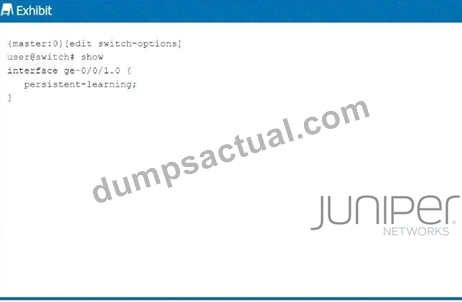
Referring to the exhibit, which behavior does this configuration enable on the ge-0/0/1.0 interface?
- A. This configuration enables a MAC address learned on the interface to be persistently retained in the Ethernet-switching table, even after a reboot.
- B. This configuration enables the device to place a MAC address that persistently causes network errors into a special protected VLAN.
- C. This configuration enables the interface to learn and remember MAC addresses, until the device is rebooted.
- D. This configuration enables the device to shut down the interface when a particular MAC address persistently sends broadcast traffic.
Answer: A
Explanation:
The configuration in the exhibit shows thepersistent-learningfeature enabled on interfacege-0/0/1.0.
Step-by-Step Breakdown:
* Persistent Learning:
* Persistent-learningensures that the MAC addresses learned on the interface are retained in the Ethernet-switching table, even after a device reboot. This prevents the need to re-learn MAC addresses after the device restarts, improving stability and reducing downtime.
* Use Case:
* This feature is particularly useful in environments where the re-learning of MAC addresses could cause temporary disruptions or delays in communication, such as in critical Layer 2 network segments.
* Command Example:
set switch-options interface ge-0/0/1.0 persistent-learning
Juniper Reference:
* Persistent MAC Learning: In Junos, enablingpersistent-learningensures that learned MAC addresses are not lost during reboots, contributing to smoother network operations in environments where stability is crucial.
NEW QUESTION # 67
Referring to the exhibit, how many broadcast domains are present in the topology?
- A. 0
- B. 1
- C. 2
- D. 3
Answer: B
NEW QUESTION # 68
What are two characteristics of a typical EBGP underlay fabric? (Choose two.)
- A. An EBGP fabric relies on an IGP to advertise loopback IPs.
- B. An EBGP fabric does not require an IGP to advertise loopback IPs.
- C. Each device in an EBGP fabric will be configured to be part of the same private AS.
- D. Each device in an EBGP fabric will be configured in its own unique private AS.
Answer: B,D
NEW QUESTION # 69
What is the default route preference for a static route on a Junos device?
- A. 0
- B. 1
- C. 2
- D. 3
Answer: A
NEW QUESTION # 70
Which statement is correct about OSPF?
- A. OSPF is a device-state protocol
- B. OSPF is a path-vector protocol
- C. OSPF is link-state protocol
- D. OSPF is a distance-vector protocol
Answer: C
NEW QUESTION # 71
BGP is primarily used for which purpose in a network?
- A. Encrypting data traffic between networks
- B. Providing Layer 2 connectivity
- C. Connecting different autonomous systems and route sharing
- D. Internal routing within a single autonomous system
Answer: C
NEW QUESTION # 72
Exhibit: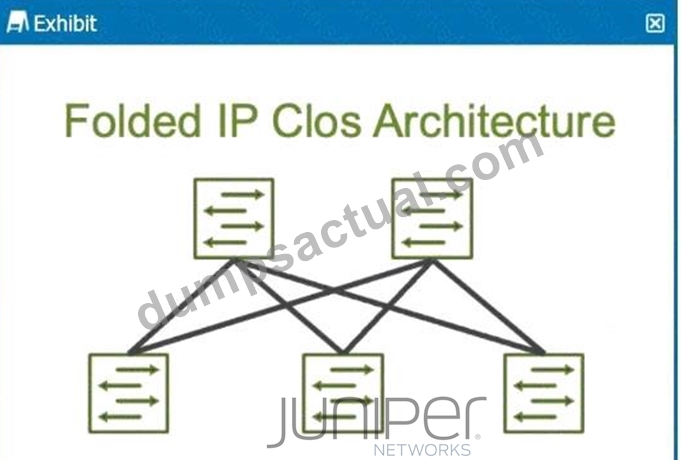
How many stages are shown in the exhibit?
- A. 0
- B. 1
- C. 2
- D. 3
Answer: D
Explanation:
The exhibit shows aFolded IP Clos Architecture, which is also referred to as a3-stage Closnetwork design.
This architecture typically consists of two layers of switches:
* Spine Layer: The top row of switches.
* Leaf Layer: The bottom row of switches.
Step-by-Step Breakdown:
* Clos Architecture:A 3-stage Clos network has two types of devices: spine and leaf. In this design, each leaf switch connects to every spine switch, providing a high level of redundancy and load balancing.
* Stage Explanation:
* Stage 1: The first set of leaf switches.
* Stage 2: The spine switches.
* Stage 3: The second set of leaf switches.
TheFolded Closarchitecture shown here effectively "folds" the 3-stage design by combining the ingress and egress leaf layers into one, reducing it to two visible layers, but still maintaining the overall3-stage architecture.
Juniper Reference:
* IP Clos Architecture: The 3-stage Clos design is commonly used in modern data centers for high availability, redundancy, and scalability.
NEW QUESTION # 73
Which Junos OS routing table stores IPv6 addresses?
- A. inet.0
- B. inet0.6
- C. inet.6
- D. inet6.0
Answer: D
Explanation:
In Junos OS, routing information is stored in different routing tables depending on the protocol and address family. For IPv6 addresses, the routing table used isinet6.0.
Step-by-Step Explanation:
* Routing Tables in Junos:
* inet.0: This is the primary routing table for IPv4 unicast routes.
* inet6.0: This is the primary routing table for IPv6 unicast routes.
* inet.3: This routing table is used for MPLS-related routing.
* Other routing tables, like inet.1, inet.2, are used for multicast and other specific purposes.
* inet6.0 Routing Table:When IPv6 is enabled on a Juniper router, all the IPv6 routes are stored in the inet6.0table. This includes both direct routes (connected networks) and learned routes (from dynamic routing protocols like OSPFv3, BGP, etc.).
* Verification:To view IPv6 routes, the command show route table inet6.0 is used. This will display the contents of the IPv6 routing table, showing the network prefixes, next-hop addresses, and protocol information for each route.
Juniper Reference:
* Junos Command: Use show route table inet6.0 to check IPv6 routing entries.
* IPv6 Routing: Ensure that the IPv6 protocol is enabled on interfaces and that routingprotocols like OSPFv3 or BGP are properly configured for IPv6 traffic handling.
NEW QUESTION # 74
What is an aggregate route?
- A. often called the route of last resort
- B. a static route with only one contributing route
- C. a mechanism that allows multiple routes to be summarized into a single route
- D. a group of IP addresses to which a router will not forward traffic
Answer: C
NEW QUESTION # 75
......
Updated Verified JN0-280 dumps Q&As - Pass Guarantee or Full Refund: https://www.dumpsactual.com/JN0-280-actualtests-dumps.html
JN0-280 PDF Questions and Testing Engine With 187 Questions: https://drive.google.com/open?id=1pCXhMoIzEh2j7MaloMB7hqcOtubZEBUj
