

[Jun-2026] Pass Fortinet NSE8_812 Tests Engine pdf - All Free Dumps
Fortinet NSE 8 - Written Exam (NSE8_812) Practice Tests 2026 | Pass NSE8_812 with confidence!
NEW QUESTION # 22
Refer to the exhibits.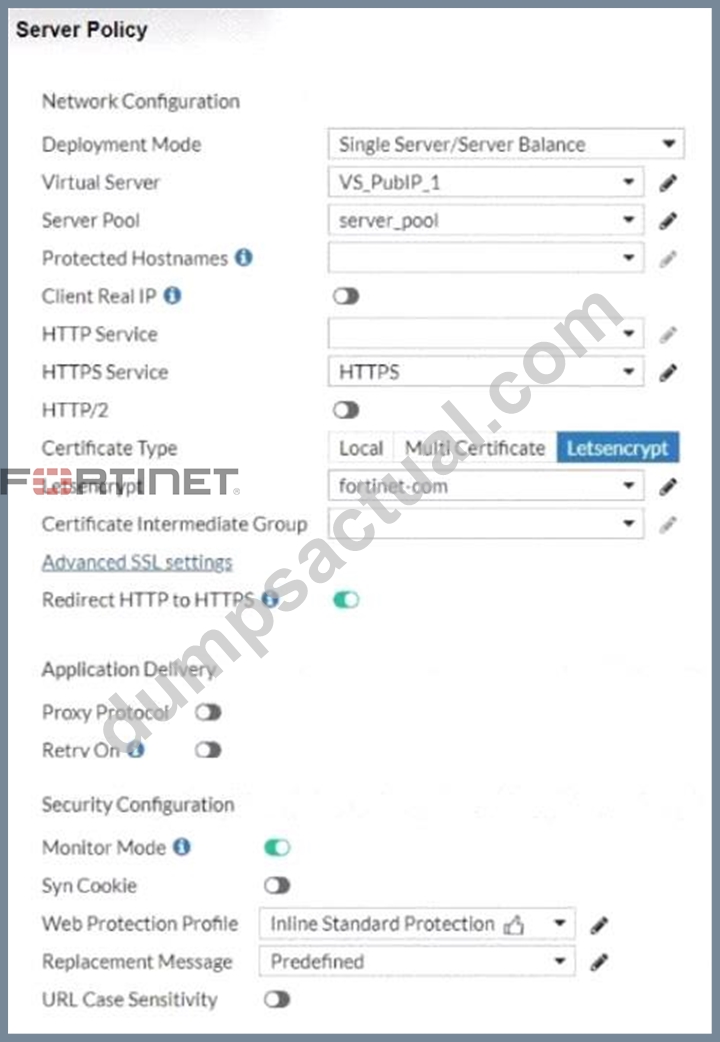
You are configuring a Let's Encrypt certificate to enable SSL protection to your website. When FortiWeb tries to retrieve the certificate, you receive a certificate status failed, as shown below.
Based on the Server Policy settings shown in the exhibit, which two configuration changes will resolve this issue? (Choose two.)
- A. Remove the Web Protection Profile from this Server Policy.
- B. Configure a TXT record of the domain and point to the IP address of the Virtual Server.
- C. Disable Redirect HTTP to HTTPS in the Server Policy.
- D. Enable HTTP service in the Server Policy.
Answer: A,C
NEW QUESTION # 23
Refer to the exhibit.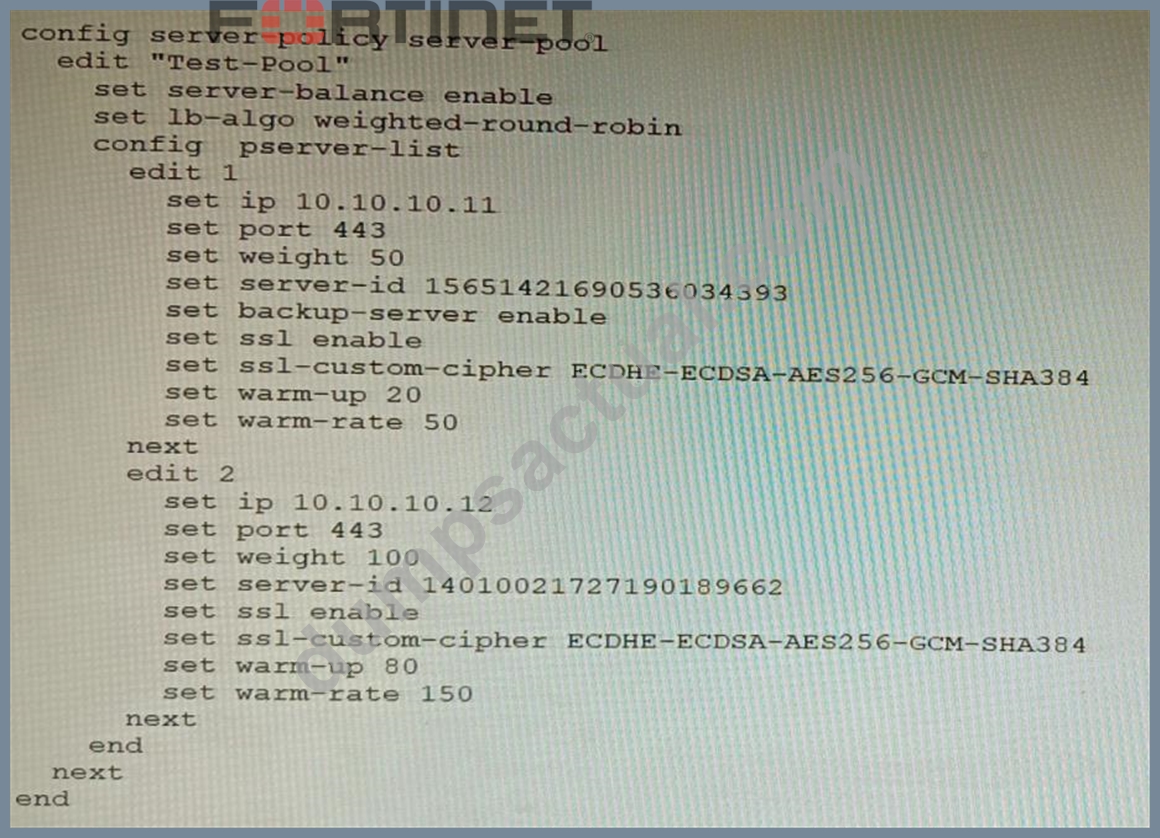
A FortiWeb appliance is configured for load balancing web sessions to internal web servers. The Server Pool is configured as shown in the exhibit.
How will the sessions be load balanced between server 1 and server 2 during normal operation?
- A. Server 1 will receive 25% of the sessions, Server 2 will receive 75% of the sessions
- B. Server 1 will receive 0% of the sessions Server 2 will receive 100% of the sessions
- C. Server 1 will receive 20% of the sessions, Server 2 will receive 66.6% of the sessions
- D. Server 1 will receive 33.3% of the sessions, Server 2 will receive 66 6% of the sessions
Answer: B
Explanation:
D is correct because server 1 has a weight of 0, which means it will not receive any sessions from the load balancer. Server 2 has a weight of 100, which means it will receive all sessions from the load balancer. This is explained in the FortiWeb Administration Guide under Server Load Balancing > Server pools > Weighted round robin. Reference: https://docs.fortinet.com/document/fortiweb/6.3.0/administration-guide/381057/server-load-balancing https://docs.fortinet.com/document/fortiweb/6.3.0/administration-guide/381057/server-load-balancing/381058/server-pools
NEW QUESTION # 24
Refer to the exhibits.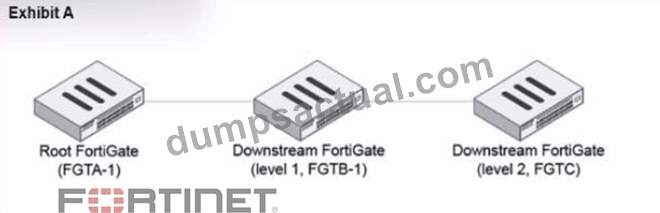
During the implementation of a Fortinet Security Fabric configuration, CLI commands were issued in the order shown in the exhibit. On the next day, the local admin for FGTC issues the following command: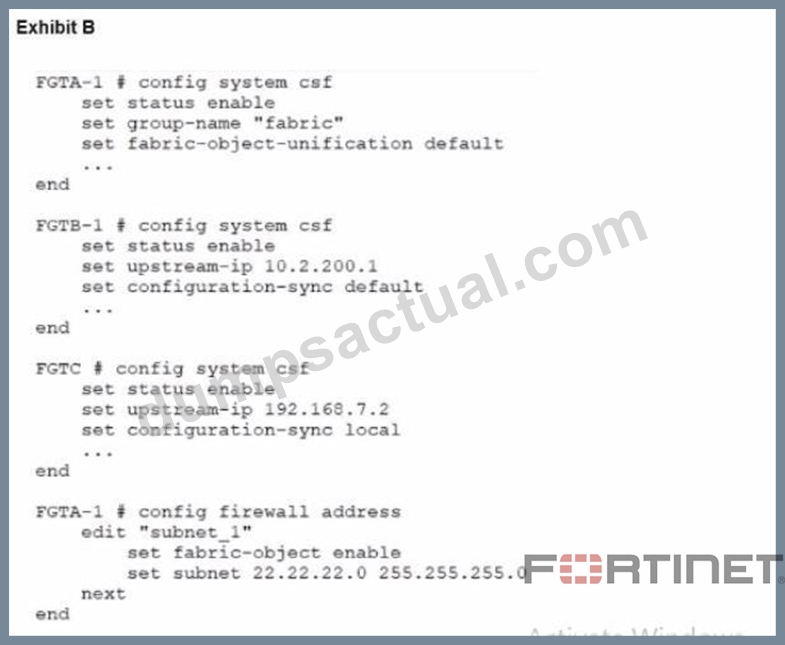
FGTC # config system csf
set configuration-sync default
end
In this scenario, which outcome is true regarding the "subnet_1" firewall address object on FGTC?
- A. The object needs to be recreated on FGTA-1 before it is automatically created on FGTC.
- B. The object will only be automatically created on FGTC if it is modified on FGTA-1.
- C. The object is not automatically created.
- D. The object is automatically created.
Answer: D
NEW QUESTION # 25
Refer to the exhibit.
A customer has deployed a FortiGate 300E with virtual domains (VDOMs) enabled in the multi-VDOM mode. There are three VDOMs: Root is for management and internet access, while VDOM 1 and VDOM 2 are used for segregating internal traffic. AccountVInk and SalesVInk are standard VDOM links in Ethernet mode.
Given the exhibit, which two statements below about VDOM behavior are correct? (Choose two.)
- A. OSPF routing can be configured between VDOM 1 and Root VDOM without any configuration changes to AccountVInk
- B. Traffic on AccountVInk and SalesVInk will not be accelerated.
- C. The VDOM links are in Ethernet mode because they have IP addressed assigned on both sides.
- D. You can apply OSPF routing on the VDOM link in either PPP or Ethernet mode
- E. Root VDOM is an Admin type VDOM, while VDOM 1 and VDOM 2 are Traffic type VDOMs.
Answer: B,D
NEW QUESTION # 26
You are creating the CLI script to be used on a new SD-WAN deployment You will have branches with a different number of internet connections and want to be sure there is no need to change the Performance SLA configuration in case more connections are added to the branch.
The current configuration is: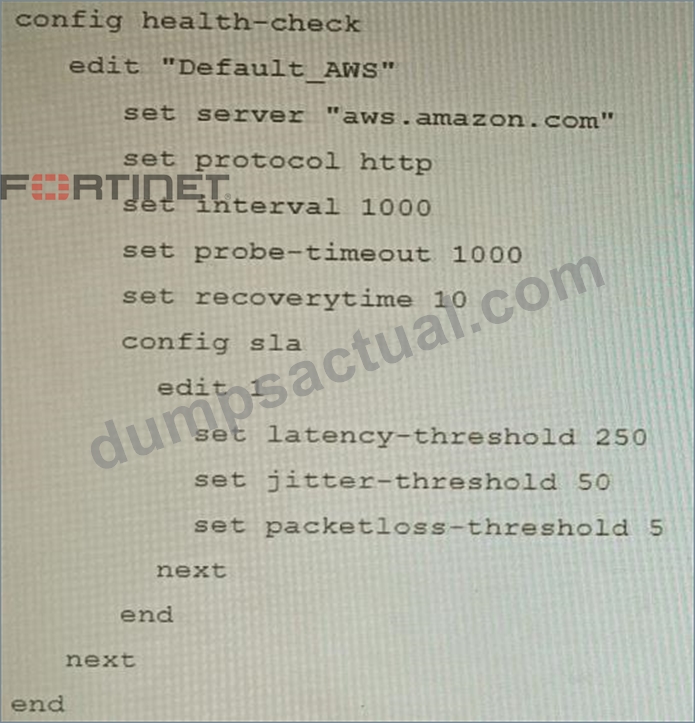
Which configuration do you use for the Performance SLA members?
- A. set members 0
- B. set members any
- C. set members all
- D. current configuration already fulfills the requirement
Answer: A
Explanation:
References:
Performance SLA | FortiGate / FortiOS 7.4.0
Configuring Performance SLA | FortiGate / FortiOS 7.4.0
NEW QUESTION # 27
Refer to the exhibits.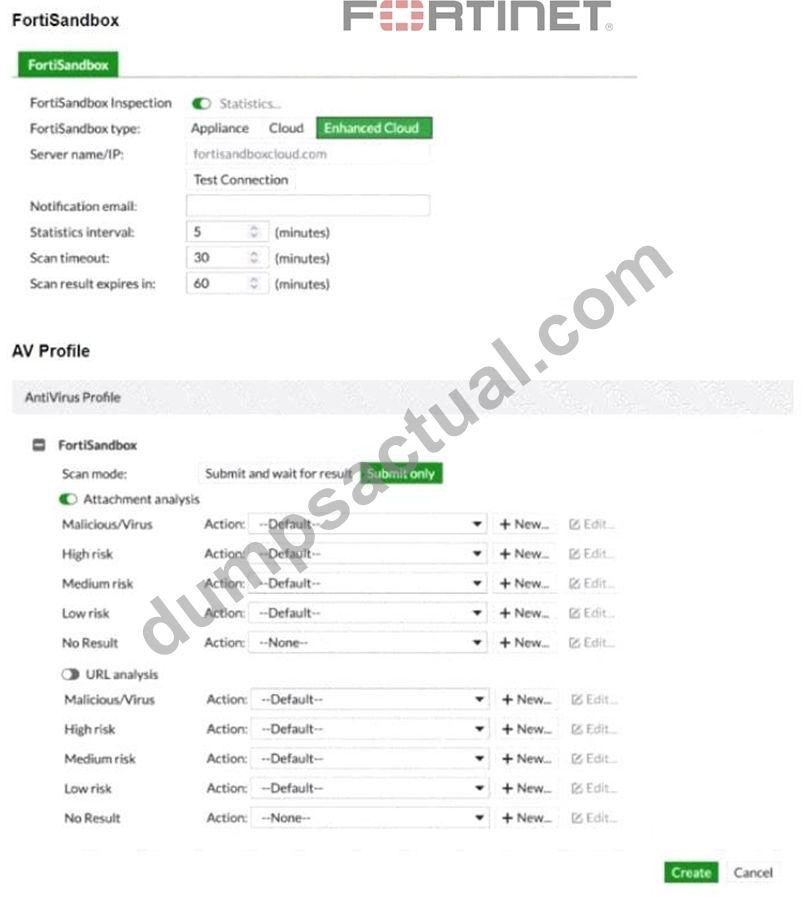
You must integrate a FortiMail and FortiSandbox Enhanced Cloud solution for a customer who is concerned about the e-mails being delayed for too long.
According to the configuration shown in the exhibits, which would be an expected behavior?
- A. FortiMail will ignore the timeout value if content disarm and reconstruction (CDR) is enabled.
- B. FortiMail will not wait for results but only for attachments that have been already submitted to the FortiSandbox in the last 60 minutes.
- C. If an attachment is sent to the FortiSandbox while the job queue is full, the e-mail might be delayed for up to 30 minutes, then e-mail will be relayed to the mail server.
- D. FortiMail will relay valid e-mails to the mail server as soon as it is done with other local inspections.
Answer: D
NEW QUESTION # 28
Refer to the exhibit, which shows diagnostic output.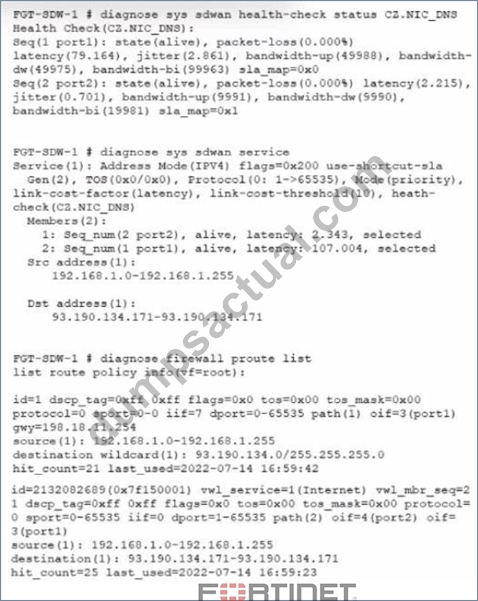
A customer reports that ICMP traffic flow from 192.168.1.11 to 93.190.134.171 is not corresponding to the SD-WAN setup.
What is the problem in this scenario?
- A. Port1 is used because it has more available bandwidth.
- B. SD-WAN Rule is matching only DNS traffic.
- C. Route for the destination IP is missing in the routing table.
- D. Traffic is matched by policy route.
Answer: D
NEW QUESTION # 29
Refer to the exhibit.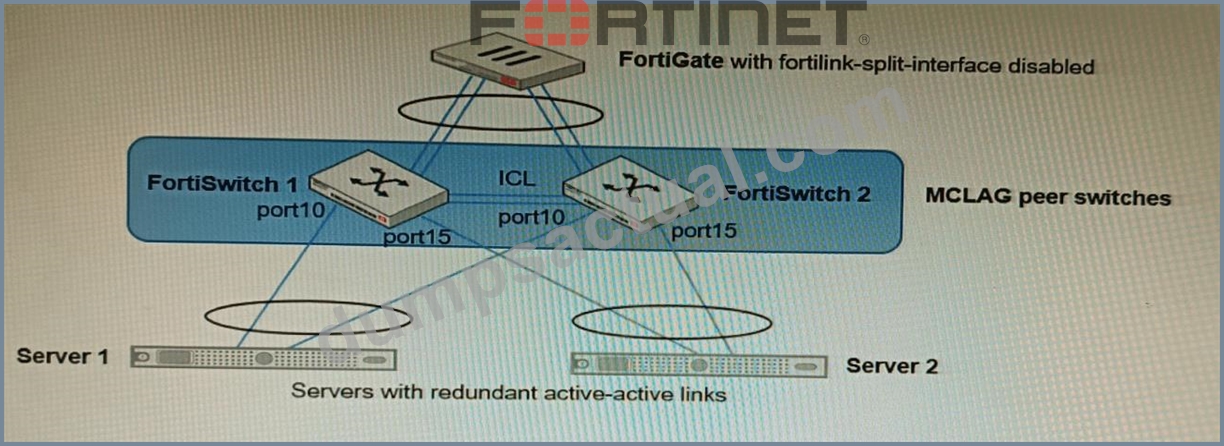
You have been tasked with replacing the managed switch Forti Switch 2 shown in the topology.
Which two actions are correct regarding the replacement process? (Choose two.)
- A. After replacing the FortiSwitch unit, the automatically created trunk name changes.
- B. CLAG-ICL needs to be manually reconfigured once the new switch is connected to the FortiGate
- C. After replacing the FortiSwitch unit, the automatically created trunk name does not change
- D. MCLAG-ICL will be automatically reconfigured once the new switch is connected to the FortiGate.
Answer: B,C
Explanation:
* A is correct because the automatically created trunk name is based on the MAC address of the FortiSwitch unit. When the FortiSwitch unit is replaced, the MAC address will change, but the trunk name will not change.
* B is correct because CLAG-ICL is a manually configured link aggregation group. When the FortiSwitch unit is replaced, the CLAG-ICL configuration will need to be manually reconfigured on the new FortiSwitch unit.
The other options are incorrect. Option C is incorrect because the automatically created trunk name does not change when the FortiSwitch unit is replaced. Option D is incorrect because MCLAG-ICL is a manually configured link aggregation group and will not be automatically reconfigured when the FortiSwitch unit is replaced.
References:
Configuring link aggregation on FortiSwitches | FortiSwitch / FortiOS 7.0.4 - Fortinet Document Library Managing FortiLink | FortiGate / FortiOS 7.0.4 - Fortinet Document Library
https://docs.fortinet.com/document/fortiswitch/7.0.8/devices-managed-by-fortios/173284/replacing-a- managed-fortiswitch-unit
NEW QUESTION # 30
Refer to The exhibit showing a FortiEDR configuration.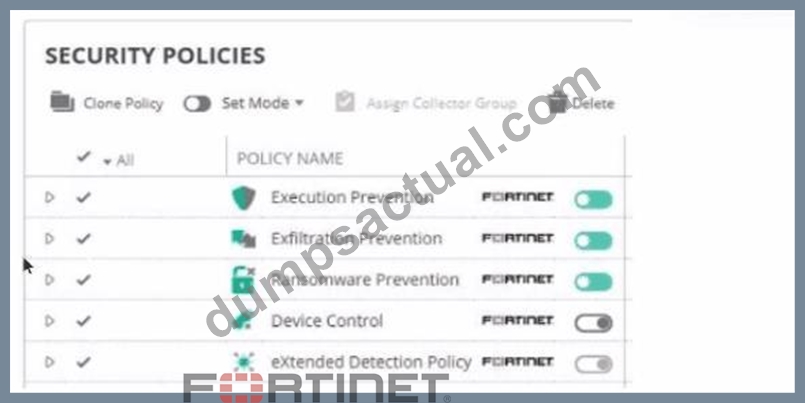
Based on the exhibit, which statement is correct?
- A. FortiEDR Collector will not collect OS Metadata.
- B. If a malicious file is executed and attempts to establish a connection it will generate duplicate events.
- C. The presence of a cryptolocker malware at rest on the filesystem will be detected by the Ransomware Prevention security policy.
- D. If an unresolved file rule is triggered, by default the file is logged but not blocked.
Answer: D
NEW QUESTION # 31
An HA topology is using the following configuration: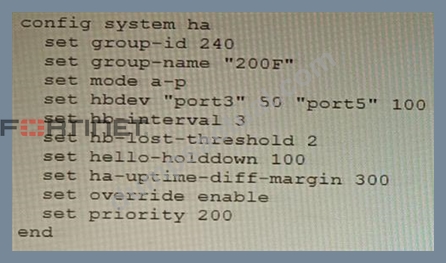
Based on this configuration, how long will it take for a failover to be detected by the secondary cluster member?
- A. 600ms
- B. 100ms
- C. 300ms
- D. 200ms
Answer: D
Explanation:
The HA heartbeat interval is 100ms, and the number of lost heartbeats before a failover is detected is 2. So, it will take 2 * 100ms = 200ms for a failover to be detected by the secondary cluster member.
Reference:
FortiGate High Availability: https://docs.fortinet.com/document/fortigate/7.0.0/administration-guide/647723/link-monitoring-and-ha-failover-time
NEW QUESTION # 32
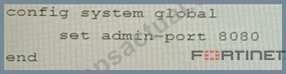
Refer to the exhibit containing the configuration snippets from the FortiGate. Customer requirements: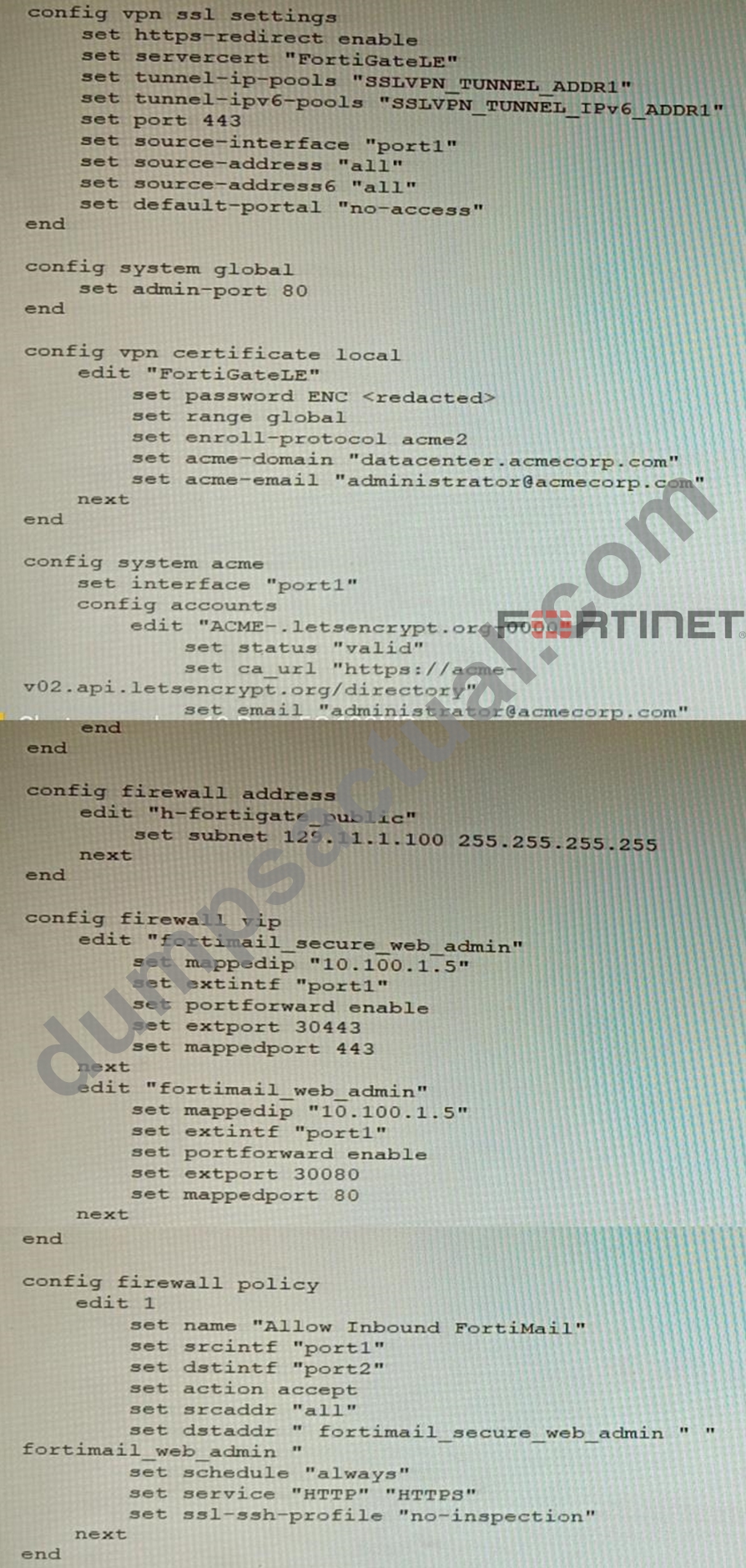
* SSLVPN Portal must be accessible on standard HTTPS port (TCP/443)
* Public IP address (129.11.1.100) is assigned to portl
* Datacenter.acmecorp.com resolves to the public IP address assigned to portl The customer has a Let's Encrypt certificate that is going to expire soon and it reports that subsequent attempts to renew that certificate are failing.
Reviewing the requirement and the exhibit, which configuration change below will resolve this issue?
A)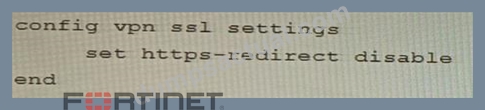
B)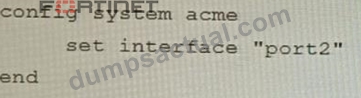
C)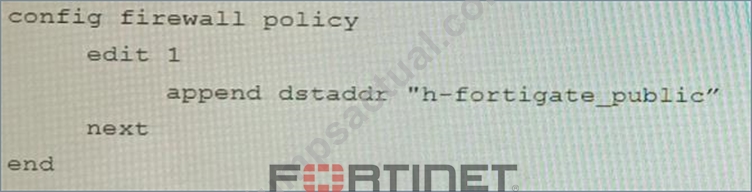
- A. Option D
- B. Option B
- C. Option A
- D. Option C
Answer: D
Explanation:
To resolve the issue of failing to renew the Let's Encrypt certificate, the configuration change that is needed is to enable the HTTP-to-HTTPS redirect option in the SSL-VPN settings. This option allows the FortiGate to redirect HTTP requests to HTTPS port 443, which is required for Let's Encrypt to validate the domain ownership and issue a new certificate. By enabling this option, the FortiGate will be able to respond to the HTTP challenge from Let's Encrypt and renew the certificate successfully. Reference: https://docs.fortinet.com/document/fortigate/6.4.0/cookbook/103437/inbound-ssl-inspection https://docs.fortinet.com/document/fortigate/6.4.0/cookbook/103438/application-detection-on-ssl-offloaded-traffic
NEW QUESTION # 33
Refer to the exhibits.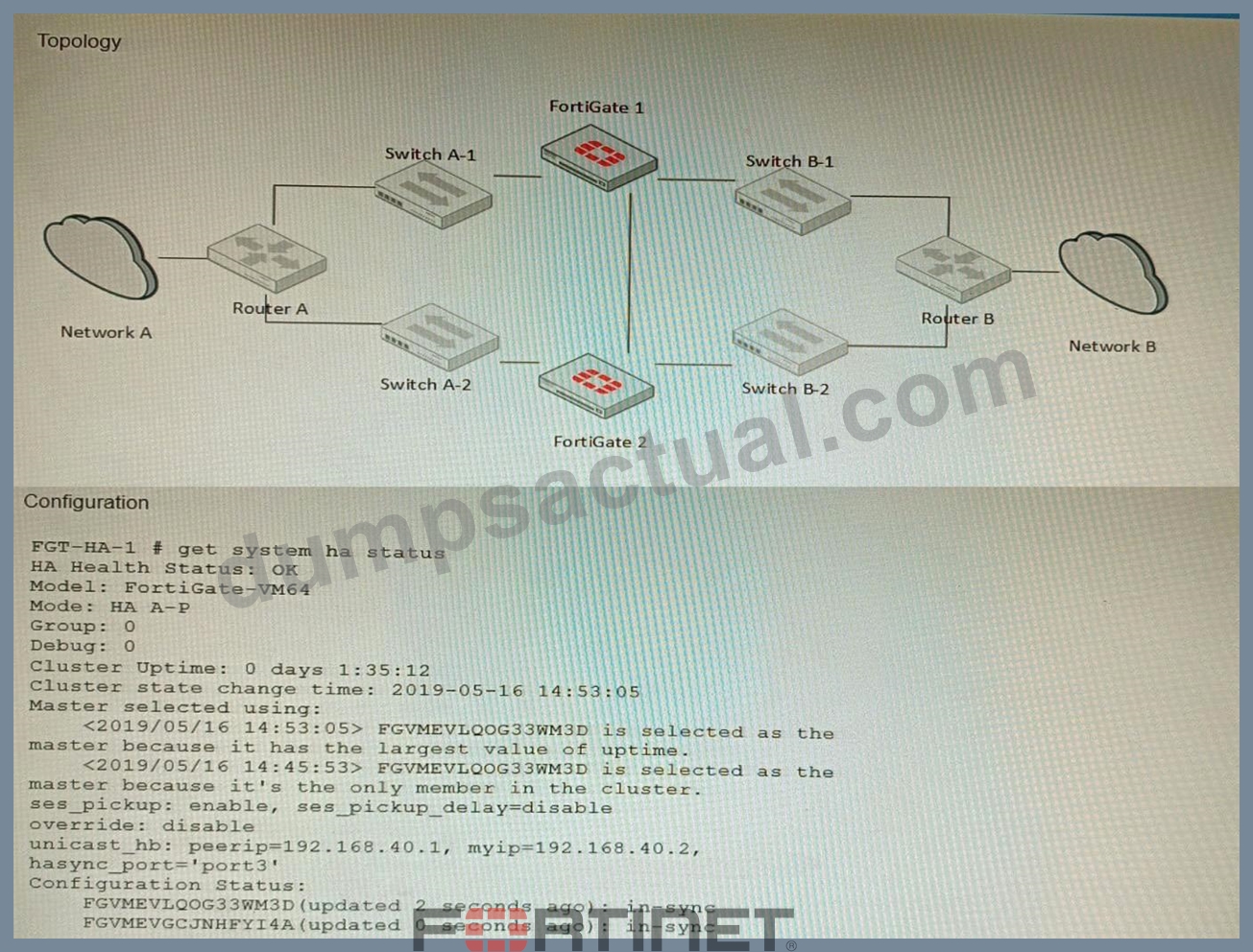
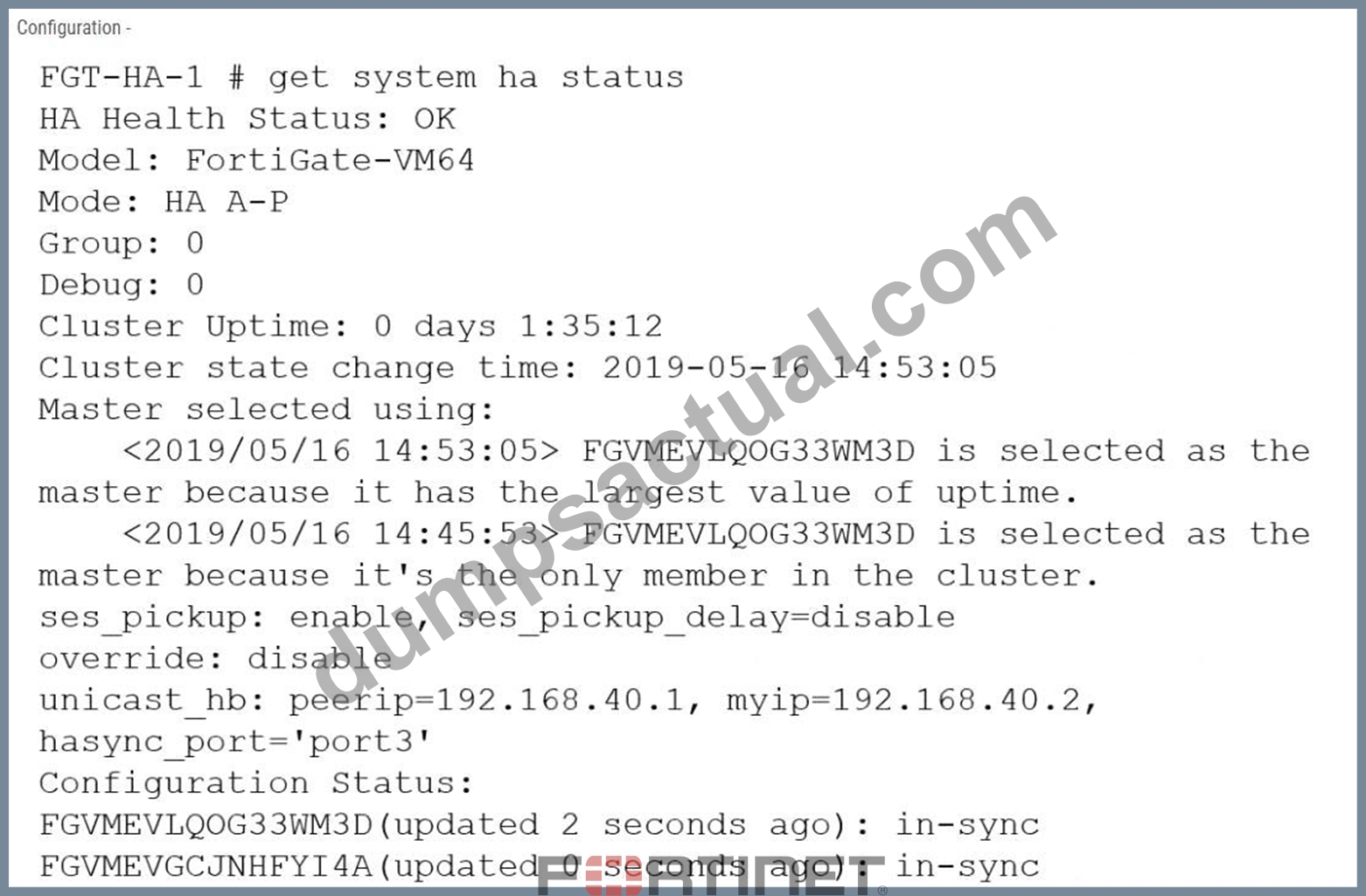
The exhibits show a FortiGate network topology and the output of the status of high availability on the FortiGate.
Given this information, which statement is correct?
- A. The ethertype values of the HA packets are 0x8890, 0x8891, and 0x8892
- B. FGVMEVLQOG33WM3D and FGVMEVGCJNHFYI4A share a virtual MAC address.
- C. The cluster mode can support a maximum of four (4) FortiGate VMs
- D. The cluster members are on the same network and the IP addresses were statically assigned.
Answer: D
Explanation:
The output of the status of high availability on the FortiGate shows that the cluster mode is active-passive, which means that only one FortiGate unit is active at a time, while the other unit is in standby mode. The active unit handles all traffic and also sends HA heartbeat packets to monitor the standby unit. The standby unit becomes active if it stops receiving heartbeat packets from the active unit, or if it receives a higher priority from another cluster unit. In active-passive mode, all cluster units share a virtual MAC address for each interface, which is used as the source MAC address for all packets forwarded by the cluster. References:
https://docs.fortinet.com/document/fortigate/6.4.0/cookbook/103439/high-availability-with-two-fortigates
NEW QUESTION # 34
Refer to The exhibit showing a FortiEDR configuration.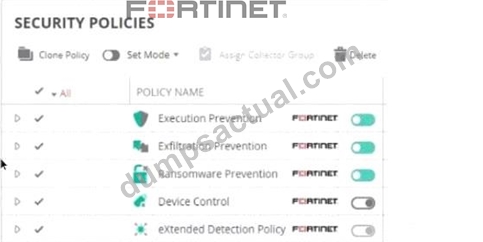
Based on the exhibit, which statement is correct?
- A. FortiEDR Collector will not collect OS Metadata.
- B. If a malicious file is executed and attempts to establish a connection it will generate duplicate events.
- C. The presence of a cryptolocker malware at rest on the filesystem will be detected by the Ransomware Prevention security policy.
- D. If an unresolved file rule is triggered, by default the file is logged but not blocked.
Answer: D
NEW QUESTION # 35
Refer to the exhibits.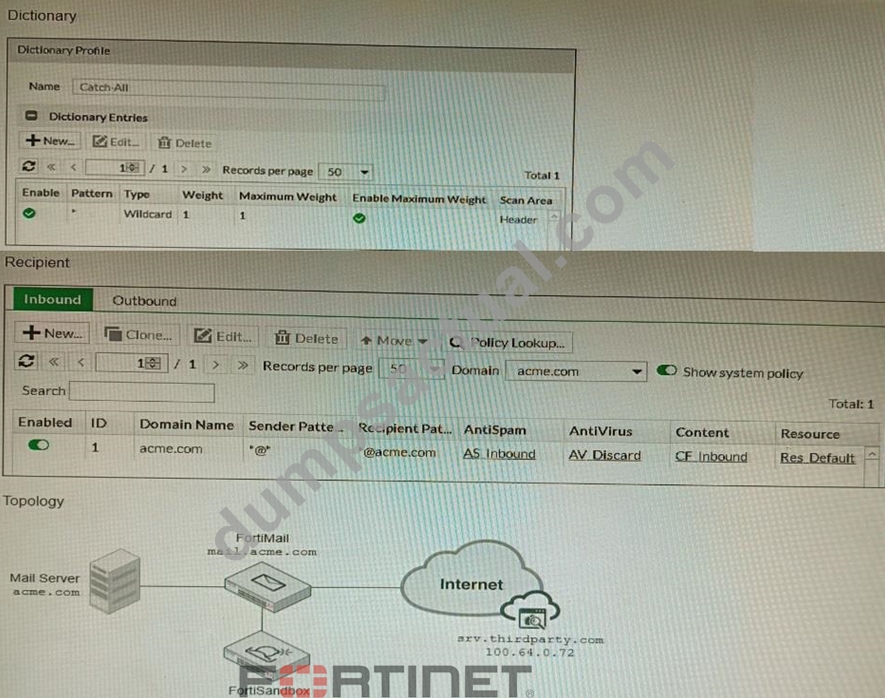
The exhibits show a FortiMail network topology, Inbound configuration settings, and a Dictionary Profile.
You are required to integrate a third-party's host service (srv.thirdparty.com) into the e-mail processing path.
All inbound e-mails must be processed by FortiMail antispam and antivirus with FortiSandbox integration. If the email is clean, FortiMail must forward it to the third-party service, which will send the email back to FortiMail for final delivery, FortiMail must not scan the e-mail again.
Which three configuration tasks must be performed to meet these requirements? (Choose three.)
- A. Apply the Catch-Ail profile to the CFInbound profile and configure a content action profile to deliver to the srv. thirdparty. com FQDN
- B. Create an IP policy with a Source value of 100. 64 .0.72/32, enable precedence, and place the policy at the top of the list.
- C. Create an access receive rule with a Sender value of srv. thirdparcy.com, Recipient value of *@acme.com, and action value of Safe
- D. Change the scan order in FML-GW to antispam-sandbox-content.
- E. Apply the Catch-AII profile to the ASinbound profile and configure an access delivery rule to deliver to the 100.64.0.72 host.
Answer: A,C
Explanation:
To integrate a third-party's host service (srv.thirdparty.com) into the e-mail processing path, while ensuring that all inbound e-mails are scanned by FortiMail antispam and antivirus with FortiSandbox integration, and then forwarded to the third-party service and back to FortiMail for final delivery, the following configuration tasks must be performed:
Apply the Catch-All profile to the CFInbound profile and configure a content action profile to deliver to the srv.thirdparty.com FQDN. This will ensure that all inbound e-mails that pass the antispam and antivirus scanning are forwarded to the third-party service for further processing.
Create an access receive rule with a Sender value of srv.thirdparty.com, Recipient value of *@acme.com, and action value of Safe. This will ensure that all e-mails that are sent back from the third-party service to FortiMail are accepted without any further scanning or filtering. Reference: https://docs.fortinet.com/document/fortimail/7.2.2/administration-guide/921588/configuring-content-profiles-and-content-action-profiles https://docs.fortinet.com/document/fortimail/7.2.2/administration-guide/629994/configuring-session-profiles
NEW QUESTION # 36
A customer's cybersecurity department needs to implement security for the traffic between two VPCs in AWS, but these belong to different departments within the company. The company uses a single region for all their VPCs.
Which two actions will achieve this requirement while keeping separate management of each department's VPC? (Choose two.)
- A. Create an 1AM account for the cybersecurity department to manage both existing VPC, create a FortiGate HA Cluster on each VPC and IPSEC VPN to force traffic between the VPCs through the FortiGate clusters
- B. Create a transit VPC with a FortiGate HA cluster, connect to the other two using VPC peering, and use routing tables to force traffic through the FortiGate cluster.
- C. Create a VPC with a FortiGate auto-scaling group with a Transit Gateway attached to the three VPC to force routing through the FortiGate cluster
- D. Migrate all the instances to the same VPC and create 1AM accounts for each department, then implement a new subnet for a FortiGate auto-scaling group and use routing tables to force the traffic through the FortiGate cluster.
Answer: B,C
Explanation:
To implement security for the traffic between two VPCs in AWS, while keeping separate management of each department's VPC, two possible actions are:
Create a transit VPC with a FortiGate HA cluster, connect to the other two using VPC peering, and use routing tables to force traffic through the FortiGate cluster. This option allows the cybersecurity department to manage the transit VPC and apply security policies on the FortiGate cluster, while the other departments can manage their own VPCs and instances. The VPC peering connections enable direct communication between the VPCs without using public IPs or gateways. The routing tables can be configured to direct all inter-VPC traffic to the transit VPC.
Create a VPC with a FortiGate auto-scaling group with a Transit Gateway attached to the three VPCs to force routing through the FortiGate cluster. This option also allows the cybersecurity department to manage the security VPC and apply security policies on the FortiGate cluster, while the other departments can manage their own VPCs and instances. The Transit Gateway acts as a network hub that connects multiple VPCs and on-premises networks. The routing tables can be configured to direct all inter-VPC traffic to the security VPC. Reference: https://docs.fortinet.com/document/fortigate-public-cloud/7.2.0/aws-administration-guide/506140/connecting-a-local-fortigate-to-an-aws-vpc-vpn https://docs.fortinet.com/document/fortigate-public-cloud/7.0.0/sd-wan-architecture-for-enterprise/166334/sd-wan-configuration
NEW QUESTION # 37
Refer to the exhibit.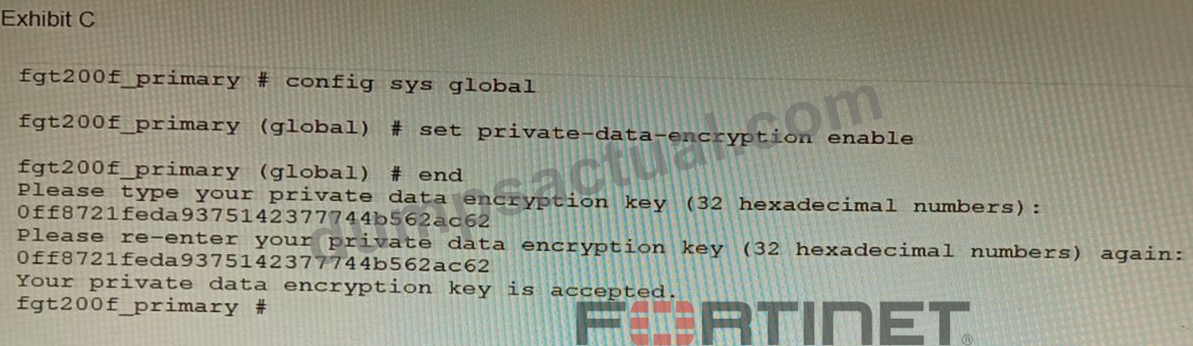
A customer has deployed a FortiGate 200F high-availability (HA) cluster that contains & TPM chip. The exhibit shows output from the FortiGate CLI session where the administrator enabled TPM.
Following these actions, the administrator immediately notices that both FortiGate high availability (HA) status and FortiManager status for the FortiGate are negatively impacted.
What are the two reasons for this behavior? (Choose two.)
- A. TPM functionality is not yet compatible with FortiGate HA D The administrator needs to manually enter the hex private data encryption key in FortiManager
- B. The FortiGate has not finished the auto-update process to synchronize the new configuration to FortiManager yet.
- C. Configuration for TPM is not synchronized between FortiGate HA cluster members.
- D. The private-data-encryption key entered on the primary did not match the value that the TPM expected.
Answer: C,D
Explanation:
The two reasons for the negative impact on the FortiGate HA status and FortiManager status after enabling TPM are:
The private-data-encryption key entered on the primary unit did not match the value that the TPM expected. This could happen if the TPM was previously enabled and then disabled, and the key was changed in between. The TPM will reject the new key and cause an error in the configuration synchronization.
Configuration for TPM is not synchronized between FortiGate HA cluster members. Each cluster member must have the same private-data-encryption key to form a valid HA cluster and synchronize their configurations. However, enabling TPM on one unit does not automatically enable it on the other units, and the key must be manually entered on each unit. To resolve these issues, the administrator should disable TPM on all units, clear the TPM data, and then enable TPM again with the same private-data-encryption key on each unit. References: https://docs.fortinet.com/document/fortigate/6.4.0/cookbook/103437/inbound-ssl-inspection https://docs.fortinet.com/document/fortigate/6.4.0/cookbook/103438/application-detection-on-ssl-offloaded-traffic
NEW QUESTION # 38
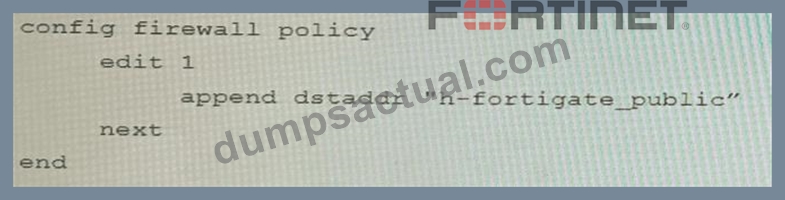
Refer to the exhibit containing the configuration snippets from the FortiGate. Customer requirements:
* SSLVPN Portal must be accessible on standard HTTPS port (TCP/443)
* Public IP address (129.11.1.100) is assigned to portl
* Datacenter.acmecorp.com resolves to the public IP address assigned to portl The customer has a Let's Encrypt certificate that is going to expire soon and it reports that subsequent attempts to renew that certificate are failing.
Reviewing the requirement and the exhibit, which configuration change below will resolve this issue?
- A.
- B.
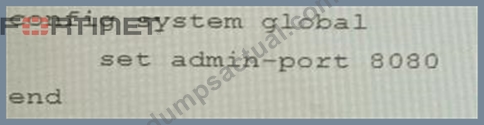
- C.
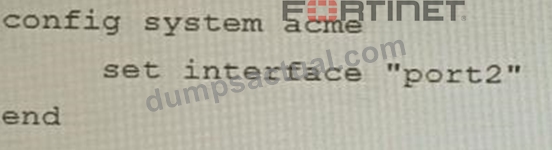
- D.
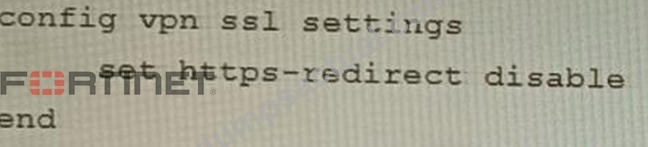
Answer: D
Explanation:
https://docs.fortinet.com/document/fortigate/7.4.1/administration-guide/822087/automatically-provision-a- certificate
NEW QUESTION # 39
Refer to the exhibits, which show a firewall policy configuration and a network topology.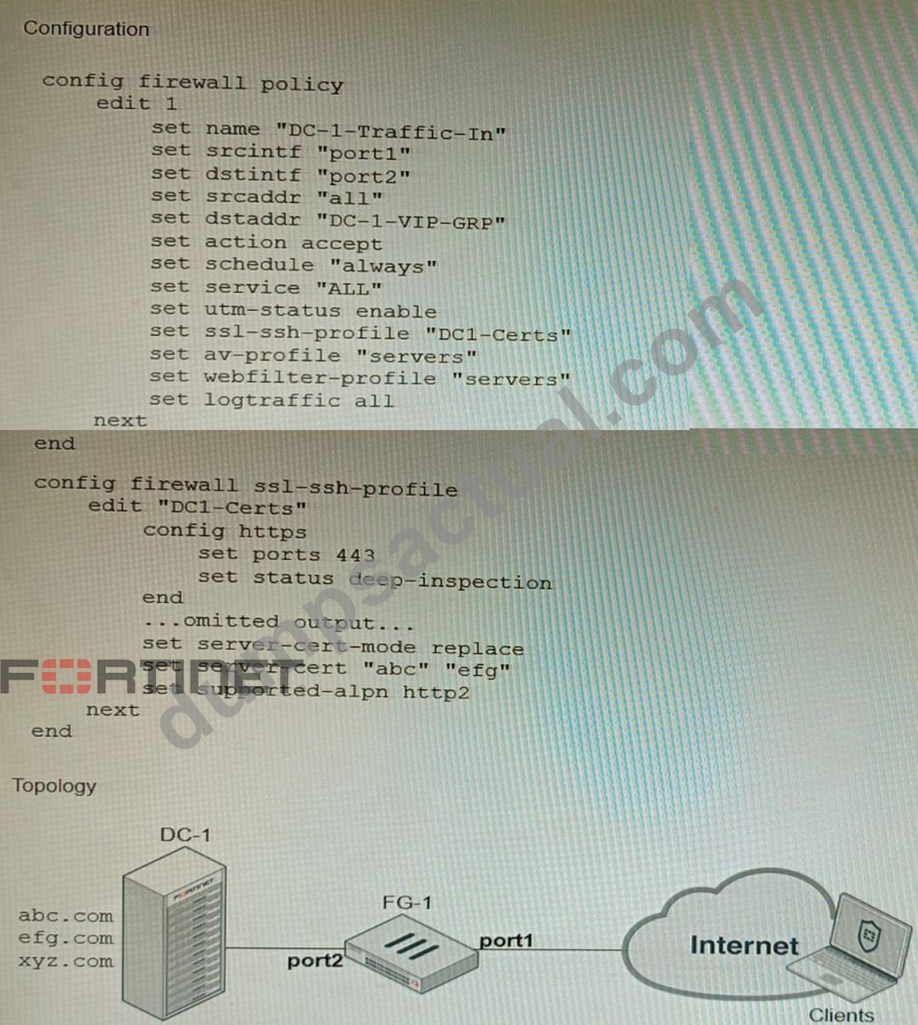
An administrator has configured an inbound SSL inspection profile on a FortiGate device (FG-1) that is protecting a data center hosting multiple web pages-Given the scenario shown in the exhibits, which certificate will FortiGate use to handle requests to xyz.com?
- A. FortiGate will use the first certificate in the server-cert list-the abc.com certificate
- B. FortiGate will reject the connection since no certificate is defined.
- C. FortiGate will use the Fortinet_CA_Untrusted certificate for the untrusted connection,
- D. FortiGate will fall-back to the default Fortinet_CA_SSL certificate.
Answer: D
Explanation:
When using inbound SSL inspection, FortiGate needs to present a certificate to the client that matches the requested domain name. If no matching certificate is found in the server-cert list, FortiGate will fall-back to the default Fortinet_CA_SSL certificate, which is self-signed and may trigger a warning on the client browser. Reference: https://docs.fortinet.com/document/fortigate/6.4.0/cookbook/103437/inbound-ssl-inspection
NEW QUESTION # 40
......
Fortinet NSE8_812 (Fortinet NSE 8 - Written Exam) Certification Exam is an advanced-level certification exam offered by Fortinet. It is designed for experienced network security professionals who are seeking to validate their knowledge and skills in designing, implementing, and managing complex network security solutions. NSE8_812 exam covers a wide range of topics, including advanced network security concepts, security protocols, security policies, and risk management. NSE8_812 exam also tests the candidate's ability to analyze complex security scenarios and recommend appropriate security measures to mitigate risks.
Get instant access to NSE8_812 practice exam questions: https://drive.google.com/open?id=1-2NqQgFtVi5vzEOoRVcltUs7jVkY_0JO
Online Exam Practice Tests with detailed explanations!: https://www.dumpsactual.com/NSE8_812-actualtests-dumps.html
