

Printable & Easy to Use L5M9 Dumps 100% Same Q&A In Your Real Exam
L5M9 Practice Test Give You First Time Success with 100% Money Back Guarantee!
NEW QUESTION # 51
Which improvement theory follows the maxim of 'don't automate, obliterate'?
- A. Benchmarking
- B. ERP
- C. BPR
- D. Continuous Improvement
Answer: C
Explanation:
The correct response is BRP- Business Process Re-engineering. The quote is from Michael Hammer. BRP is about finding better ways of processing, by taking everything apart and putting it back together again in a more efficient and effective way. See p.86.
NEW QUESTION # 52
At Red Glass Ltd a strategy has been developed by the Operations Department to reduce costs and streamline supply chain operations. This is being incorporated into the organisation's overarching corporate strategy. What is the name given to this type of strategy development?
- A. bottom- up
- B. value engineering
- C. structure-related strategy
- D. lean
Answer: A
Explanation:
The correct answer is bottom-up. There are 2 forms of strategy development: top down and bottom up. Bottom up is when a department within an organisation makes a strategy and it is passed up the ladder for implementation. Top down is the opposite (it is filtered down the ladder from senior management to individual departments). See p.42.
NEW QUESTION # 53
Barry is a Hotel Manager and is keen to understand where his business is failing. He has asked his staff to conduct a number of different techniques to uncover failures within the service. Of those listed below, which of the following would provide Barry with answers the quickest? Select TWO
- A. in-process checks
- B. phone surveys
- C. machine diagnostic checks
- D. point-of-departure interviews
Answer: A,C
Explanation:
In-process checks and machine diagnostic checks provide answers the quickest as these are conducted DURING processes. Surveys and Point-of-departure interviews are conducted AFTER guests have left- so there is a time-delay here. They're also more resource- intensive. See p.96 for a list of techniques that can be used by a company to uncover failures.
NEW QUESTION # 54
Tools by Tom is a manufacturer of hardware. They have recently advertised that a new range of hammers would be released shortly, however due to issues in the supply chain and a low-quality delivery of steal, the production of the new hammers has been put on hold. Of the following, which are internal impacts of failure for the company? Select TWO.
- A. wasted resources
- B. decreased market share
- C. customer complaints
- D. loss of credibility
- E. downtime
Answer: A,E
Explanation:
3 and 4 are internal impacts of failure- the others are external. See p.93 for more information.
NEW QUESTION # 55
The methodology for defining customer requirements and creating products that meet those needs is commonly known as which of the following?
- A. business process re-engineering
- B. value engineering
- C. quality function deployment
- D. defining business needs
Answer: C
Explanation:
This is Quality Function Deployment. It's a framework for ensuring that products are designed in line with what customers want/ need. P.112
NEW QUESTION # 56
In the SERVQUAL model how many different types of gaps should be identified by a service provider?
- A. 0
- B. 1
- C. 2
- D. 3
Answer: D
Explanation:
There are 5 gaps in the SERVQUAL model: knowledge, standards, delivery, communication and satisfaction. The gaps measure the 'distance' between what the company provides and what customers expect. See p.56-57.
NEW QUESTION # 57
Below are details of 4 local manufacturing companies. For each company you must decide what the main objective is for the organisation and what layout their manufacturing plant has.
Company 1: This company creates large, delicate products which are hard to move. The main aim of the company is to stand out from competitors due to the superior level of materials used and by using the latest forms of technology to create the items.
Company 2: This company produces 72 different items and has designated zones within its premises for the creation of each item. The zones are organised based on the technology used and some products may be passed between different zones to be completed. The company creates many different items in response to changing customer demands, with many product lines only lasting a single season.
Company 3: Company 3 creates one product which flows along a single production line, with staff members adding to the product on four different occasions. The company must produce a high volume of this singular product in order to break even. Therefore, there is always a steady flow of items through the plant and it is important there is no stoppage in production.
Company 4: This company produces small batches of products, as and when they are ordered by customers. Due to uncertainty in demand, a high profit margin is added to the cost of each item. Teams in the factory are grouped into different areas depending on the technological process they are using.
Complete the table below by listing the objective criteria and plant layout for each company. Each response should only be used once: flexibility, speed, quality, cost, functional layout, cell layout, product layout, fixedposition layout
Which of the following will you put into box 8?
- A. product layout
- B. functional layout
- C. cell layout
- D. fixed-position layout
Answer: B
Explanation:
The correct answers are as follows:
NEW QUESTION # 58
Little Joy Ltd is a large company with several functional departments. Below are details of four departments. For each, you must decide which functional area of the business the department is, as well as the SERVQUAL Gap that each Department Lead is concerned with.
Department 1: This department is concerned with the creation of products. The products are created in line with BS EN 716-1 and undergo vigorous tests before they leave the factory. Many customers are unaware of the additional costs of testing to BS EN 716-1 and complain about the price of this product line.
Department 2: Other departments of the business are internal customers of this functional area and approach the Department Lead when they require something to be bought. Often the internal customers have unrealistic expectations of the timescales involved in the process and the Department Lead spends a lot of time explaining lead times and logistics.
Department 3: This functional area creates the budgets for the company and emails these to the Department Leads at the beginning of every quarter. Due to the complexity of the documents, other functional areas of the business often don't understand the information provided.
Department 4: This area of the business is concerned with revenue, which has recently slumped. The Department Lead is conducting market surveys to find out the reason for this.
Complete the table below by listing the Functional Area of the business, and the corresponding SERVQUAL Gap. Each response should only be used once: procurement, finance, sales, production, satisfaction gap, delivery gap, standards gap, communication gap.
Which of the following will you put into box 2?
- A. procurement
- B. finance
- C. sales
- D. production
Answer: A
Explanation:
The correct answers are as follows: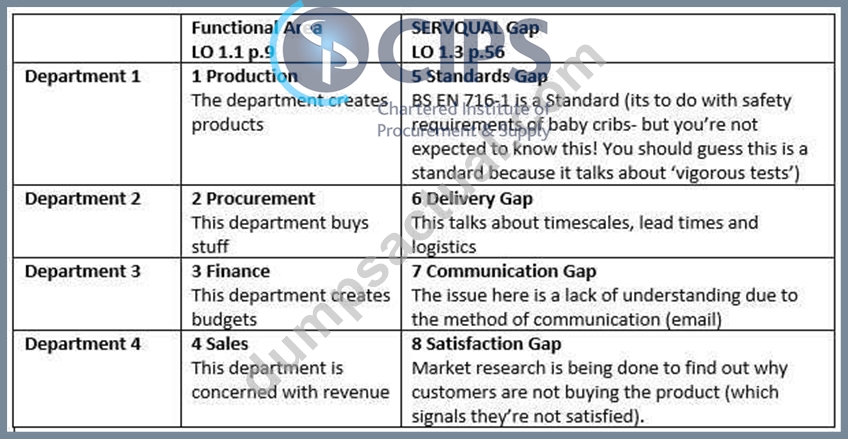
NEW QUESTION # 59
Below are details of five companies who operate a Total Quality Management System (TQM). For each company, select the system used and identify which area of the Balanced Scorecard this relates to.
Company 1: The focus of this company is to gather real-time data to assess the quality of products created during the manufacturing process. There are tight budgets and reworking any defects will affect the bottom line.
Company 2: This company is concerned about how their products are received. They have recently completed market research focused on their client's feelings. The objective is now to improve the product's look and performance to meet these expectations.
Company 3: The focus of this company is defining the customer requirements and translating this into a high-quality specification and effective operational process.
Company 4: Within this company there is a group of 6 employees who meet regularly with the objective of reducing issues that arise in the manufacturing of products.
Complete the table below by listing the TQM System used and the relevant Balanced Scorecard criteria for each company. Each response should only be used once: Quality Circle, Statistical Process Control, Kansei Engineering, Quality Function Deployment, Finance Criteria, Business Process Criteria, Learning and Growth Criteria, Customer Criteria.
Which of the following will you put into box 1?
- A. kansei engineering
- B. quality circle
- C. quality function deployment
- D. statistical process control
Answer: D
Explanation:
The correct answers are as follows:
NEW QUESTION # 60
Total Quality Management is built on 8 founding principles. Which of the following do these include? Select THREE.
- A. employee involvement
- B. supply chain integration
- C. process improvement
- D. bottom-up process design
- E. fact-based decision making
Answer: A,C,E
Explanation:
The other 5 principles are; customer focus, system integration, communication and continuous improvement
NEW QUESTION # 61
Doug's Doughnuts Ltd is a large manufacturer of doughnuts. They produce in excess of 100,000 doughnuts per day which are boxed and sent to supermarkets and other retail outlets for sale. Large pieces of machinery are used to make the doughnuts. Which form of maintenance would be the most appropriate to use at Doug's Doughnuts?
- A. condition based
- B. reactive
- C. run to breakdown
- D. preventative
Answer: D
Explanation:
Preventative maintenance should be used at Doug's Doughnuts. The machines should be serviced regularly to ensure they're working well. A break-down in machinery would stop production, and because Doug's Doughnuts produce so many items per day, this would cause a serious issue for the company. Run to breakdown means you don't repair anything until the item is completely broken. Condition-based maintenance is when maintenance is scheduled when it is required, usually to a schedule. Reactive is when maintenance is conducted when something breaks. See p.103.
NEW QUESTION # 62
Operations Management is concerned with the management of resources in the production of tangible goods. Is this TRUE?
- A. yes- operations management is ensuring a company has the correct resources to create goods
- B. no- operations management is concerned with ensuring the organisation is profitable
- C. yes- operations management ensures there are sufficient goods produced to meet customer demand
- D. no - operations management can also be concerned with the creation of intangible goods
Answer: D
Explanation:
you can't touch or hold), also requires operations management. P.2
NEW QUESTION # 63
There are four manufacturing companies located on Seashell Industrial Estate. Each company creates a different product and employs a different maintenance approach to its operations. For each company, select the corresponding maintenance approach and the key operating process characteristic.
Company 1: This company creates craft beer and offers customers a tour of the brewery for a small charge. The brewing equipment is serviced monthly and the brewery is kept extremely clean. All equipment is labelled with the last service date.
Company 2: This company produces seasonal items such as Easter Eggs and Christmas Cake. The equipment has a control panel where lights will flash red advising staff to check oil levels and components. Staff can then report issues to the maintenance team if remedial work is required. Product demand fluctuates throughout the year.
Company 3: This equipment does not often break down and is only fixed when it is reported by staff as no longer working. Company 3 creates toys, providing a large range of product sizes and colours based on different customer requirements.
Company 4: Parts of the machine are serviced quarterly but in general, the machine is left to run its course and is then replaced when it is no longer financially viable to fix. The company produces cereal and the operating process is focused on the quantity produced and therefore uses standardised processes.
Complete the table below by listing the maintenance approach and operating process characteristic for each company. Each response should only be used once: preventative maintenance, run to breakdown maintenance, condition-based maintenance, mixed maintenance, volume, visibility, variation, variety
Which of the following will you put into box 2?
- A. run-to-breakdown maintenance
- B. condition-based maintenance
- C. mixed maintenance
- D. preventative maintenance
Answer: B
Explanation:
The correct answers are as follows: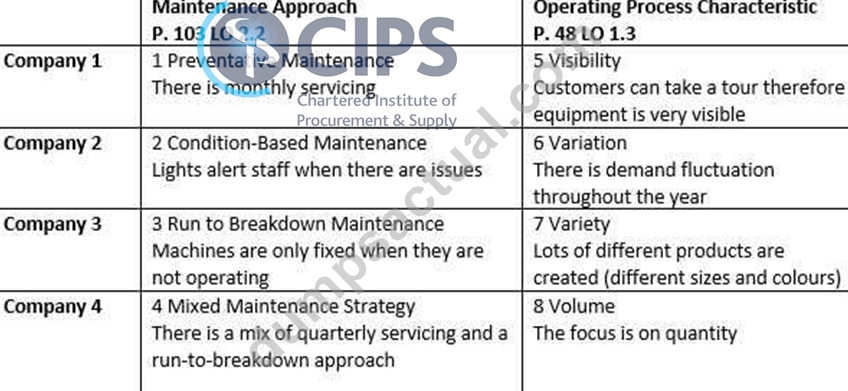
NEW QUESTION # 64
Blue Slipper Ltd is a multi-national organisation that produces a variety of cosmetic products. A team has been put together to create a strategy for the Marketing Department in order to increase sales and thus profitability. What level of strategy is being created?
- A. corporate level strategy
- B. operational level strategy
- C. business level strategy
- D. functional level strategy
Answer: D
Explanation:
The correct answer is functional level strategy as Marketing is a function within the business. P.32 discusses the three levels of strategy: corporate (whole organisation), business level (divided by business unit such as lipsticks, mascara etc) and function (divided by department such as marketing, operations and HR). The last option is made up.
NEW QUESTION # 65
There are four manufacturing companies located on Seashell Industrial Estate. Each company creates a different product and employs a different maintenance approach to its operations. For each company, select the corresponding maintenance approach and the key operating process characteristic.
Company 1: This company creates craft beer and offers customers a tour of the brewery for a small charge. The brewing equipment is serviced monthly and the brewery is kept extremely clean. All equipment is labelled with the last service date.
Company 2: This company produces seasonal items such as Easter Eggs and Christmas Cake. The equipment has a control panel where lights will flash red advising staff to check oil levels and components. Staff can then report issues to the maintenance team if remedial work is required. Product demand fluctuates throughout the year.
Company 3: This equipment does not often break down and is only fixed when it is reported by staff as no longer working. Company 3 creates toys, providing a large range of product sizes and colours based on different customer requirements.
Company 4: Parts of the machine are serviced quarterly but in general, the machine is left to run its course and is then replaced when it is no longer financially viable to fix. The company produces cereal and the operating process is focused on the quantity produced and therefore uses standardised processes.
Complete the table below by listing the maintenance approach and operating process characteristic for each company. Each response should only be used once: preventative maintenance, run to breakdown maintenance, condition-based maintenance, mixed maintenance, volume, visibility, variation, variety
Which of the following will you put into box 5?
- A. visibility
- B. volume
- C. variety
- D. variation
Answer: A
Explanation:
The correct answers are as follows:
NEW QUESTION # 66
An Operations Manager is responsible for making many decisions. Which of the following would be a strategic decision made by an Operations Manager?
- A. deciding how to allocate key raw materials among the functional areas
- B. creating quality standards
- C. deciding which inventory to carry
- D. scheduling the production of manufactured goods
Answer: A
Explanation:
4 is the only strategic decision listed here. The other options are 'operations decisions' rather than 'strategic'. Strategic decisions influence the direction the company is going in and may have an effect on the long-term strategy of the company. Operational decisions are about ensuring everything runs smoothly and the Five Rights are achieved. This is from p.4-6 of the study guide.
NEW QUESTION # 67
A bread factory is introducing a 'Poka yolk' methodology to reduce defects. What will be the focus of this?
- A. staff- the reduction of human error
- B. machinery- ensuring there is little to no downtime in machinery use
- C. inputs such as the quality of raw materials
- D. outputs- which will be measured against strict criteria
Answer: A
Explanation:
Poka Yolk is about reducing human / user errors. This is from p.134
NEW QUESTION # 68
Which of the following situations would use a fixed-position layout?
- A. buffet style restaurant
- B. ship construction
- C. supermarket
- D. vehicle assembly
Answer: B
Explanation:
Ship construction would used a fixed-position layout. This is when you're making something that is too big/ heavy to pass through a traditional factory / conveyor belt set up. So rather than the item passing to different teams/ departments, each team / department comes to the item when it is their time to work on it. In the other examples the item (vehicle, food in the supermarket or buffet) the products get moved around- the ship is the only item that remains where it is. This question is based on the 4 types of Plant Layout on p.17. This could form part of a drag and drop question too.
NEW QUESTION # 69
There are four manufacturing companies located on Seashell Industrial Estate. Each company creates a different product and employs a different maintenance approach to its operations. For each company, select the corresponding maintenance approach and the key operating process characteristic.
Company 1: This company creates craft beer and offers customers a tour of the brewery for a small charge. The brewing equipment is serviced monthly and the brewery is kept extremely clean. All equipment is labelled with the last service date.
Company 2: This company produces seasonal items such as Easter Eggs and Christmas Cake. The equipment has a control panel where lights will flash red advising staff to check oil levels and components. Staff can then report issues to the maintenance team if remedial work is required. Product demand fluctuates throughout the year.
Company 3: This equipment does not often break down and is only fixed when it is reported by staff as no longer working. Company 3 creates toys, providing a large range of product sizes and colours based on different customer requirements.
Company 4: Parts of the machine are serviced quarterly but in general, the machine is left to run its course and is then replaced when it is no longer financially viable to fix. The company produces cereal and the operating process is focused on the quantity produced and therefore uses standardised processes.
Complete the table below by listing the maintenance approach and operating process characteristic for each company. Each response should only be used once: preventative maintenance, run to breakdown maintenance, condition-based maintenance, mixed maintenance, volume, visibility, variation, variety
Which of the following will you put into box 4?
- A. mixed maintenance
- B. condition-based maintenance
- C. run-to-breakdown maintenance
- D. preventative maintenance
Answer: A
Explanation:
The correct answers are as follows:
NEW QUESTION # 70
According to Juran, there are several options to improve quality- these include which of the following? Select THREE
- A. renovate
- B. repair
- C. reallocate
- D. refine
- E. remove
Answer: A,B,D
Explanation:
repair, refine and renovate are part of Juran's quality improvement interventions ( there are '4 Rs' - the last one is reinvent- p.122). The end of Chapter 2.3 talks about three different philosophies of TQM: Crosby, Juran and Deming. As far as I'm aware these don't come up often as questions, mainly because they're all so similar. You may get a question on this, and possibly on Deming's Plan-Do-Check-Act cycle (CIPS LOVE the Deming cycle for some reason) but don't stress too much about memorising all the philosophies word for word.
NEW QUESTION # 71
Dillan is an Operations Manager at Fancy Foods Ltd which is looking to expand the business into a new geographic are a. Dillan is doing some research into three potential locations for a new manufacturing and warehouse facility. Which of the following would be primary considerations for Dillan? Select TWO
- A. utilities services available
- B. room for expansion
- C. flow of traffic in the surrounding area
- D. the availability of labour
- E. potential business growth in the area
Answer: A,D
Explanation:
The primary considerations are: 1. the availability of labour (this is because you don't want to build a manufacturing facility in a place that's hard for workers to get to) and 5 the utilities services available (you don't want to build a manufacturing facility if you're going to have trouble linking the site up to water and electricity). The other options listed would come under 'secondary considerations'. There's a table of these on p.16
NEW QUESTION # 72
The goal of Operations Management is to create processes which ensure the three Es: Efficiency, Effectiveness and Efficacy. What is meant be Efficacy?
- A. the process meets the intended purpose
- B. the process produces as little waste as possible
- C. the process is optimised
- D. the process is cost-effective
Answer: A
Explanation:
1 is correct, Efficacy means the process meets its intended purpose (i.e. that it produces the intended result/ effect). This is from p.3 of the study guide.
NEW QUESTION # 73
......
Fully Updated Free Actual CIPS L5M9 Exam Questions: https://www.dumpsactual.com/L5M9-actualtests-dumps.html
All Obstacles During L5M9 Exam Preparation with L5M9 Real Test Questions: https://drive.google.com/open?id=1GfrFUP9kqiE5357rQwUUaOw-idNdg2-q
