

Pass Your CTFL_Syll_4.0 Exam Easily With 100% Exam Passing Guarantee [2025]
CTFL_Syll_4.0 Dumps are Available for Instant Access from DumpsActual
NEW QUESTION # 58
Which of the following is not an example of a typical content of a test completion report for a test project?
- A. The residual risk level if a risk-based test approach was adopted
- B. The additional effort spent on test execution compared to what was planned
- C. The unexpected test environment downtime that resulted in slower test execution
- D. The test procedures of all test cases that have been executed
Answer: D
Explanation:
This answer is correct because the test procedures of all test cases that have been executed are not a typical content of a test completion report for a test project. A test completion report is a document that summarizes the test activities and results at the end of a test project. It usually includes information such as the test objectives, scope, approach, resources, schedule, results, deviations, issues, risks, lessons learned, and recommendations for improvement. The test procedures of all test cases that have been executed are part of the test documentation, but they are not relevant for the test completion report, as they do not provide a high-level overview of the test project outcomes and performance. Reference: ISTQB Foundation Level Syllabus v4.0, Section 2.5.3.2
NEW QUESTION # 59
In a two-hour uninterrupted test session, performed as part of an iteration on an Agile project, a heuristic checklist was used to help the tester focus on some specific usability issues of a web application.
The unscripted tests produced by the tester's experience during such session belong to which one of the following testing quadrants?
- A. Q2
- B. Q4
- C. Q3
- D. Q1
Answer: C
Explanation:
Explanation
The unscripted tests produced by the tester's experience during the two-hour test session belong to the testing quadrant Q3. The testing quadrants are a classification of testing types based on two dimensions: the test objectives (whether the testing is focused on supporting the team or critiquing the product) and the test basis (whether the testing is based on the technology or the business). The testing quadrants are labeled as Q1, Q2, Q3, and Q4, and each quadrant represents a different testing perspective, such as unit testing, acceptance testing, usability testing, or performance testing. The testing quadrant Q3 corresponds to the testing types that have the objective of critiquing the product from the business perspective, such as exploratory testing, usability testing, user acceptance testing, alpha testing, beta testing, etc. The unscripted tests performed by the tester in the given scenario are examples of exploratory testing and usability testing, as they are based on the tester's experience, intuition, and learning of the web application, and they focus on some specific usabilityissues, such as the user interface, the user satisfaction, the user feedback, etc. The other options are incorrect, because:
The testing quadrant Q1 corresponds to the testing types that have the objective of supporting the team from the technology perspective, such as unit testing, component testing, integration testing, system testing, etc. These testing types are usually performed by developers or testers who have access to the source code, the design, the architecture, or the configuration of the software system, and they aim to verify the functionality, the quality, and the reliability of the software system at different levels of integration.
The testing quadrant Q2 corresponds to the testing types that have the objective of supporting the team from the business perspective, such as functional testing, acceptance testing, story testing, scenario testing, etc. These testing types are usually performed by testers or customers who have access to the requirements, the specifications, the user stories, or the business processes of the software system, and they aim to validate that the software system meets the expectations and the needs of the users and the stakeholders.
The testing quadrant Q4 corresponds to the testing types that have the objective of critiquing the product from the technology perspective, such as performance testing, security testing, reliability testing, compatibility testing, etc. These testing types are usually performed by testers or specialists who have access to the tools, the metrics, the standards, or the benchmarks of the software system, and they aim to evaluate the non-functional aspects of the software system, such as the efficiency, the security, the reliability, or the compatibility of the software system under different conditions or environments.
References: ISTQB Certified Tester Foundation Level (CTFL) v4.0 sources and documents:
ISTQB Certified Tester Foundation Level Syllabus v4.0, Chapter 1.3.1, Testing in Software Development Lifecycles ISTQB Glossary of Testing Terms v4.0, Testing Quadrant, Exploratory Testing, Usability Testing, Unit Testing, Component Testing, Integration Testing, System Testing, Functional Testing, Acceptance Testing, Story Testing, Scenario Testing, Performance Testing, Security Testing, Reliability Testing, Compatibility Testing
NEW QUESTION # 60
Who of the following has the best knowledge to decide what tests in a test project should be automated?
- A. The developer
- B. The test leader
- C. The development manager
- D. The customer
Answer: B
Explanation:
The test leader is the person who is responsible for planning, monitoring, and controlling the test activities and resources in a test project. The test leader should have the best knowledge of the test objectives, scope, risks, resources, schedule, and quality criteria. The test leader should also be aware of the test automation criteria, such as the execution frequency, the test support, the team education, the roles and responsibilities, and the devs and testers collaboration1. Based on these factors, the test leader can decide which tests are suitable for automation and which are not, and prioritize them accordingly. The test leader can also coordinate with the test automation engineers, the developers, and the stakeholders to ensure the alignment of the test automation strategy with the test project goals and expectations. References = ISTQB Certified Tester Foundation Level (CTFL) v4.0 Syllabus, Chapter 2, Section 2.3.1, Page 152; ISTQB Glossary of Testing Terms v4.0, Page 403; ISTQB Certified Tester Foundation Level (CTFL) v4.0 Syllabus, Chapter 6, Section 6.1.1, Page 514; Top 8 Test Automation Criteria You Need To Fulfill - QAMIND1
NEW QUESTION # 61
Which of the following issues cannot be identified by static analysis tools?
- A. Referencing a variable with an undefined value
- B. Very low MTBF (Mean Time Between failure)
- C. Potentially endless loops
- D. Security vulnerabilities
Answer: B
Explanation:
Static analysis tools are software tools that examine the source code of a program without executing it. They can detect various types of issues, such as syntax errors, coding standards violations, security vulnerabilities, and potential bugs12. However, static analysis tools cannot identify issues that depend on the runtime behavior or performance of the program, such as very low MTBF (Mean Time Between failure)3. MTBF is a measure of the reliability of a system or component. It is calculated by dividing the total operating time by the number of failures. MTBF reflects how often a system or component fails during its expected lifetime. Static analysis tools cannot measure MTBF because they do not run the program or observe its failures. MTBF can only be estimated by dynamic testing, which involves executing the program under various conditions and collecting data on its failures4. Therefore, very low MTBF is an issue that cannot be identified by static analysis tools.
The other options, such as potentially endless loops, referencing a variable with an undefined value, and security vulnerabilities, are issues that can be identified by static analysis tools. Static analysis tools can detect potentially endless loops by analyzing the control flow and data flow of the program and checking for conditions that may never become false5. Static analysis tools can detect referencing a variable with an undefined value by checking the scope and initialization of variables and reporting any use of uninitialized variables6. Static analysis tools can detect security vulnerabilities by checking for common patterns of insecure code, such as buffer overflows, SQL injections, cross-site scripting, and weak encryption. References = What Is Static Analysis? Static Code Analysis Tools - Perforce Software, How Static Code Analysis Works | Perforce, Static Code Analysis: Techniques, Top 5 Benefits & 3 Challenges, What is MTBF? Mean Time Between Failures Explained | Perforce, Static analysis tools - Software Testing MCQs - CareerRide, ISTQB_Chapter3 | Quizizz, [Static Code Analysis for Security Vulnerabilities | Perforce].
NEW QUESTION # 62
A system has a self-diagnostics module that starts executing after the system is reset. The diagnostics are running 12 different tests on the systems memory hardware. The following is one of the requirements set for the diagnostics module:
'The time taking the diagnostics tests to execute shall be less than 2 seconds' Which of the following is a failure related to the specified requirement?
- A. The diagnostic tests that measure the speed of the memory, fail
- B. The diagnostic tests take too much time to execute
- C. The diagnostic tests fail to start after a system reset
- D. The diagnostic tests fail due to incorrect implementation of the test code
Answer: B
Explanation:
A failure is an event in which a component or system does not perform a required function within specified limits1. A requirement is a condition or capability needed by a user to solve a problem or achieve an objective2. In this case, the requirement is that the diagnostics tests should execute in less than 2 seconds. Therefore, any event that violates this requirement is a failure. The only option that clearly violates this requirement is B. The diagnostic tests take too much time to execute. If the diagnostic tests take more than 2 seconds to complete, then they do not meet the specified limit and thus fail. The other options are not necessarily failures related to the specified requirement. Option A. The diagnostic tests fail to start after a system reset is a failure, but not related to the time limit. It is related to the functionality of the self-diagnostics module. Option C. The diagnostic tests that measure the speed of the memory, fail is also a failure, but not related to the time limit. It is related to the accuracy of the memory tests. Option D. The diagnostic tests fail due to incorrect implementation of the test code is also a failure, but not related to the time limit. It is related to the quality of the test code. Reference = ISTQB® Certified Tester Foundation Level Syllabus v4.0, Requirements Engineering Fundamentals.
NEW QUESTION # 63
Which ONE of the following options BEST describes a key characteristic of non-functional testing?
- A. Performing non-functional testing starting at the system test level.
- B. Limiting non-functional testing to security testing and performance testing only.
- C. Conducting non-functional testing exclusively at the acceptance test level.
- D. Ensuring non-functional testing focuses only on user experience and usability.
Answer: A
Explanation:
Non-functional testing evaluates attributes like performance, security, and usability, which are typically assessed at thesystem test level or higher(A). It is not restricted to acceptance testing (B), goes beyond security and performance testing (C), and covers more than just user experience (D).
NEW QUESTION # 64
Given some statements about independence of testing
i.Independence is a replacement for familiarity with the code
ii.Independence helps remove the biases produced because of own work
iii.Similar kind of failures can be detected by anyone
iv.Assumptions by different people are different revealing weaknesses Which of the following CORRECTLY represents the benefits?
- A. ii and iv
- B. i and iii
- C. iii and iv
- D. i and iv
Answer: A
Explanation:
Independence in testing provides several benefits. Firstly, it helps remove the biases that might be introduced by the person who developed the code or created the tests (ii). This is because an independent tester can evaluate the software without being influenced by their prior work. Secondly, different people bring different perspectives and assumptions to the testing process, which can help uncover different types of weaknesses (iv).
References:
* ISTQB CTFL Syllabus V4.0, Section 1.5.3 on the benefits of independence in testing, which emphasizes the reduction of bias and the introduction of diverse viewpoints.
NEW QUESTION # 65
Which of the following is not an example of a typical content of a test completion report for a test project?
- A. The residual risk level if a risk-based test approach was adopted
- B. The additional effort spent on test execution compared to what was planned
- C. The unexpected test environment downtime that resulted in slower test execution
- D. The test procedures of all test cases that have been executed
Answer: D
Explanation:
Explanation
This answer is correct because the test procedures of all test cases that have been executed are not a typical content of a test completion report for a test project. A test completion report is a document that summarizes the test activities and results at the end of a test project. It usually includes information such as the test objectives, scope, approach, resources, schedule, results, deviations, issues, risks, lessons learned, and recommendations for improvement. The test procedures of all test cases that have been executed are part of the test documentation, but they are not relevant for the test completion report, as they do not provide a high-level overview of the test project outcomes and performance. References: ISTQB Foundation Level Syllabus v4.0, Section 2.5.3.2
NEW QUESTION # 66
Which of the following statements is true?
- A. A defect may cause a failure which, when occurring, always causes an error
- B. Bugs are defects found during component testing, while failures are defects found at higher test levels
- C. Failures can be caused by defects, but also by environmental conditions
- D. A defect does not always produce a failure, while a bug always produces a failure
Answer: C
Explanation:
Failures can be caused by defects, but also by environmental conditions. A failure is an event in which the software system does not perform a required function or performs a function incorrectly, according to the expected behavior. A defect is a flaw in the software system or a deviation from the requirements or the specifications, that may cause a failure. However, not all failures are caused by defects, as some failures may be caused by environmental conditions, such as hardware malfunctions, network interruptions, power outages, incompatible configurations, etc. Environmental conditions are factors that affect the operation of the software system, but are not part of the software system itself. The other statements are false, because:
* A defect does not always produce a failure, while a bug always produces a failure. This statement is false, because a defect may or may not produce a failure, depending on the inputs, the outputs, the states, or the scenarios of the software system, and a bug is just another term for a defect, so it has the
* same possibility of producing a failure as a defect. For example, a defect in a rarely used feature or a hidden branch of the code may never produce a failure, while a defect in a frequently used feature or a critical path of the code may produce a failure often. A bug is not a different concept from a defect, but rather a synonym or a colloquial term for a defect, so it has the same definition and implications as a defect.
* A defect may cause a failure which, when occurring, always causes an error. This statement is false, because an error is not a consequence of a failure, but rather a cause of a defect. An error is a human action or a mistake that produces a defect in the software system, such as a typo, a logic flaw, a requirement misunderstanding, etc. An error is not observable in the software system, but rather in the human mind or the human work products, such as the code, the design, the documentation, etc. A failure is not a cause of an error, but rather a result of a defect, which is a result of an error. For example, an error in the code may cause a defect in the software system, which may cause a failure in the software behavior.
* Bugs are defects found during component testing, while failures are defects found at higher test levels.
This statement is false, because bugs and failures are not different types of defects, but rather different terms for defects and their manifestations. As mentioned before, bugs are just another word for defects, and failures are the events in which the software system does not perform as expected due to defects.
Bugs and failures can be found at any test level, not only at component testing or higher test levels. Test levels are the stages of testing that correspond to the levels of integration of the software system, such as component testing, integration testing, system testing, and acceptance testing. Defects and failures can occur and be detected at any test level, depending on the test objectives, the test basis, the test techniques, and the test environment. References: ISTQB Certified Tester Foundation Level (CTFL) v4.0 sources and documents:
* ISTQB Certified Tester Foundation Level Syllabus v4.0, Chapter 1.1.2, Testing and Quality1
* ISTQB Certified Tester Foundation Level Syllabus v4.0, Chapter 1.2.1, Testing Principles1
* ISTQB Certified Tester Foundation Level Syllabus v4.0, Chapter 1.3.1, Testing in Software Development Lifecycles1
* ISTQB Glossary of Testing Terms v4.0, Failure, Defect, Bug, Environmental Condition, Error, Test Level2
NEW QUESTION # 67
The following 4 equivalence classes are given:
Which of the following alternatives includes correct test values for x. based on equivalence partitioning?
- A. -99; 99:101; 1001
- B. -100; 100:1000; 1001
- C. -1000; -100; 100; 1000
- D. -500; 0; 100; 1000
Answer: C
Explanation:
The question is about selecting the correct test values for x based on equivalence partitioning. Equivalence partitioning is a software test design technique that divides the input data of a software unit into partitions of equivalent data from which test cases can be derived. In this case, the given equivalence classes are:
(x \leq -100)
(-100 < x < 100)
(100 \leq x < 1000)
(x \geq 1000)
Option D provides a value from each of these partitions:
For (x \leq -100), it gives -1000.
For (-100 < x < 100), it gives -100 and 100.
For (100 \leq x < 1000), it gives 500.
For (x \geq 1000), it gives 1500.
So, option D covers all four given equivalence classes with appropriate values.
Reference:
1: ISTQB Foundation Level Syllabus 2018, Version 4.0, p. 38
2: ISTQB Foundation Level Syllabus 2018, Version 4.0, p. 39
3: ISTQB Foundation Level Syllabus 2018, Version 4.0, p. 40
NEW QUESTION # 68
Test automation allows you to:
- A. demonstrate the absence of defects
- B. produce tests that are less subject to human errors
- C. avoid performing exploratory testing
- D. increase test process efficiency by facilitating management of defects
Answer: B
Explanation:
Explanation
Test automation allows you to produce tests that are less subject to human errors, as they can execute predefined test scripts or test cases with consistent inputs, outputs, and expected results. Test automation can also reduce the manual effort and time required to execute repetitive or tedious tests, such as regression tests, performance tests, or data-driven tests. Test automation does not demonstrate the absence of defects, as it can only verify the expected behavior of the system under test, not the unexpected or unknown behavior. Test automation does not avoid performing exploratory testing, as exploratory testing is a valuable technique to discover new information, risks, or defects that are not covered by automated tests. Test automation does not increase test process efficiency by facilitating management of defects, as defect management is a separate activity that involves reporting, tracking, analyzing, and resolving defects, which may or may not be related to automated tests. References: ISTQB Certified Tester Foundation Level (CTFL) v4.0 sources and documents:
ISTQB Certified Tester Foundation Level Syllabus v4.0, Chapter 3.3.1, Test Automation1 ISTQB Glossary of Testing Terms v4.0, Test Automation2
NEW QUESTION # 69
Which ONE of the following statements BEST applies checklist-based testing?
- A. Checklists should primarily consist of automated test cases to maximize efficiency.
- B. Checklists should be used exclusively for functional testing, as they are unsuitable for non-functional testing.
- C. Checklists should contain specific test conditions that can be individually and directly checked.
- D. Checklists should contain general guidelines to ensure that all aspects of the software are covered.
Answer: C
Explanation:
Comprehensive and Detailed Explanation From Exact Extract:
"Checklist items are often phrased in the form of a question. It should be possible to check each item separately and directly... Checklists can be created to support various test types, including functional and non- functional testing..." (ISTQB CTFL Syllabus v4.0, Section 4.4.3 - Checklist-Based Testing, Page 44)
NEW QUESTION # 70
In which of the following test documents would you expect to find test exit criteria described9
- A. Project plan
- B. Requirements specification
- C. Test design specification
- D. Test plan
Answer: D
Explanation:
Test exit criteria are the conditions that must be fulfilled before concluding a particular testing phase. These criteria act as a checkpoint to assess whether we have achieved the testing objectives and are done with testing1. Test exit criteria are typically defined in the test plan document, which is one of the outputs of the test planning phase. The test plan document describes the scope, approach, resources, and schedule of the testing activities. It also identifies the test items, the features to be tested, the testing tasks, the risks, and the test deliverables2. According to the ISTQB Certified Tester Foundation Level Syllabus v4.0, the test plan document should include the following information related to the test exit criteria3:
* The criteria for evaluating test completion, such as the percentage of test cases executed, the percentage of test coverage achieved, the number and severity of defects found and fixed, the quality and reliability of the software product, and the stakeholder satisfaction.
* The criteria for evaluating test process improvement, such as the adherence to the test strategy, the efficiency and effectiveness of the testing activities, the lessons learned and best practices identified, and the recommendations for future improvements.
Therefore, the test plan document is the most appropriate test document to find the test exit criteria described.
The other options, such as test design specification, project plan, and requirements specification, are not directly related to the test exit criteria. The test design specification describes the test cases and test procedures for a specific test level or test type3. The project plan describes the overall objectives, scope, assumptions, risks, and deliverables of the software project4. The requirements specification describes the functional and non-functional requirements of the software product5. None of these documents specify the conditions for ending the testing process or evaluating the testing outcomes. References = ISTQB Certified Tester Foundation Level Syllabus v4.0, Entry and Exit Criteria in Software Testing | Baeldung on Computer Science, Entry And Exit Criteria In Software Testing - Rishabh Software, Entry and Exit Criteria in Software Testing Life Cycle - STLC [2022 Updated] - Testsigma Blog, ISTQB releases Certified Tester Foundation Level v4.0 (CTFL).
NEW QUESTION # 71
For each of the test cases to be executed, the following table specifies the priority order and dependencies on other test cases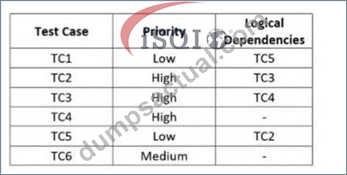
Which of the following test execution schedules is compatible with the logical dependencies and allows executing the test cases in priority order?
- A. TC4, TC3, TC2, TC6, TC1, TC5
- B. TC4, TC6, TC3, TC2, TC5, TC1
- C. TC4, TC3, TC2, TC6, TC5. TC1
- D. TC3, TC5, TC6, TC1, TC4, TC3
Answer: A
Explanation:
This answer is correct because it follows the logical dependencies and allows executing the test cases in priority order. TC4, TC3, and TC2 are executed first because they have the highest priority. TC6 is executed next because it has a logical dependency on TC2. TC1 is executed next because it has a logical dependency on TC5. Finally, TC5 is executed last because it has the lowest priority. References: ISTQB Certified Tester Foundation Level (CTFL) v4.0 documents
NEW QUESTION # 72
Which ONE of the following options is aPRODUCT riskand NOT aPROJECT risk?
- A. Incorrect calculation logic in the software, leading to inaccurate results.
- B. Delays in the delivery of work products by the project team.
- C. Staff shortages in the project leading to scheduling problems.
- D. Poor communication between team members, making project management more difficult.
Answer: A
Explanation:
Product risksare risks thatimpact the quality or functionality of the software, whereasproject risksaffect theprocess, resources, or timeline.
* (A) is correctbecause incorrect calculations impact software correctness.
* (B), (C), and (D) are project risksas they relate toteam coordination, staffing, and schedulingrather than software defects.
Identifyingproduct risksearlyimproves defect detection and ensures better coverage for high-risk areas.
Reference:ISTQB CTFL v4.0 Syllabus, Section 5.2.2 - Product and Project Risks
NEW QUESTION # 73
Which of the following statements about exploratory testing is true?
- A. Exploratory testing is an experience-based test technique used by testers during informal code reviews to find defects by exploring the source code
- B. In exploratory testing, testers usually produce scripted tests and establish bidirectional traceability between these tests and the items of the test basis
- C. When exploratory testing is conducted following a session-based approach, the issues detected by the testers can be documented in session sheets
- D. Exploratory testing is an experience-based test technique in which testers explore the requirements specification to detect non testable requirements
Answer: C
Explanation:
Exploratory testing is an experience-based test technique in which testers dynamically design and execute tests based on their knowledge, intuition, and learning of the software system, without following predefined test scripts or test cases. Exploratory testing can be conducted following a session-based approach, which is a structured way of managing and measuring exploratory testing. In a session-based approach, the testers perform uninterrupted test sessions, usually lasting between 60 and 120 minutes, with a specific charter or goal, and document the issues detected, the test coverage achieved, and the time spent in session sheets.
Session sheets are records of the test activities, results, and observations during a test session, which can be used for reporting, debriefing, and learning purposes. The other statements are false, because:
* Exploratory testing is not a test technique in which testers explore the requirements specification to detect non testable requirements, but rather a test technique in which testers explore the software system to detect functional and non-functional defects, as well as to learn new information, risks, or opportunities. Non testable requirements are requirements that are ambiguous, incomplete, inconsistent, or not verifiable, which can affect the quality and effectiveness of the testing process. Non testable requirements can be detected by applying static testing techniques, such as reviews or inspections, to the requirements specification, before the software system is developed or tested.
* Exploratory testing is not a test technique used by testers during informal code reviews to find defects by exploring the source code, but rather a test technique used by testers during dynamic testing to find defects by exploring the behavior and performance of the software system, without examining the source code. Informal code reviews are static testing techniques, in which the source code isanalyzed by one or more reviewers, without following a formal process or using a checklist, to identify defects, violations, or improvements. Informal code reviews are usually performed by developers or peers, not by testers.
* In exploratory testing, testers usually do not produce scripted tests and establish bidirectional traceability between these tests and the items of the test basis, but rather produce unscripted tests and adapt them based on the feedback and the findings of the testing process. Scripted tests are tests that are designed and documented in advance, with predefined inputs, outputs, and expected results, and are executed according to a test plan or a test procedure. Bidirectional traceability is the ability to trace both forward and backward the relationships between the items of the test basis, such as the requirements, the design, the risks, etc., and the test artifacts, such as the test cases, the test results, the defects, etc.
Scripted tests and bidirectional traceability are usually associated with more formal and structured testing approaches, such as specification-based or structure-based test techniques, not with exploratory testing. References: ISTQB Certified Tester Foundation Level (CTFL) v4.0 sources and documents:
* ISTQB Certified Tester Foundation Level Syllabus v4.0, Chapter 2.2.3, Experience-based Test Design Techniques1
* ISTQB Glossary of Testing Terms v4.0, Exploratory Testing, Session-based Testing, Session Sheet, Non Testable Requirement, Static Testing, Informal Review, Dynamic Testing, Scripted Testing, Bidirectional Traceability2
NEW QUESTION # 74
Which ONE of the following options MOST ACCURATELY describes the activities of "testing" and
"debugging"?
- A. Testing identifies a defect that is caused by an error in the software, whereas debugging is concerned with finding the causes of this defect, analyzing these causes, and eliminating them.
- B. Testing triggers a defect that is caused by an error in the software, whereas debugging is concerned with finding the causes of this defect, analyzing these causes, and eliminating them.
- C. Testing triggers a failure that is caused by a defect in the software, whereas debugging is concerned with finding the causes of this failure (defects), analyzing these causes, and eliminating them.
- D. Testing triggers a failure that is caused by a defect in the software, whereas debugging is concerned with finding the causes of this failure (defects), analyzing these causes, and reproducing them.
Answer: C
Explanation:
Testing and debugging are separate but related activities. Testing executes the software to identify failures that result from defects (A). Debugging is the developer's responsibility and involves finding the cause of a failure (defect), analyzing it, and fixing the defect. The ISTQB syllabus explicitly differentiates these activities. Testing does not modify the software, whereas debugging does.
Reference:ISTQB CTFL v4.0 Syllabus, Section 1.1.2 - Testing and Debugging
NEW QUESTION # 75
A new web app aims at offering a rich user experience. As a functional tester, you have run some functional tests to verify that, before releasing the app, such app works correctly on several mobile devices, all of which are listed as supported devices within the requirements specification. These tests were performed on stable and isolated test environments where you were the only user interacting with the application. All tests passed, but in some of those tests you observed the following issue: on some mobile devices only, the response time for two web pages containing images was extremely slow.
Based only on the given information, which of the following recommendation would you follow?
- A. The issue is related to performance efficiency, not functionality. Thus, as a functional tester, you should not open any defect report as all the functional tests passed
- B. You should not open any defect report and inform the test manager that the devices on which you observed the issue should no longer be supported so that they will be removed from the requirements specification
- C. You should open a defect report providing detailed information on which devices and by running which tests you observed the issue
- D. You should not open any defect report as the problem is most likely due to poor hardware equipment on the devices where you observed the issue
Answer: C
Explanation:
As a functional tester, you should open a defect report providing detailed information on which devices and by running which tests you observed the issue. A defect report is a document that records the occurrence, nature, and status of a defect detected during testing, and provides information for further investigation and resolution.
A defect report should include relevant information such as the defect summary, the defect description, the defect severity, the defect priority, the defect status, the defect origin, the defect category, the defect reproduction steps, the defect screenshots, the defect attachments, etc. Opening a defect report is a good practice for any tester who finds a defect in the software system, regardless of the type or level of testing performed. The other options are not recommended, because:
* The issue is related to performance efficiency, not functionality, but that does not mean that as a functional tester, you should not open any defect report as all the functional tests passed. Performance efficiency is a quality characteristic that measures how well the software system performs its functions under stated conditions, such as the response time, the resource utilization, the throughput, etc.
Performance efficiency is an important aspect of the user experience, especially for web applications that run on different devices and networks. Even if the functional tests passed, meaning that the software system met the functional requirements, the performance issue observed on some devices could still affect the user satisfaction, the usability, the reliability, and the security of the software system.
Therefore, as a functional tester, you have the responsibility to report the performance issue as a defect, and provide as much information as possible to help the developers or the performance testers to investigate and resolve it.
NEW QUESTION # 76
......
Study resources for the Valid CTFL_Syll_4.0 Braindumps: https://www.dumpsactual.com/CTFL_Syll_4.0-actualtests-dumps.html
Latest ISTQB Foundation Level CTFL_Syll_4.0 Actual Free Exam Questions: https://drive.google.com/open?id=1yGVnzW-dQ3DytrXYBYcT7LY7g2GM7tF_
