

Updated Jun-2025 100% Cover Real ADA-C01 Exam Questions - 100% Pass Guarantee
Use Real Snowflake Dumps - 100% Free ADA-C01 Exam Dumps
NEW QUESTION # 16
When adding secure views to a share in Snowflake, which function is needed to authorize users from another account to access rows in a base table?
- A. CURRENT ACCOUNT
- B. CURRENT_CLIENT
- C. CURRENT_ROLE
- D. CURRENT_USER
Answer: D
Explanation:
According to the Working with Secure Views documentation, secure views are designed to limit access to sensitive data that should not be exposed to all users of the underlying table(s). When sharing secure views with another account, the view definition must include a function that returns the identity of the user who is querying the view, such as CURRENT_USER, CURRENT_ROLE, or CURRENT_ACCOUNT. These functions can be used to filter the rows in the base table based on the user's identity. For example, a secure view can use the CURRENT_USER function to compare the user name with a column in the base table that contains the authorized user names. Only the rows that match the user name will be returned by the view. The CURRENT_CLIENT function is not suitable for this purpose, because it returns the IP address of the client that is connected to Snowflake, which is not related to the user's identity.
NEW QUESTION # 17
What is required for stages, without credentials, to limit data exfiltration after a storage integration and associated stages are created?
- A. ALTER ACCOUNT my_account SET
REQUIRE_STORAGE_INTEGRATION_FOR_STAGE_CREATION = false;
ALTER ACCOUNT my_account SET
REQUIRE_STORAGE_INTEGRATION_FOR_STAGE_OPERATION = false;
ALTER ACCOUNT my_account SET
PREVENT_UNLOAD_TO_INLINE_URL = true; - B. ALTER ACCOUNT my_account SET
REQUIRE_STORAGE_INTEGRATION_FOR_STAGE_CREATION = false;
ALTER ACCOUNT my_account SET
REQUIRE_STORAGE_INTEGRATION_FOR_STAGE_OPERATION = false;
ALTER ACCOUNT my_account SET
PREVENT_UNLOAD_TO_INLINE_URL = false; - C. ALTER ACCOUNT my_account SET
REQUIRE_STORAGE_INTEGRATION_FOR_STAGE_CREATION = true;
ALTER ACCOUNT my_account SET
REQUIRE_STORAGE_INTEGRATION FOR STAGE_OPERATION = true;
ALTER ACCOUNT my_account SET
PREVENT_UNLOAD_TO_INLINE_URL = true; - D. ALTER ACCOUNT my_account SET
REQUIRE_STORAGE_INTEGRATION_FOR_STAGE_CREATION = true;
ALTER ACCOUNT my_account SET
REQUIRE_STORAGE_INTEGRATION_FOR_STAGE_OPERATION = true;
ALTER ACCOUNT my_account SET
PREVENT_UNLOAD_TO_INLINE_URL = false;
Answer: C
Explanation:
Explanation
According to the Snowflake documentation1, stages without credentials are a way to create external stages that use storage integrations to access data files in cloud storage without providing any credentials to Snowflake.
Storage integrations are objects that define a trust relationship between Snowflake and a cloud provider, allowing Snowflake to authenticate and authorize access to the cloud storage. To limit data exfiltration after a storage integration and associated stages are created, the following account-level parameters can be set:
*REQUIRE_STORAGE_INTEGRATION_FOR_STAGE_CREATION: This parameter enforces that all external stages must be created using a storage integration. This prevents users from creating external stages with inline credentials or URLs that point to unauthorized locations.
*REQUIRE_STORAGE_INTEGRATION_FOR_STAGE_OPERATION: This parameter enforces that all operations on external stages, such as PUT, GET, COPY, and LIST, must use a storage integration. This prevents users from performing operations on external stages with inline credentials or URLs that point to unauthorized locations.
*PREVENT_UNLOAD_TO_INLINE_URL: This parameter prevents users from unloading data from Snowflake tables to inline URLs that do not use a storage integration. This prevents users from exporting data to unauthorized locations.
Therefore, the correct answer is option D, which sets all these parameters to true. Option A is incorrect because it sets PREVENT_UNLOAD_TO_INLINE_URL to false, which allows users to unload data to inline URLs that do not use a storage integration. Option B is incorrect because it sets both REQUIRE_STORAGE_INTEGRATION_FOR_STAGE_CREATION and REQUIRE_STORAGE_INTEGRATION_FOR_STAGE_OPERATION to false, which allows users to create and operate on external stages without using a storage integration. Option C is incorrect because it sets all the parameters to false, which does not enforce any restrictions on data exfiltration.
NEW QUESTION # 18
What session parameter can be used to test the integrity of secure views based on the account that is accessing that view?
- A. MIMIC_CONSUMER_ACCOUNT
- B. PRODUCER_TEST_ACCT
- C. TEST_ACCOUNT_ID
- D. SIMULATED_DATA_SHARING_CONSUMER
Answer: D
Explanation:
Explanation
The SIMULATED_DATA_SHARING_CONSUMER session parameter allows a data provider to test the integrity of secure views based on the account that is accessing that view2. By setting this parameter to the name of the consumer account, the data provider can query the secure view and see the results that a user in the consumer account will see2. This helps to ensure that sensitive data in a shared database is not exposed to unauthorized users1. The other options are not valid session parameters in Snowflake3
NEW QUESTION # 19
When a role is dropped, which role inherits ownership of objects owned by the dropped role?
- A. The SYSADMIN role
- B. The role executing the command
- C. The role above the dropped role in the RBAC hierarchy
- D. The SECURITYADMIN role
Answer: C
Explanation:
Explanation
According to the Snowflake documentation1, when a role is dropped, ownership of all objects owned by the dropped role is transferred to the role that is directly above the dropped role in the role hierarchy. This is to ensure that there is always a single owner for each object in the system.
1: Drop Role | Snowflake Documentation
NEW QUESTION # 20
An Administrator needs to implement an access control mechanism across an organization. The organization users access sensitive customer data that comes from different regions and needs to be accessible for Analysts who work in these regions. Some Analysts need very specific access control depending on their functional roles in the organization. Following Snowflake recommended practice, how should these requirements be met? (Select TWO).
- A. Use a third-party tool to share the data.
- B. Implement views on top of base tables that exclude or mask sensitive data.
- C. Include masking rules as part of data ingestion and transformation pipelines.
- D. Implement row access policies and Dynamic Data Masking policies.
- E. Use zero-copy cloning to replicate the database schema and provide access as needed.
Answer: B,D
Explanation:
The scenario describes a need for fine-grained access control over sensitive customer data across multiple regions, with functional-role-based access for analysts. Snowflake recommends applying a layered security model that separates raw data from user-facing access and leverages built-in policy features.
Explanation of Correct Answers:
A . Implement views on top of base tables that exclude or mask sensitive data.
Creating secure views allows administrators to abstract sensitive fields or filter out certain rows and columns.
It enables role-based access control by granting specific roles access only to the secure views.
Common practice is to restrict access to base tables and give users access to views that enforce business logic and data access rules.
B . Implement row access policies and Dynamic Data Masking policies.
Row Access Policies control access at the row level, determining what data a user can see based on their role or session context.
Dynamic Data Masking allows you to mask sensitive column data (like PII) dynamically based on the accessing role.
Both are central features of Snowflake's fine-grained access control.
Why the other options are incorrect:
C . Include masking rules as part of data ingestion and transformation pipelines.
This is not a Snowflake-recommended best practice for access control.
It hardcodes data access rules into ETL/ELT logic, which reduces flexibility and central control.
Also, it masks the data permanently at ingestion time, rather than dynamically at query time.
D . Use a third-party tool to share the data.
Snowflake supports native Secure Data Sharing, and using a third-party tool is unnecessary and introduces complexity.
It does not address row/column-level access control within Snowflake itself.
E . Use zero-copy cloning to replicate the database schema and provide access as needed.
Zero-copy cloning is ideal for testing, development, and backup purposes, not for controlling access.
It duplicates metadata but doesn't provide a mechanism for fine-grained, real-time access control.
SnowPro Administrator Reference:
Row Access Policies Overview
Dynamic Data Masking Overview
Access Control Best Practices
Using Secure Views for Access Control
NEW QUESTION # 21
An Administrator wants to delegate the administration of a company's data exchange to users who do not have access to the ACCOUNTADMIN role.
How can this requirement be met?
- A. Grant imported privileges on data exchange EXCHANGE_NAME to ROLE_NAME;
- B. Grant ownership on data exchange EXCHANGE_NAME to ROLE NAME;
- C. Grant modify on data exchange EXCHANGE_NAME to ROLE_NAME;
- D. Grant usage on data exchange EXCHANGE_NAME to ROLE_NAME;
Answer: C
Explanation:
According to the [GRANT MODIFY] documentation, the MODIFY privilege on a data exchange allows a role to perform administrative tasks on the data exchange, such as inviting members, approving profiles, and reviewing listings. This privilege can be granted by the ACCOUNTADMIN role or a role that already has the MODIFY privilege on the data exchange. Therefore, to delegate the administration of a company's data exchange to users who do not have access to the ACCOUNTADMIN role, the best option is to grant the MODIFY privilege on the data exchange to a role that the users can assume. The other options are incorrect because:
* A. There is no such privilege as IMPORTED PRIVILEGES in Snowflake. The correct privilege name is IMPORT SHARE, which allows a role to create a database from a share. This privilege is not related to the administration of a data exchange, but to the consumption of shared data.
* C. There is no such privilege as OWNERSHIP in Snowflake. The correct privilege name is OWNED BY, which indicates the role that owns an object and has full control over it. However, this privilege cannot be granted or revoked, but only transferred by the current owner to another role using the GRANT OWNERSHIP command. Therefore, this option is not feasible for delegating the administration of a data exchange.
* D. The USAGE privilege on a data exchange allows a role to access the data exchange and view the available data listings. This privilege does not allow a role to perform administrative tasks on the data exchange, such as inviting members, approving profiles, and reviewing listings. Therefore, this option is not sufficient for delegating the administration of a data exchange.
NEW QUESTION # 22
The following SQL command was executed:
Use role SECURITYADMIN;
Grant ownership
On future tables
In schema PROD. WORKING
To role PROD_WORKING_OWNER;
Grant role PROD_WORKING_OWNER to role SYSADMIN;
Use role ACCOUNTADMIN;
Create table PROD.WORKING.XYZ (value number) ;
Which role(s) can alter or drop table XYZ?
- A. Only the PROD_WORKING_OWNER role can alter or drop table XYZ.
- B. Because ACCOUNTADMIN created the table, only the ACCOUNTADMIN role can alter or drop table XYZ.
- C. PROD_WORKING_OWNER, ACCOUNTADMIN, and SYSADMIN can alter or drop table XYZ.
- D. SECURITYADMIN, SYSADMIN, and ACCOUNTADMIN can alter or drop table XYZ.
Answer: C
Explanation:
Explanation
According to the GRANT OWNERSHIP documentation, the ownership privilege grants full control over the table and can only be held by one role at a time. However, the current owner can also grant the ownership privilege to another role, which transfers the ownership to the new role. In this case, the SECURITYADMIN role granted the ownership privilege on future tables in the PROD.WORKING schema to the PROD_WORKING_OWNER role. This means that any table created in that schema after the grant statement will be owned by the PROD_WORKING_OWNER role. Therefore, the PROD_WORKING_OWNER role can alter or drop table XYZ, which was created by the ACCOUNTADMIN role in the PROD.WORKING schema. Additionally, the ACCOUNTADMIN role can also alter or drop table XYZ, because it is the top-level role that has all privileges on all objects in the account. Furthermore, the SYSADMIN role can also alter or drop table XYZ, because it was granted the PROD_WORKING_OWNER role by the SECURITYADMIN role. The SYSADMIN role can activate the PROD_WORKING_OWNER role and inherit its privileges, including the ownership privilege on table XYZ. The SECURITYADMIN role cannot alter or drop table XYZ, because it does not have the ownership privilege on the table, nor does it have the PROD_WORKING_OWNER role.
NEW QUESTION # 23
A resource monitor named MONTHLY_FINANCE_LIMIT has been created and applied to two virtual warehouses (fin_wh1 and fin_wh2) using the following SQL: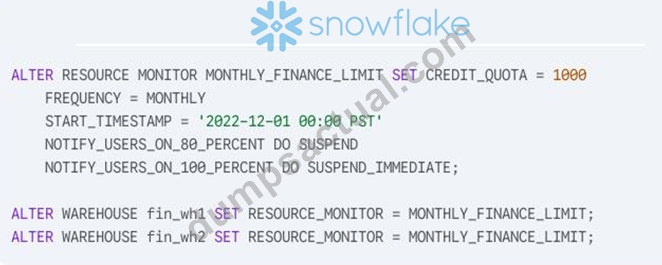
Given that the combined total of credits consumed by fin_wh1 and fin_wh2 (including cloud services) has reached 800 credits and both warehouses are suspended, what should the ACCOUNTADMIN execute to allow both warehouses to be resumed? (Select TWO).
- A. ALTER WAREHOUSE fin_wh1 UNSET RESOURCE_MONITORS;
- B. ALTER RESOURCE MONITOR MONTHLY_FINANCE_LIMIT RESET;
- C. ALTER WAREHOUSE fin_wh1 RESUME;
- D. ALTER WAREHOUSE fin_wh1 UNSET RESOURCE_MONITOR MONTHLY_FINANCE_LIMIT;
- E. ALTER WAREHOUSE fin_wh2 RESUME;
- F. ALTER WAREHOUSE fin_wh2 UNSET RESOURCE_MONITOR MONTHLY_FINANCE_LIMIT;
- G. ALTER RESOURCE MONITOR MONTHLY_FINANCE_LIMIT SET CREDIT_QUOTA = 1500;
Answer: B,G
Explanation:
❗ Scenario:
Resource Monitor MONTHLY_FINANCE_LIMIT has a credit quota of 1000.
800 credits have been used and warehouses are already suspended.
According to monitor configuration:
At 80%, warehouses are suspended.
At 100%, warehouses would be suspended immediately.
Warehouses cannot resume until the monitor is reset or the quota is increased.
✅ E. SET CREDIT_QUOTA = 1500
Increases the monthly credit limit to 1500.
Since current usage is 800 < 1500, this puts usage below 80%.
This allows resumption of warehouses.
✅ F. RESET
sql
CopyEdit
ALTER RESOURCE MONITOR MONTHLY_FINANCE_LIMIT RESET;
Resets usage to zero for the current period.
Allows warehouses to resume immediately - same effect as a fresh cycle.
❌ Why Other Options Are Incorrect:
A . / B. ALTER WAREHOUSE ... RESUME
Won't work while the resource monitor is actively suspending the warehouses due to limits.
C . / D. UNSET RESOURCE_MONITOR
You can't remove a resource monitor from a warehouse while it is currently suspended by that same monitor.
You must first reset or adjust the monitor.
G . UNSET RESOURCE_MONITORS
Invalid syntax - there's no RESOURCE_MONITORS plural keyword.
SnowPro Administrator Reference:
Resource Monitors Overview
ALTER RESOURCE MONITOR
Best Practices for Controlling Warehouse Credit Usage
NEW QUESTION # 24
How should an Administrator configure a Snowflake account to use AWS PrivateLink?
- A. Contact Snowflake Support.
- B. Create CNAME records in the DNS.
- C. Block public access to Snowflake.
- D. Use SnowCD to evaluate the network connection.
Answer: B
Explanation:
To configure a Snowflake account to use AWS PrivateLink, the Administrator needs to create CNAME records in the DNS that point to the private endpoints provided by Snowflake. This allows the clients to connect to Snowflake using the same URL as before, but with private connectivity. According to the Snowflake documentation, "After you have created the VPC endpoints, Snowflake provides you with a list of private endpoints for your account. You must create CNAME records in your DNS that point to these private endpoints. The CNAME records must use the same hostnames as the original Snowflake URLs for your account." The other options are either incorrect or not sufficient to configure AWS PrivateLink. Option B is not necessary, as the Administrator can enable AWS PrivateLink using the SYSTEM$AUTHORIZE_PRIVATELINK function1. Option C is not recommended, as it may prevent some data traffic from reaching Snowflake, such as large result sets stored on AWS S32. Option D is not related to AWS PrivateLink, but to Snowflake Connectivity Diagnostic (SnowCD), which is a tool for diagnosing network issues between clients and Snowflake3.
NEW QUESTION # 25
When adding secure views to a share in Snowflake, which function is needed to authorize users from another account to access rows in a base table?
- A. CURRENT ACCOUNT
- B. CURRENT_CLIENT
- C. CURRENT_ROLE
- D. CURRENT_USER
Answer: D
Explanation:
Explanation
According to the Working with Secure Views documentation, secure views are designed to limit access to sensitive data that should not be exposed to all users of the underlying table(s). When sharing secure views with another account, the view definition must include a function that returns the identity of the user who is querying the view, such as CURRENT_USER, CURRENT_ROLE, or CURRENT_ACCOUNT. These functions can be used to filter the rows in the base table based on the user's identity. For example, a secure view can use the CURRENT_USER function to compare the user name with a column in the base table that contains the authorized user names. Only the rows that match the user name will be returned by the view. The CURRENT_CLIENT function is not suitable for this purpose, because it returns the IP address of the client that is connected to Snowflake, which is not related to the user's identity.
NEW QUESTION # 26
What access control policy will be put into place when future grants are assigned to both database and schema objects?
- A. Database privileges will take precedence over schema privileges.
- B. An access policy combining both the database object and the schema object will be used, with the most permissive policy taking precedence.
- C. Schema privileges will take precedence over database privileges.
- D. An access policy combining both the database object and the schema object will be used, with the most restrictive policy taking precedence.
Answer: C
Explanation:
Explanation
When future grants are defined on the same object type for a database and a schema in the same database, the schema-level grants take precedence over the database level grants, and the database level grants are ignored4.
This behavior applies to privileges on future objects granted to one role or different roles4. Future grants allow defining an initial set of privileges to grant on new (i.e. future) objects of a certain type in a database or a schema3. As soon as the new objects are created inside the database or schema, the predefined set of privileges are assigned to the object automatically without any manual intervention3.
NEW QUESTION # 27
What is a characteristic of Snowflake's transaction locking and concurrency modeling?
- A. Queries executed within a given transaction see that transaction's uncommitted changes.
- B. A deadlock cannot occur in Snowflake, since concurrently executed queries and DML statements do not block one another.
- C. Transaction locking in Snowflake is enforced exclusively at the row and table levels.
- D. If two queries are concurrently executed against the same table, one of the two queries will be blocked until the other query completes.
Answer: B
Explanation:
Explanation
According to the Snowflake documentation1, Snowflake uses a multi-version concurrency control (MVCC) model, which means that each transaction operates on a consistent snapshot of the database at a point in time.
This allows queries and DML statements to run concurrently without blocking each other, as they do not modify the same data. Therefore, a deadlock, which occurs when concurrent transactions are waiting on resources that are locked by each other, cannot happen in Snowflake. Option B is incorrect because queries and DML statements do not block each other in Snowflake, unless they are explicitly started transactions and multiple statements in each transaction2. Option C is incorrect because transaction locking in Snowflake is enforced at the partition level, not the row or table level3. Option D is incorrect because queries executed within a given transaction do not see that transaction's uncommitted changes, but only the committed changes that occurred before the transaction started1.
NEW QUESTION # 28
An organization's sales team leverages this Snowflake query a few times a day:
SELECT CUSTOMER ID, CUSTOMER_NAME, ADDRESS, PHONE NO
FROM CUSTOMERS
WHERE LAST UPDATED BETWEEN TO_DATE (CURRENT_TIMESTAMP) AND (TO_DATE (CURRENT_TIMESTAMP) -7); What can the Snowflake Administrator do to optimize the use of persisted query results whenever possible?
- A. Assign everyone on the sales team to the same virtual warehouse.
- B. Assign everyone on the sales team to the same security role.
- C. Leverage the CURRENT_DATE function for date calculations.
- D. Wrap the query in a User-Defined Function (UDF) to match syntax execution.
Answer: C
Explanation:
According to the web search results from my predefined tool search_web, one of the factors that affects the reuse of persisted query results is the exact match of the query syntax1. If the query contains functions that return different values for successive runs, such as CURRENT_TIMESTAMP, then the query will not match the previous query and will not benefit from the cache. To avoid this, the query should use functions that return consistent values for the same day, such as CURRENT_DATE, which returns the current date without the time component2. Option A is incorrect because wrapping the query in a UDF does not guarantee the syntax match, as the UDF may also contain dynamic functions. Option B is incorrect because the virtual warehouse does not affect the persisted query results, which are stored at the account level1. Option C is incorrect because the security role does not affect the persisted query results, as long as the role has the necessary privileges to access the tables and views used in the query1.
1: Using Persisted Query Results | Snowflake Documentation 2: Date and Time Functions | Snowflake Documentation
NEW QUESTION # 29
A user has enrolled in Multi-factor Authentication (MFA) for connecting to Snowflake. The user informs the Snowflake Administrator that they lost their mobile phone the previous evening.
Which step should the Administrator take to allow the user to log in to the system, without revoking their MFA enrollment?
- A. Instruct the user to connect to Snowflake using SnowSQL, which does not support MFA authentication.
- B. Instruct the user to append the normal URL with /?mode=mfa_bypass&code= to log on.
- C. Alter the user and set DISABLE_MFA to true, which will suspend the MFA requirement for 24 hours.
- D. Alter the user and set MINS TO BYPASS MFA to a value that will disable MFA long enough for the user to log in.
Answer: D
Explanation:
The MINS_TO_BYPASS_MFA property allows the account administrator to temporarily disable MFA for a user who has lost their phone or changed their phone number1. The user can log in without MFA for the specified number of minutes, and then re-enroll in MFA using their new phone1. This does not revoke their MFA enrollment, unlike the DISABLE_MFA property, which cancels their enrollment and requires them to re-enroll from scratch1. The other options are not valid ways to bypass MFA, as SnowSQL does support MFA authentication2, and there is no such URL parameter as /?mode=mfa_bypass&code= for Snowflake3
NEW QUESTION # 30
A requirement has been identified to allow members of a corporate Data Product team to bring in data sets from the Snowflake Marketplace. The members of this team use the role DP_TEAM.
What grant statements must the ACCOUNTADMIN execute in order for the DP TEAM role to import and work with data from the Marketplace?
- A. grant import share on account to role dp_team;
grant create database on account to role dp_team; - B. grant imported privileges on account to role dp_team;
grant create database on account to role dp_team; - C. grant usage on snowflake_marketplace to role dp_team;
grant create database on account to role dp_team; - D. grant marketplace in account to role dp_team;
grant create database from share to role dp_team;
Answer: A
Explanation:
Option D is the correct answer because it follows the steps described in the Snowflake documentation for importing data from the Snowflake Marketplace. The ACCOUNTADMIN role needs to grant the IMPORT SHARE privilege on the account to the DP_TEAM role, which allows the role to import data from any provider in the marketplace. The ACCOUNTADMIN role also needs to grant the CREATE DATABASE privilege on the account to the DP_TEAM role, which allows the role to create a database from a share. Option A is incorrect because there is no MARKETPLACE privilege in Snowflake. Option B is incorrect because the USAGE privilege on SNOWFLAKE_MARKETPLACE is not sufficient to import data from the marketplace. Option C is incorrect because there is no IMPORTED PRIVILEGES privilege in Snowflake.
NEW QUESTION # 31
A Snowflake Administrator has a multi-cluster virtual warehouse and is using the Snowflake Business Critical edition. The minimum number of clusters is set to 2 and the maximum number of clusters is set to 10. This configuration works well for the standard workload, rarely exceeding 5 running clusters. However, once a month the Administrator notes that there are a few complex long-running queries that are causing increased queue time and the warehouse reaches its maximum limit at 10 clusters.
Which solutions will address the issues happening once a month? (Select TWO).
- A. Examine the complex queries and determine if they can be made more efficient usingclustering keys or materialized views.
- B. Increase the minimum number of clusters started in the multi-cluster configuration to 5.
- C. Increase the multi-cluster maximum to 20 or more clusters.
- D. Have the group running the complex monthly queries use a separate appropriately-sized warehouse to support their workload.
- E. Use a task to increase the cluster size for the time period that the more complex queries are running and another task to reduce the size of the cluster once the complex queries complete.
Answer: D,E
Explanation:
Explanation
According to the Snowflake documentation1, a multi-cluster warehouse is a virtual warehouse that consists of multiple clusters of compute resources that can scale up or down automatically to handle the concurrency and performance needs of the queries submitted to the warehouse. A multi-cluster warehouse has a minimum and maximum number of clusters that can be specified by the administrator. Option A is a possible solution to address the issues happening once a month, as it allows the administrator to use a task to increase the cluster size for the time period that the more complex queries are running and another task to reduce the size of the cluster once the complex queries complete. This way, the warehouse can have more resources available to handle the complex queries without reaching the maximum limit of 10 clusters, and then return to the normal cluster size to save costs. Option B is another possible solution to address the issues happening once a month, as it allows the administrator to have the group running the complex monthly queries use a separate appropriately-sized warehouse to support their workload. This way, the warehouse can isolate the complex queries from the standard workload and avoid queue time and resource contention. Option C is not a recommended solution to address the issues happening once a month, as it would increase the costs and complexity of managing the multi-cluster warehouse, and may not solve the underlying problem of inefficient queries. Option D is a good practice to improve the performance of the queries, but it is not a direct solution to address the issues happening once a month, as it requires analyzing and optimizing the complex queries using clustering keys or materialized views, which may not be feasible or effective in all cases. Option E is not a recommended solution to address the issues happening once a month, as it would increase the costs and waste resources by starting more clusters than needed for the standard workload.
NEW QUESTION # 32
An Administrator has a user who needs to be able to suspend and resume a task based on the current virtual warehouse load, but this user should not be able to modify the task or start a new run.
What privileges should be granted to the user to meet these requirements? (Select TWO).
- A. OWNERSHIP on the task
- B. OWNERSHIP on the database and schema containing the task
- C. USAGE on the database and schema containing the task
- D. EXECUTE TASK on the task
- E. OPERATE on the task
Answer: C,E
Explanation:
Explanation
The user needs the OPERATE privilege on the task to suspend and resume it, and the USAGE privilege on the database and schema containing the task to access it1. The EXECUTE TASK privilege is not required for suspending and resuming a task, only for triggering a new run1. The OWNERSHIP privilege on the task or the database and schema would allow the user to modify or drop the task, which is not desired.
NEW QUESTION # 33
DatabaseA has a single schema called Schema1. This schema contains many tables and views. The ANALYST role has privileges to select from all objects in Database A. Schema1.
The SYSADMIN role clones DatabaseA to DatabaseA_clone.
What privileges does the ANALYST role have on tables and views in DatabaseA_clone? (Select TWO).
- A. SELECT on all tables, and only secure views in DatabaseA_clone. Schemal
- B. USAGE on the database DatabaseA_clone. Schemal
- C. SELECT on all tables and views in DatabaseA_clone. Schema1
- D. USAGE on the schema DatabaseA clone
- E. SELECT on all tables, and only non-secure views in DatabaseA_clone. Schemal
Answer: C,E
Explanation:
According to the Snowflake documentation, when a database or schema is cloned, the clone inherits all granted privileges on the clones of all child objects contained in the source object, such as tables and views. However, the clone of the container itself does not inherit the privileges granted on the source container. Therefore, the ANALYST role will have SELECT privilege on all tables and views in DatabaseA_clone.Schema1, but not USAGE privilege on the database or schema. The type of view (secure or non-secure) does not affect the cloning of privileges.
NEW QUESTION # 34
A Snowflake customer is experiencing higher costs than anticipated while migrating their data warehouse workloads from on-premises to Snowflake. The migration workloads have been deployed on a single warehouse and are characterized by a large number of small INSERTs rather than bulk loading of large extracts. That single warehouse has been configured as a single cluster, 2XL because there are many parallel INSERTs that are scheduled during nightly loads.
How can the Administrator reduce the costs, while minimizing the overall load times, for migrating data warehouse history?
- A. There should be another 2XL warehouse deployed to handle a portion of the load queries.
- B. The 2XL warehouse should be changed to 4XL to increase the number of threads available for parallel load queries.
- C. The INSERTS should be converted to several tables to avoid contention on large tables that slows down query processing.
- D. The warehouse should be kept as a SMALL or XSMALL and configured as a multi-cluster warehouse to handle the parallel load queries.
Answer: D
Explanation:
According to the Snowflake Warehouse Cost Optimization blog post, one of the strategies to reduce the cost of running a warehouse is to use a multi-cluster warehouse with auto-scaling enabled. This allows the warehouse to automatically adjust the number of clusters based on the concurrency demand and the queue size. A multi-cluster warehouse can also be configured with a minimum and maximum number of clusters, as well as a scaling policy to control the scaling behavior. This way, the warehouse can handle the parallel load queries efficiently without wasting resources or credits. The blog post also suggests using a smaller warehouse size, such as SMALL or XSMALL, for loading data, as it can perform better than a larger warehouse size for small INSERTs. Therefore, the best option to reduce the costs while minimizing the overall load times for migrating data warehouse history is to keep the warehouse as a SMALL or XSMALL and configure it as a multi-cluster warehouse to handle the parallel load queries. The other options are incorrect because:
* A. Deploying another 2XL warehouse to handle a portion of the load queries will not reduce the costs, but increase them. It will also introduce complexity and potential inconsistency in managing the data loading process across multiple warehouses.
* B. Changing the 2XL warehouse to 4XL will not reduce the costs, but increase them. It will also provide more compute resources than needed for small INSERTs, which are not CPU-intensive but I/O-intensive.
* D. Converting the INSERTs to several tables will not reduce the costs, but increase them. It will also create unnecessary data duplication and fragmentation, which will affect the query performance and data quality.
NEW QUESTION # 35
What is a characteristic of Snowflake's transaction locking and concurrency modeling?
- A. Queries executed within a given transaction see that transaction's uncommitted changes.
- B. A deadlock cannot occur in Snowflake, since concurrently executed queries and DML statements do not block one another.
- C. Transaction locking in Snowflake is enforced exclusively at the row and table levels.
- D. If two queries are concurrently executed against the same table, one of the two queries will be blocked until the other query completes.
Answer: B
Explanation:
According to the Snowflake documentation1, Snowflake uses a multi-version concurrency control (MVCC) model, which means that each transaction operates on a consistent snapshot of the database at a point in time. This allows queries and DML statements to run concurrently without blocking each other, as they do not modify the same data. Therefore, a deadlock, which occurs when concurrent transactions are waiting on resources that are locked by each other, cannot happen in Snowflake. Option B is incorrect because queries and DML statements do not block each other in Snowflake, unless they are explicitly started transactions and multiple statements in each transaction2. Option C is incorrect because transaction locking in Snowflake is enforced at the partition level, not the row or table level3. Option D is incorrect because queries executed within a given transaction do not see that transaction's uncommitted changes, but only the committed changes that occurred before the transaction started1.
NEW QUESTION # 36
......
ADA-C01 Dumps PDF - ADA-C01 Real Exam Questions Answers: https://www.dumpsactual.com/ADA-C01-actualtests-dumps.html
Realistic ADA-C01 Dumps Latest Practice Tests Dumps: https://drive.google.com/open?id=1YUHMbThPQ1C7Sjs5B0lUN1lMWYxr4HQV
